AI isn’t creating new cyber threats — it’s making existing ones faster, cheaper, and harder to detect. Here’s what that actually means in practice.

Picture this: It’s a random Tuesday. Your phone buzzes with a video call from your boss. She looks, sounds, and acts exactly like herself, stressed about a deal that’s about to collapse unless you green-light a $250,000 wire right now. You pause. She leans in: “It’s me. We’ve done this before.” You click approve.
Except it wasn’t her. It was an AI deepfake stitched together in minutes from public clips. By the time the real CFO calls, the money is gone.
Welcome to 2026. The AI hacker isn’t coming. It’s already here, and it’s faster, cheaper, and quieter than anything we’ve seen.
The New Reality: Hackers Just Got a Superpower
Cybercrime used to reward patience and rare skill. Now, generative AI is the great equaliser. Low-skill attackers can generate hyper-personalised phishing that reads as if it came from your actual coworker. They can chain exploits automatically, spin up adaptive malware that mutates to dodge defences, and launch deepfake calls that fool even cautious employees.
Security reports show a sharp rise in AI-enabled attacks. Adversaries now operate at significantly higher speeds; some campaigns compress initial access to lateral movement in minutes. In some cases, the time between initial access and lateral movement has dropped to minutes or even seconds.
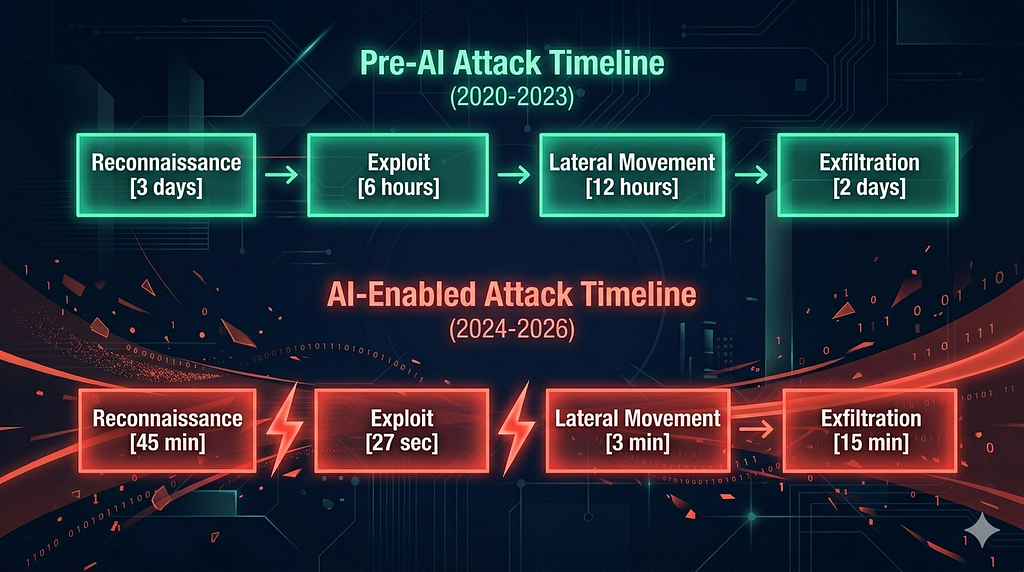
At the same time, most modern attacks are now malware-free, slipping past traditional defences entirely.
Nation-states are already leveraging these capabilities. There are documented cases of AI being used to support large-scale intrusion campaigns and even to help attackers pose as legitimate job candidates inside organisations.
The reality is:
AI isn’t creating new types of attacks — it’s compressing time, lowering skill barriers, and scaling what already works.
The barrier to entry has effectively collapsed. A decent laptop, open-source tools, and some creativity are now enough.
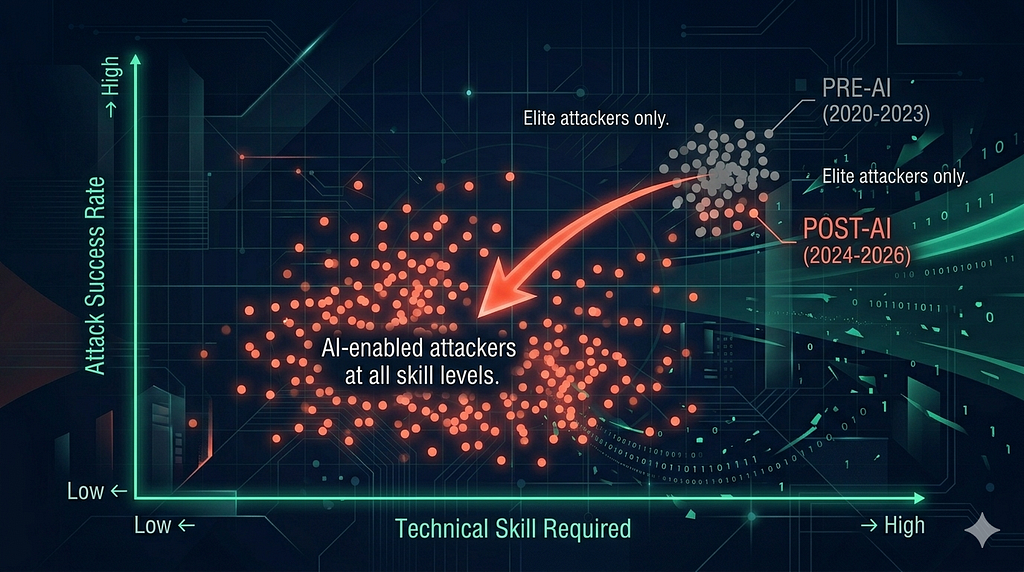
AI acts as a capacity multiplier for attackers who already have motivation and opportunity.
What AI Attacks Actually Look Like (Demystified)
Here’s what matters in practice, without the jargon:
Model extraction is about copying how an AI system thinks. An attacker doesn’t need direct access; they can repeatedly query the system, learn its patterns, and replicate or exploit its behaviour elsewhere.
Prompt injection is about tricking AI into ignoring its instructions. Hidden commands are embedded inside normal-looking input, and the system follows them because it cannot reliably distinguish intent.
Data poisoning is about corrupting what the AI learns from. If bad data gets into the training pipeline, the model absorbs those flaws permanently.
None of these are dramatic — and that’s exactly why they work.
They don’t require elite hacking skills. They rely on understanding how systems behave and exploiting the gap between what we expect and what they actually do.
But Here’s What Most Headlines Miss: Defence Is Catching Up
AI is not just an attacker’s advantage — it’s a defensive one too.
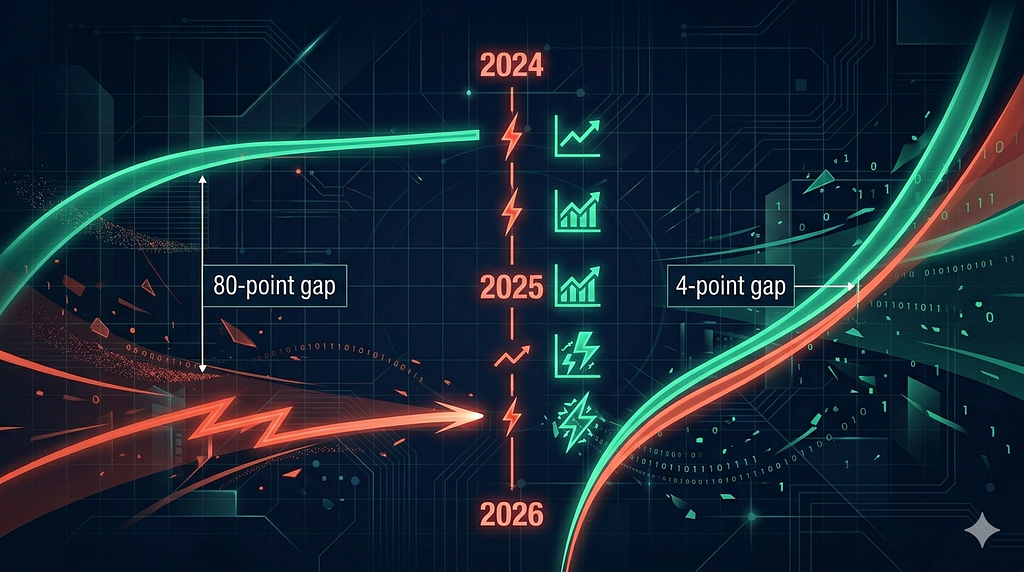
Organisations are deploying AI-driven security operations that can detect anomalies, triage alerts, and respond faster than traditional teams. Instead of reacting hours later, systems can now flag unusual behaviour in real time.
This shift matters. Organisations using AI effectively are already reducing response times and limiting damage significantly.
The balance isn’t fixed — it’s shifting.
The gap between attackers and defenders increasingly comes down to who adopts and integrates AI more effectively, not who has access to it.
The Ethical Frontier: Where Control Matters Most
As AI becomes embedded in security operations, ethical boundaries become harder to ignore.
Using AI to simulate attacks, probe vulnerabilities, or automate defence raises real questions around privacy, fairness, and unintended consequences. Without guardrails, even defensive use can introduce risk.
This is why responsible AI frameworks — clear rules, auditability, and oversight — are becoming essential.
Ethics isn’t a brake on innovation — it’s the steering wheel. Without it, both attackers and defenders lose control.
So… How Worried Should You Actually Be?
Let’s keep this grounded.
As an individual: Be aware, not paranoid. The biggest risks are still social engineering — deepfakes, phishing, and impersonation. The simplest defence still works: pause, verify, and don’t rely on voice or video alone.
As a business leader, you should be paying attention. AI is lowering the cost of attacking mid-sized organisations. But companies combining strong fundamentals with modern tools are already seeing results.
In government or critical infrastructure: The risks are real and already active. AI is accelerating reconnaissance and persistence at scale.
Overall? Concerned, but not alarmed. This isn’t a new kind of threat — it’s a faster version of an old one.
What Actually Works in 2026 (No Sci-Fi Required)
The fundamentals haven’t changed — only the urgency has.
- Identity is the new perimeter. Strong authentication and access control remain critical.
- Train people to verify, not just detect. Deepfakes make “spotting fakes” unreliable.
- Use AI, but don’t outsource judgment. Keep humans in critical decisions.
- Fix the basics. Patch systems and segment networks — AI exploits weak hygiene.
- Share intelligence. Collective defence is becoming a real advantage.
The takeaway is simple: discipline beats complexity.
The Bottom Line
The age of the AI hacker is here. But so is the age of the more capable defender.
We’re not facing an entirely new threat — we’re facing a faster, more scalable version of the same game. The organisations that succeed won’t be the ones with the most advanced tools, but the ones that combine technology with clear thinking, strong processes, and responsible use.
Be concerned. But more importantly, be prepared.
The hackers have already moved. The smart defenders are catching up.
Your Next Cyberattack Might Be AI-Generated. Here’s How Worried You Should Be was originally published in DataDrivenInvestor on Medium, where people are continuing the conversation by highlighting and responding to this story.