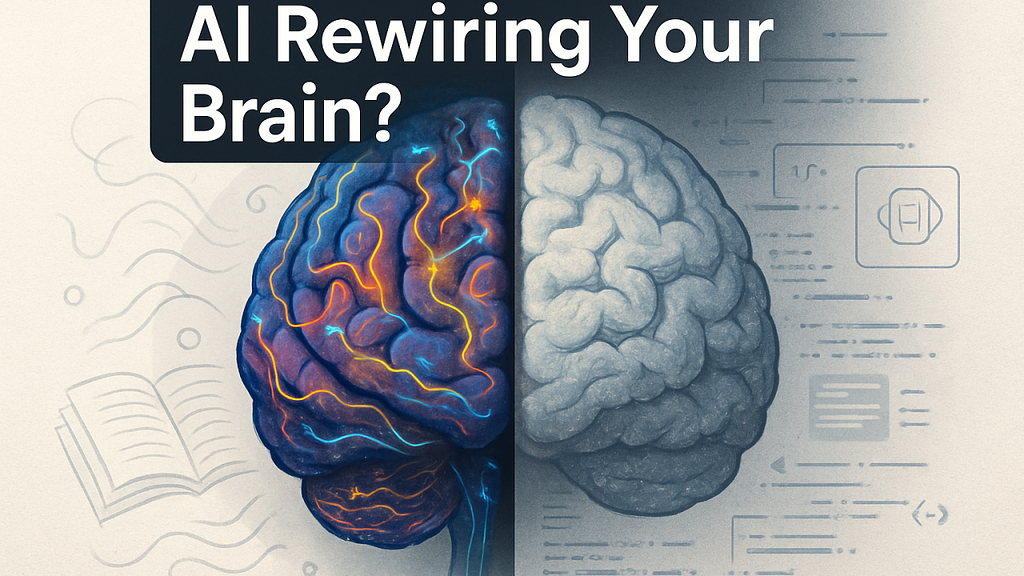
AI isn’t making you dumb. It’s making thinking optional. And that’s far more dangerous.
We need to talk about something uncomfortable.
It’s not that people have stopped thinking.
It’s that thinking is no longer required as often as it used to be.
And that changes everything.
The Quiet Shift Nobody Noticed
There was a time when thinking was slow.
If you had a question, you had to sit with it. You had to turn it over in your mind, get frustrated with it, walk away from it, come back to it. If you had a problem, you had to wrestle with it. If you had an idea, you had to develop it step by step, nurturing it like something fragile and uncertain before it hardened into something real.
Now?
You type. You ask. You get answers instantly.
It feels like progress. And in many ways, it is. But something subtle is happening underneath that convenience — something most people are too busy being productive to notice.
You are slowly outsourcing the act of thinking itself.
Not all at once. Not dramatically. But in small, invisible ways:
- You ask AI before you even try to think
- You accept answers before you’ve had a chance to form your own
- You rely on suggestions instead of sitting with open-ended exploration
- You stop tolerating uncertainty long enough to let insight emerge
And because it all feels efficient — because the output is good, the speed is remarkable, and your to-do list keeps shrinking — you don’t notice the cost.
This Isn’t a Technology Problem

Let’s be clear: this is not about stopping AI. AI is not the enemy. The technology is extraordinary, and the people who learn to use it well will have a genuine advantage in almost every professional field.
But this is about something more dangerous than a bad tool. It’s about what happens to human thinking when thinking is no longer necessary.
Throughout history, tools have always changed us — and not always in ways we anticipated or wanted.
Calculators reduced our reliance on mental arithmetic. Search engines reduced our need to actually remember things. Navigation apps have quietly eroded our spatial awareness; most people under thirty couldn’t navigate a new city without GPS, even if their lives depended on it.
But AI is categorically different from all of these tools.
Because it doesn’t just give you information. It gives you finished thinking. Ideas. Arguments. Plans. Solutions. Entire frameworks of reasoning — packaged, polished, and ready to use.
When a calculator does your arithmetic, your mind still had to understand the problem. When AI solves your problem, your mind often doesn’t need to engage at all. You go from question to answer, bypassing the messy, uncomfortable, essential process in between.
And when thinking becomes available “on demand,” something subtle but catastrophic happens:
You stop practicing it.
The Real Risk: Cognitive Atrophy
Most people assume that intelligence declines because of a lack of ability. That’s not what’s happening here.
What’s happening is a lack of use.
Think about it like a muscle. If you never lift weights, your muscles weaken — not because anything broke, but because the body adapts to what is demanded of it. If you never read deeply, your comprehension gradually declines. If you never write, your ability to express complex ideas fades.
So what happens if you rarely think deeply anymore?
The same thing. Not instantly. Not dramatically. But gradually, silently, almost invisibly — until one day you sit down with a complex problem and realize you don’t trust your own mind to handle it without assistance. You feel the urge to check something before you’ve even allowed yourself to try.
That’s not laziness. That’s atrophy.
And here’s what makes it particularly insidious: you won’t feel it happening. The outputs of your work may actually improve as your independent thinking quietly declines. The AI fills the gap so seamlessly that the gap itself becomes invisible.
The New Mental Habit Nobody Is Talking About
There is a new reflex forming in modern minds: “I’ll just ask AI.”
Before you’ve tried to solve it. Before you’ve sat with it. Before you’ve written a single word of your own thinking down.
And the danger isn’t using AI. The danger is using it first.
Because the first input into your thinking shapes everything that follows. Once you’ve read an AI-generated answer, your thinking doesn’t develop from scratch — it responds and reacts to what’s already in front of you. You become the editor of someone else’s thinking, not the originator of your own.
This matters more than most people realize. Your most original ideas — the insights that are genuinely yours, the creative leaps that come from your unique combination of experience, memory, and intuition — those almost never survive the process of asking AI first. They get crowded out before they can form.
What’s Really Being Lost
When we talk about cognitive atrophy in the age of AI, most conversations stay at the surface. People worry about fact-checking, about accuracy, about whether the AI is telling the truth.
But the deeper losses are harder to measure:
Curiosity that lingers. The kind that keeps you up at night, that sends you down rabbit holes, that makes a question follow you through your day. Instant answers kill that. Once you have the answer, the curiosity evaporates — along with everything it might have led you to discover.
Ideas that develop slowly. The best ideas rarely arrive fully formed. They emerge through a process of reflection, distraction, return, revision. When AI shortcuts that process, you often get a competent idea rather than a great one.
Creativity that comes from struggle. Constraints and difficulty are not enemies of creativity — they are its engine. The friction of not knowing forces the mind into unusual places. Remove the friction and you often remove the breakthrough.
Confidence in your own reasoning. This is perhaps the most quietly devastating loss. When you stop trusting your own thinking, you start to feel dependent in a way that’s hard to articulate but easy to feel. Decision-making becomes harder. Conviction becomes rarer. You second-guess yourself more, not less, despite having access to more information than any generation in history.
AI removes friction. And friction is where thinking actually happens.
The Truth Nobody Likes Hearing
The easier thinking becomes, the less you do it.
Not because you are incapable. Not because you are lazy. But because you are no longer required to think — and anything that is not required eventually becomes optional, and anything optional eventually becomes rare.
The real question is not whether AI can think. It clearly can, and in many domains it thinks faster and more comprehensively than most humans.
The real question is: Will you still think when you no longer have to?
Because that is where we are heading. A world where answers are instant. Where mental effort is optional. Where thinking hard about something feels almost eccentric — like insisting on walking when a car is available.
In that world, two types of people will emerge:
The Passive Thinkers — who outsource quickly, rely heavily, and accept easily. Their outputs may look impressive. Their inner capacity will quietly hollow out.
The Active Thinkers — who question first, struggle before outsourcing, and think before they ask. They will be slower in some moments. They will also be the ones capable of genuine insight when it matters most.
The gap between these two groups won’t be intelligence.
It will be habit.
How to Stay Mentally Sharp in an AI World
The solution is not to avoid AI. That’s both unrealistic and unnecessary. The solution is simpler and harder at the same time:
Don’t let AI think first.
Before you open a chat window, try this: pause for sixty seconds. Ask yourself — what do I actually think about this? What would I try first? What do I already know?
Even if your answer is incomplete, half-formed, or completely wrong — think it first. Then use AI. Not as a replacement for your thinking, but as a second opinion on it.
This one shift changes everything. Because now you’re bringing your thinking to the AI, rather than having the AI do your thinking for you. You’re in dialogue with it, rather than dependent on it. You remain the originator. AI becomes the collaborator.
Other practices worth building into your daily life:
- Write before you search. When you have a complex problem, write down your current thinking before consulting any external source. This externalizes your reasoning and makes it visible — and protects it from being crowded out.
- Sit with questions. Not every question needs an immediate answer. Let some of them stay open for a day, a week. See what your own mind does with them.
- Do hard reading. Long-form, dense, difficult reading is one of the best workouts available for sustained attention and independent thought. Don’t let AI summarize everything for you.
- Notice the reflex. Simply noticing when you’re about to reach for AI before trying yourself is the beginning of changing the habit.
The Most Dangerous Illusion
AI creates a powerful illusion: that output equals intelligence.
It doesn’t.
You can produce brilliant-looking results without meaningfully engaging your thinking at all. High output. Low cognition. And most people won’t notice until their confidence in their own reasoning starts to quietly fade — until they find themselves unable to hold a complex thought without external scaffolding.
That’s the trap. And it’s sprung so gently that most people will never feel it close.
Final Thought
AI is not making people less intelligent overnight. It’s doing something quieter and more insidious: it’s making thinking optional.
And optional skills are the first to disappear.
The real advantage in the AI era will not belong to the people who use AI the most. It will belong to the people who still know how to think without it — who can sit with uncertainty, wrestle with hard problems, and trust the slow, imperfect, irreplaceable process of their own minds.
Think first. Then use AI.
Not the other way around.
That single shift protects something that no tool, however powerful, can ever give back once it’s gone.
This article draws from themes explored in depth in The Quiet Erosion: How AI Is Reshaping Human Thinking — a 167-page exploration of cognitive dependency, creativity, and how to stay mentally sharp in an AI-driven world. Available at victoruluga.gumroad.com.
Your Brain Is Being Quietly Outsourced — And You Haven’t Noticed Yet was originally published in Coinmonks on Medium, where people are continuing the conversation by highlighting and responding to this story.