 FF2k5 min read·Just now
--
You Don’t Own Anything and That’s Working As Intended
An FF2K dispatch from the claims economy
───
Let me describe a magic trick.
You earn money. You deposit it in a bank. The bank lends most of it to someone else. You think you have money. You don’t. You have a claim — a promise from the bank that, should you show up and ask nicely, they will reconstruct the money from various other promises and hand it back to you.
This is not fraud. This is called banking.
Now let’s say you got smart and moved some of that money into stocks. Congratulations — you’re a shareholder. Except you’re not, technically. Your broker is holding shares in “street name.” Cede & Co. — a nominee shell entity operated by the Depository Trust Company — is the legal owner of record for roughly 90% of all U.S. publicly traded securities. You own a securities entitlement: a contractual right against your broker, who has a contractual right against DTC, who has the actual shares.
Three layers of counterparty between you and the thing you think you own.
Don’t worry, though. Your broker will almost certainly honor the claim. Probably.
───
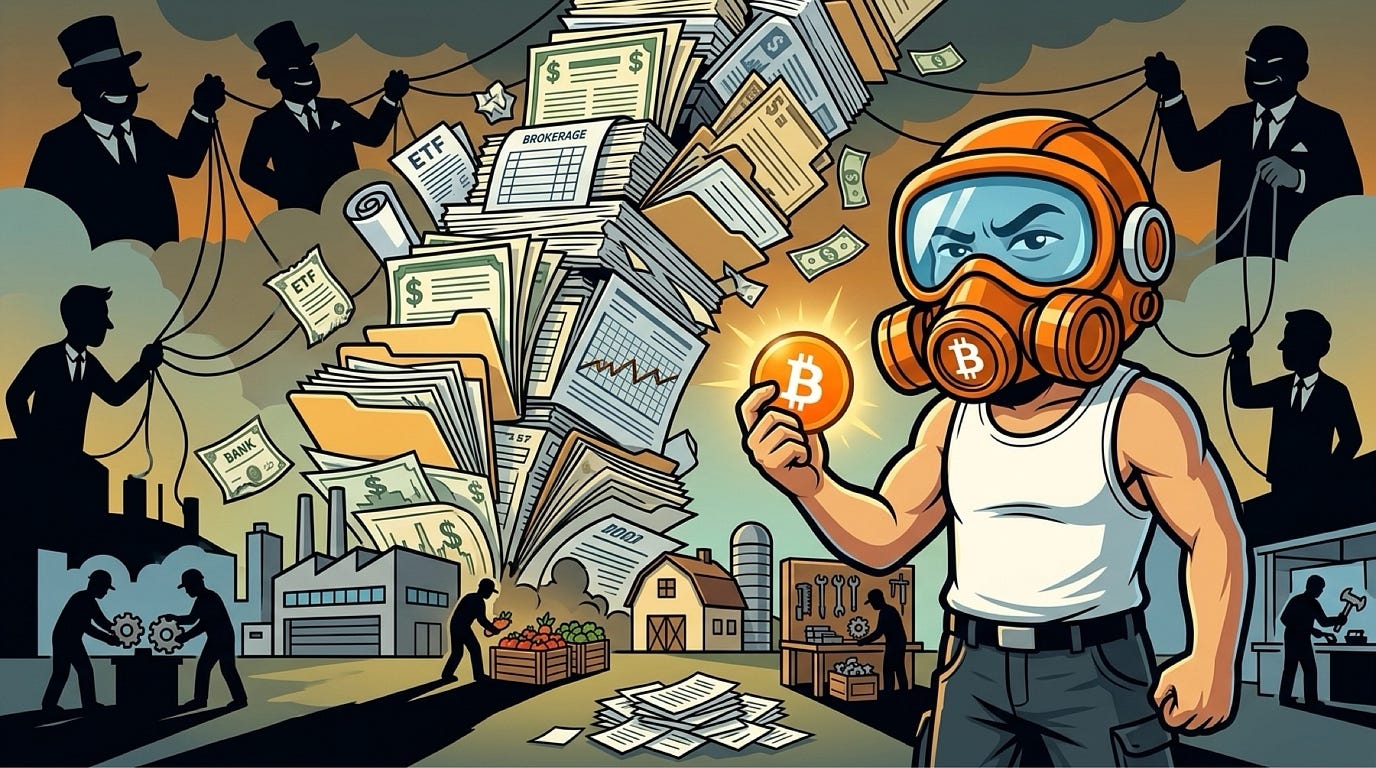
The Claims Pyramid
Here’s what the modern financial system actually is: a pyramid of layered claims on real things, with the real things somewhere at the bottom, increasingly theoretical.
- Your dollars are a claim on the Federal Reserve, which is a claim on U.S. government creditworthiness, which is a claim on the future productivity of Americans who haven’t been born yet.
- • Your bank deposits are a claim on a bank that holds a fraction of your money and lent the rest to people buying boats.
- • Your stocks are a claim on a broker who has a claim on DTC who has the shares.
- • Your ETF shares are a claim on the ETF trust, which has a claim on the underlying stocks, which cycle back up through the broker/DTC stack again.
- • Your 401(k) is a claim administered by a plan custodian, governed by ERISA, invested in funds that are claims on stocks that are…
You get it.
At every layer, there is a counterparty. At every layer, that counterparty could fail, freeze, get bailed out, suspend redemptions, go bankrupt, or simply change the rules.
And at no layer do you hold the underlying thing.
───
The Gold People Tried to Escape This
Physical gold enthusiasts clocked the problem early.
“Just hold the real thing,” they said. “No counterparty.”
And they were right — sort of.
Actual gold bars in your possession are a genuine bearer asset. No one else’s liability.
But then the financial system offered them gold ETFs. You can get “gold exposure” without the inconvenience of storing a heavy yellow rock. And millions of people bought GLD and IAU and felt good about themselves.
GLD is a claim. It’s a share in a trust that holds gold custodied at HSBC London. You cannot call HSBC and ask them to FedEx you a bar. Minimum redemption is reserved for authorized participants — the big banks. You, the retail investor, will settle in cash.
You traded the counterparty risk of a bank for the counterparty risk of a different bank, wearing a gold costume.
Paper gold futures are even better. One hundred claims, one bar. A musical chairs game that only ends when someone actually wants the chair.
───
Why This Keeps Working
The claims economy functions because almost no one asks for the underlying asset at the same time.
Banks work because most depositors don’t simultaneously demand their money back.
DTC works because most investors don’t simultaneously demand paper certificates.
Paper gold works because most holders will accept cash settlement.
The system isn’t fraudulent, technically. Every layer has legal backing. The lawyers thought of this. Your “beneficial ownership” is legally protected — you have a property interest, not just a contractual right.
But here’s what bothers me:
The protections all flow through the same system that created the problem.
FDIC covers bank failures — funded by banks, backstopped by the Treasury, which borrows from the Fed.
SIPC covers brokerage failures.
DTC protects against settlement failures.
Every layer of protection is itself another institution you have to trust, operating on premises it does not fully back.
You’re insured against counterparty failure by a counterparty.
Beautiful. Very normal. Nothing to see here.
───
The Discipline of Actual Ownership
What would it mean to actually own something?
Bearer assets.
You hold it, you own it.
No institution in the middle. No claim against a custodian. No “entitlement.” No trust that the trust is trustworthy.
The financial system has systematically replaced actual ownership with claims because claims are useful to the system.
When Cede & Co. holds your shares, they can be lent, pledged, netted, offset, and traded at high speed.
When your deposits are claims, the bank can lend them out and expand the money supply.
When gold sits in an ETF vault, it can be tracked on a Bloomberg terminal without anyone touching it.
The machinery of modern finance runs on dematerialized, transferable claims — because actual bearer assets are slow, heavy, annoying, and don’t plug neatly into the software.
The convenience is real.
The cost is that you accepted someone else’s promise in exchange for a real thing — and you probably didn’t notice.
───
The Exit
Bitcoin is a bearer asset.
Not a claim on Bitcoin.
Not a promise of Bitcoin.
Not “Bitcoin exposure.”
Not a receipt for Bitcoin held at a custodian.
If you self-custody — your keys, your coins — it is mathematically yours in the same way that a gold bar in your hand is physically yours.
No institution to fail.
No custodian to freeze accounts.
No counterparty to become insolvent.
No Cede & Co. holding the legal title while you hold the entitlement.
This is not a sales pitch. This is just what the word bearer means.
The rest of the financial system — the entire claims pyramid — runs on the assumption that the intermediaries will remain solvent, cooperative, and honest, more or less indefinitely.
Most of the time that assumption holds. The system is large, heavily insured, and backed by governments with printing presses.
But you are not owners in that system.
You are creditors — senior, well-protected, probably fine creditors, but creditors.
Your “assets” are someone else’s liabilities.
Bitcoin, held in self-custody, is nobody’s liability.
It doesn’t promise you anything.
It doesn’t need to.
The coin is the thing.
The claims economy is remarkably stable, until it isn’t.
Bitcoin doesn’t care either way.