XRPL Foundation publishes AMM v2, enhancing DEX capital efficiency with StableSwap and concentrated liquidity
The upgrade introduces two new pool curves to the XRP Ledger's decentralized exchange, targeting stablecoin and real-world asset trading.
Share
Add us on Google by Editorial Team May. 26, 2026The XRP Ledger just got the biggest upgrade to its decentralized exchange since automated market makers first went live on the chain in March 2024. The XRPL Foundation published the AMM v2 standard on May 26, introducing StableSwap and Concentrated Liquidity pool curves designed to make capital work harder for liquidity providers.
XRP was trading between $1.33 and $1.34 around the time of the announcement. The real story, though, isn’t the token price. It’s what this means for a ledger that already holds over $3 billion in tokenized real-world assets.
What AMM v2 actually changes
The original XRPL AMM, known as XLS-30, launched on March 22, 2024, using a constant product model that spreads liquidity evenly across every possible price point.
AMM v2 fixes that inefficiency by adding two new curve types. StableSwap pools are optimized for assets that trade near a 1:1 ratio, think stablecoins, foreign exchange pairs, or tokenized versions of the same underlying asset. Concentrated Liquidity pools let providers focus their capital within specific price ranges, a model popularized by Uniswap V3 that now accounts for roughly 60% of AMM volume on major DeFi platforms.
AdvertisementThe proposal is filed under XLS discussion #547, branded as “AMM Swappable Curves.” It’s a draft amendment, which means it still needs to pass through the XRPL’s consensus-based amendment voting process before going live. Existing pools won’t be affected. The original constant product model stays intact for any pools already created. New pools, however, will let creators choose which curve best fits their trading pair.
Why this matters for tokenized assets and stablecoins
The XRPL has been positioning itself as infrastructure for tokenized real-world assets, and the numbers back that up. Over $3 billion in tokenized assets currently sit on the ledger, spanning everything from government bonds to commodities.
Trading tokenized versions of traditional assets creates a specific problem that constant product AMMs handle poorly. When you’re swapping one stablecoin for another, or trading tokenized euros for tokenized dollars, the price barely moves. A constant product curve wastes most of its liquidity on price ranges that will never be reached. StableSwap curves concentrate liquidity right around that 1:1 peg, dramatically reducing slippage for traders and improving returns for providers.
Concentrated Liquidity addresses a related but different problem. For assets with moderate price movement, providers can define a custom range where they want their capital deployed. If XRP typically trades between $1.30 and $1.40 over a given period, a provider can concentrate all their liquidity in that band instead of covering every price from $0 to infinity.
What this means for investors
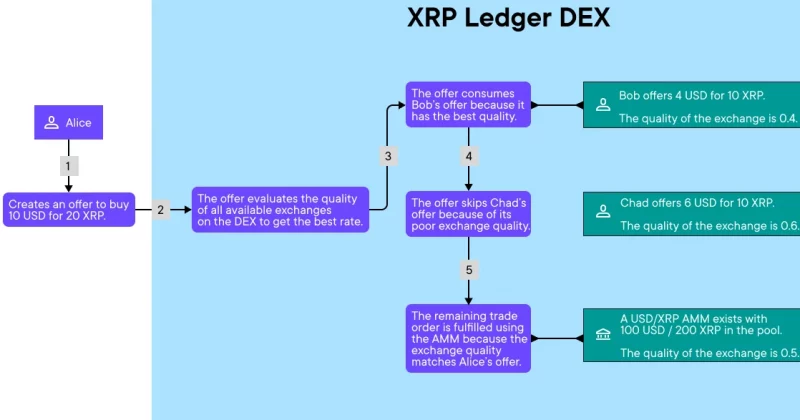
The XRPL’s DEX combines an automated market maker with a centralized limit order book, a hybrid design that most other chains don’t offer. Adding sophisticated AMM curves on top of that order book structure creates a trading environment that could appeal to institutions accustomed to traditional market microstructure.
Roughly 60% of AMM volume on major platforms now flows through concentrated liquidity pools. The $3 billion in tokenized assets already on the ledger represents a built-in demand base for these new pool types. Stablecoin pairs, FX pairs, and tokenized securities all benefit from StableSwap curves.
The risk is execution. On Uniswap V3, studies have repeatedly shown that passive concentrated liquidity providers often underperform compared to those actively managing their positions. The XRPL Foundation will need robust tooling and education to prevent retail LPs from getting outmaneuvered by professionals.
There’s also the amendment voting itself. The XRPL uses a consensus process where validators must approve protocol changes, and not every proposal makes it through on the first attempt.
Disclosure: This article was edited by Editorial Team. For more information on how we create and review content, see our Editorial Policy.