
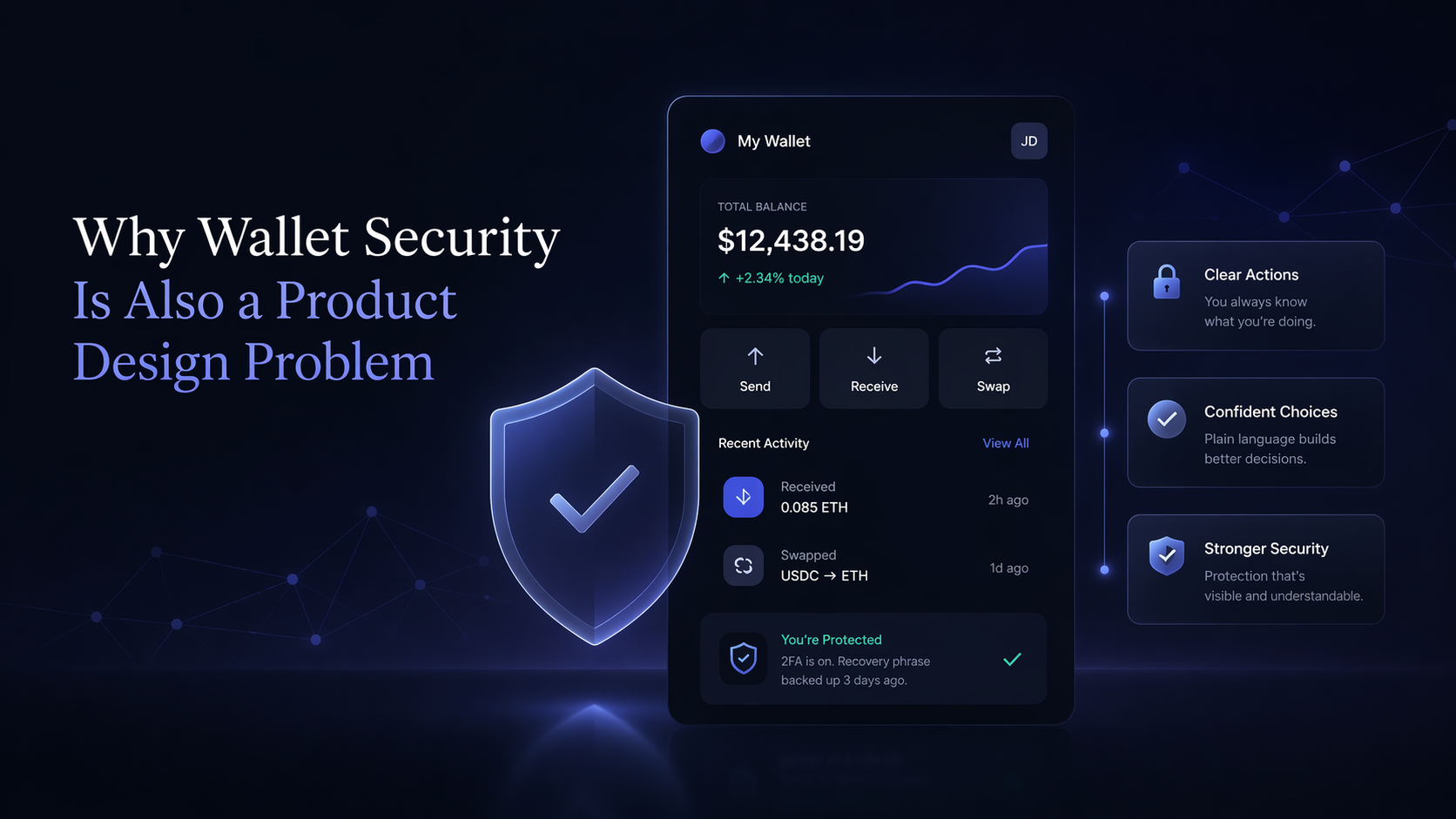
Why Wallet Security Is Also a Product Design Problem
 Adrian Vale3 min read·Just now
--
The safest wallet experience is not only about encryption and custody. It is also about whether users can clearly understand what they are doing.
When people talk about wallet security, the conversation usually starts in the same place.
Private keys.
Recovery phrases.
Infrastructure.
Encryption.
Self-custody.
All of that matters, and it should. Without a serious technical foundation, no wallet can be taken seriously for long.
But that is only part of the story.
What many users actually experience as “security” is a mix of two things: the technical strength of the product, and the clarity of the product itself. A wallet may be built on the right principles and still feel uneasy in everyday use if the interface creates hesitation, confusion, or doubt at the exact moments when people need confidence the most.
That is why wallet security is also a product design problem.
Most people do not experience security as an architecture diagram. They experience it through decisions. They experience it when checking balances, reviewing a destination address, reading a transaction prompt, moving assets across networks, or trying to understand whether the action on screen matches the action in their head.
This is where design stops being cosmetic and starts becoming structural.
A clear product reduces avoidable mistakes. A readable interface lowers mental friction. Strong transaction review helps users slow down in the right places. Good design does not remove responsibility, but it can make responsibility easier to carry.
That distinction matters in crypto more than in many other categories.
Traditional financial products often sit on top of familiar recovery systems and institutional layers. Crypto wallets operate differently. Once a transfer is approved and confirmed, there is usually no easy undo button waiting on the other side. That reality raises the cost of misunderstanding. It also raises the value of interfaces that help users stay oriented. The Ethlas security page reflects exactly this broader logic: user control, non-custodial responsibility, careful approvals, secure recovery habits, device safety, and phishing awareness are all treated as part of the security picture, not as unrelated side notes.
In weaker products, security is often presented as a set of claims.
Secure.
Protected.
Advanced.
Trusted.
But users do not build trust from adjectives alone. They build trust from experience.
They trust products that feel deliberate.
They trust products that reduce ambiguity.
They trust products that make important actions easier to understand.
This is why confusing products often feel less secure, even when they are technically stronger than they appear. Unclear products force users to guess. They create low-level uncertainty. They introduce little pauses before important actions, not because the action itself is inherently suspicious, but because the product did not create enough clarity around it.
Those moments add up.
A wallet that feels difficult to read becomes a wallet that people second-guess. A wallet that makes people second-guess ordinary actions starts to weaken confidence. And once confidence weakens, “security” stops feeling like a solid product quality and starts feeling like a fragile promise.
The stronger approach is to treat security as both engineering and communication.
That means the technical layer has to be sound. But it also means the product has to support human judgment. It has to help users notice what matters. It has to slow them down where slowing down is useful. It has to make risk feel legible instead of hidden behind jargon or momentum.
This is one reason some newer wallet products are moving toward clearer and more intentional safety experiences. One example is Ethlas wallet security, which frames security not only around protection, but around user control, readable actions, and a non-custodial environment where responsibility stays visible instead of being obscured.
That way of thinking feels important.
Because in the end, a secure wallet is not only one that is hard to exploit.
It is also one that is hard to misunderstand.
And as crypto products continue to mature, that may become one of the clearest dividing lines between wallets that merely claim security and wallets that actually help users practice it.