WHY VIETNAM IS WINNING THE MANUFACTURING WAR (AND WHAT THAT MEANS FOR INVESTORS )
 Dreams On Gasoline3 min read·Just now
--
For decades, global manufacturing followed a simple map:
China → The world’s factory.
But that map is being redrawn.
And at the center of that shift is
Vietnam.
Not by accident.
Not by hype.
But by design, timing, and global necessity.
The Big Shift: Supply Chains Are Being Rewritten
The global manufacturing system is no longer about cost alone.
It’s about:
- Risk diversification
- Geopolitical alignment
- Supply chain resilience
And this is where Vietnam wins.
As companies rethink dependence on a single country, Vietnam has emerged as a primary alternative manufacturing hub — not secondary, not experimental.
Vietnam is no longer “China +1” — it’s becoming a core node.
The Growth Engine: Manufacturing Is Not Rising — It’s Dominating
Let’s get specific.
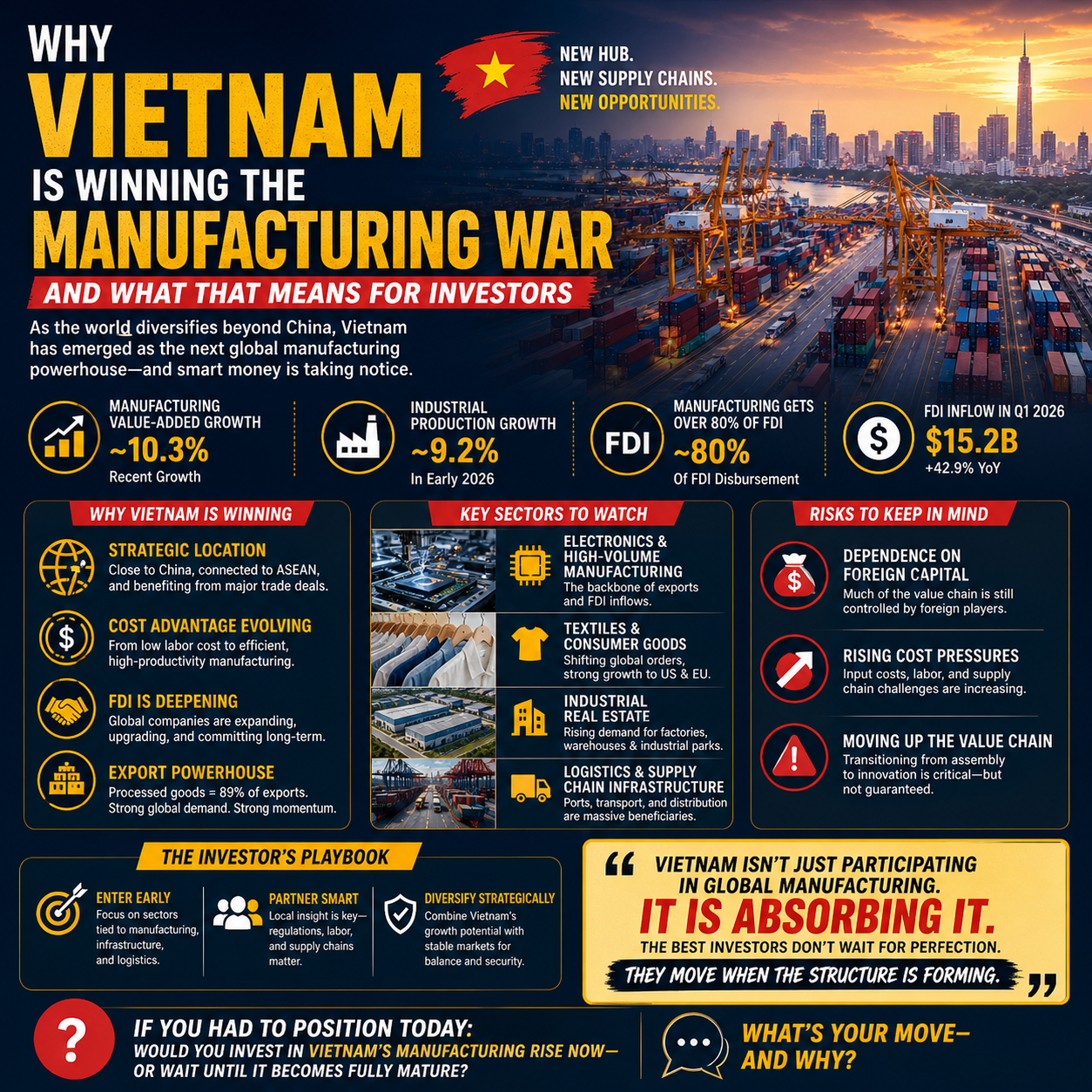
- Manufacturing value-added growth hit ~10.3% recently
- Industrial production rose ~9.2% in early 2026
- Manufacturing accounts for over 80% of FDI disbursement
This isn’t a trend.
It’s a structural backbone.
Even more telling:
- Vietnam attracted $15.2B in FDI in Q1 2026 (+42.9% YoY)
- The majority is flowing into processing and manufacturing sectors
Investors are not “testing” Vietnam anymore.
They are scaling inside it.
Why Vietnam Is Winning (The 4 Real Drivers)
1. Strategic Geography + Trade Positioning
Vietnam sits in a powerful position:
- Close to China (supply chain integration)
- Connected to ASEAN markets
- Benefiting from major trade agreements (EU, US shifts, regional deals)
This allows companies to:
- Manufacture in Vietnam
- Export globally
- Avoid geopolitical friction
2. Cost Advantage — Still Relevant, But Evolving
Yes, Vietnam is still competitive on labor cost.
But here’s the shift:
It’s moving from cheap labor → efficient production.
Manufacturing is becoming:
- More organized
- More integrated
- More export-driven
3. FDI Is Not Just Entering — It’s Deepening
This is where most people miss the signal.
Vietnam isn’t just attracting new factories.
Existing investors are:
- Expanding capacity
- Upgrading technology
- Extending operations
That means:
Confidence is no longer short-term — it’s long-term commitment.
4. Export Power Is Driving Everything
- Processed goods make up nearly 89% of exports
- Exports grew strongly in early 2026 despite global pressure
Vietnam is not just producing.
It is:
Plugged directly into global demand.
Sector-Level Opportunities (Where Investors Should Actually Look)
1. Electronics & High-Volume Manufacturing
- Core of Vietnam’s export engine
- Strong multinational presence
- Scaling production lines
2. Textiles & Consumer Goods
- Benefiting from global supply chain shifts
- Major export growth to US and EU markets
3. Industrial Real Estate
This is the quiet winner.
Factories need:
- Land
- Logistics hubs
- Warehousing
And demand is rising as manufacturing expands.
4. Logistics & Supply Chain Infrastructure
As production grows:
- Transport
- Ports
- Distribution
…become critical investment areas.
But Here’s What Serious Investors Must Understand (The Risks)
This is where your authority shows — you don’t sell hype.
1. Heavy Dependence on Foreign Capital
A large portion of manufacturing:
- Is driven by foreign companies
- Controlled externally
That means:
Vietnam benefits — but doesn’t fully control the value chain.
2. Rising Costs Are Starting to Show
- Input costs increasing
- Supply chain pressure rising
Margins will tighten over time.
3. Transition Risk: Moving Up the Value Chain
Vietnam is trying to shift from:
- Assembly → Innovation
That transition is not guaranteed.
The Real Investor Insight (This Is the Edge)
Most people see Vietnam as:
“A fast-growing manufacturing hub.”
That’s surface-level thinking.
The real insight is this:
Vietnam is at the “scale phase” of industrial development — not the “control phase.”
Which means:
- High growth
- High activity
- High participation
But not yet:
- Full value capture
- Full technological dominance
So What Should Smart Investors Do?
Strategy 1: Enter Early in Industrial Expansion
Focus on:
- Manufacturing-linked sectors
- Industrial real estate
- Logistics
Strategy 2: Partner, Don’t Just Build
Local understanding matters:
- Regulations
- Labor
- Supply chains
Strategy 3: Combine Vietnam with a Stability Market
This is where your earlier thesis connects.
Use:
- Vietnam → for growth
- Malaysia → for structure and financial stability
Final Thought
Vietnam is not just participating in global manufacturing.
It is absorbing it.
And in the next decade:
- Some will watch from the outside
- Some will enter too late
- A few will position early
Because in markets like this:
You don’t wait for perfection.
You move when the structure is forming.
If you had to position today:
Would you invest in Vietnam’s manufacturing rise now —
or wait until it becomes fully mature?
What’s your move — and why?