Why Tokens Still Don’t Feel Native To The Internet
--
You don’t think about how a file moves.
You just send it.
An image.
A PDF.
A link.
A song.
Email.
WhatsApp.
AirDrop.
QR.
The internet figured this out a long time ago.
Value didn’t.
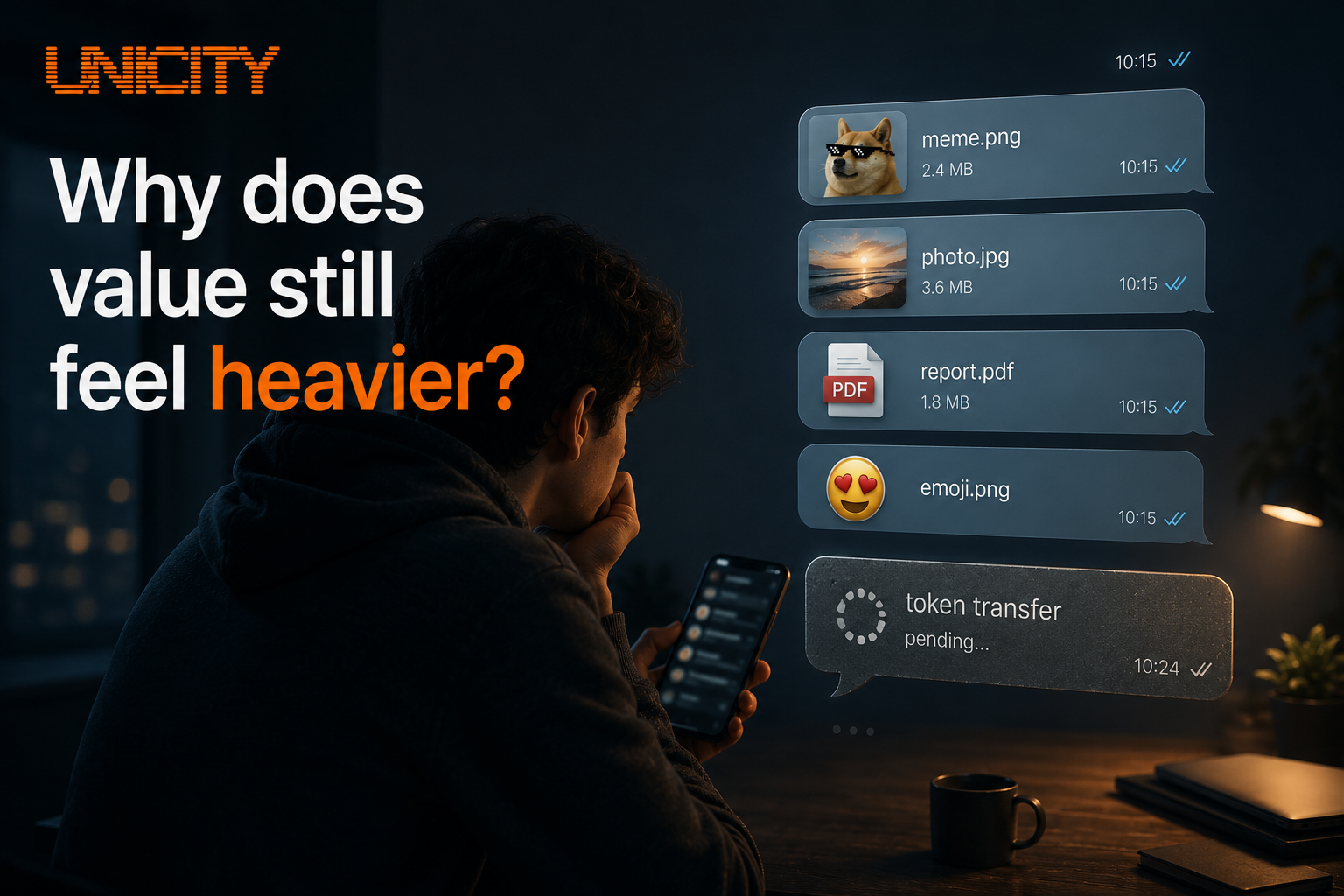
Sending a token still feels less natural than sending a meme.
You copy wallet addresses.
Switch networks.
Wait for confirmations.
Check explorers.
Hope nothing breaks.
We normalized friction because blockchain made us expect it.
For something that’s supposed to be digital money, crypto still behaves more like banking infrastructure than the internet.
That’s because most blockchains were built around one assumption:
Everything must live inside a shared ledger.
Every transaction.
Every balance.
Every state update.
The entire system revolves around everyone agreeing on everything.
And that changes the feeling of ownership.
Your token isn’t really moving.
It’s just another entry being updated inside a global database.
Unicity approaches this differently.
Not by making the shared ledger faster.
By asking a more uncomfortable question:
What does a blockchain actually need to do?
Their answer is surprisingly small:
Prevent double-spending.
Nothing else.
That changes everything.
In Unicity, the token itself becomes the object.
Not an account entry.
Not a balance inside a chain.
A self-contained asset.
Something that carries its own history and ownership with it.
Imagine sending value through a messenger as naturally as sending a photo.
No explorer tabs.
No chain switching.
No feeling like you’re interacting with infrastructure.
Just ownership moving through the internet like information already does.
The blockchain doesn’t need to process every action anymore.
It only needs to prove one thing:
This asset wasn’t spent twice.
Everything else can happen directly between participants.
Peer-to-peer.
Off-chain.
In parallel.
That sounds technical.
But the real impact is emotional.
Because suddenly the interaction starts feeling familiar.
Like the internet.
You don’t ask:
“Which chain is this file on?”
You just send it.
That’s the mental shift Unicity is pushing toward.
Tokens that behave more like digital objects than database entries.
And maybe that matters more than another scalability metric.
Because the biggest problem in crypto was never only speed.
It was friction.
Crypto created digital ownership.
But never made ownership feel native.
Every interaction reminded you that complex infrastructure was sitting underneath.
The experience never disappeared.
The internet won because complexity became invisible.
You don’t think about TCP/IP before sending a message.
You don’t think about routing protocols before opening a website.
Every successful internet primitive eventually disappeared into the experience.
That’s what native technology feels like.
Most blockchains still feel like infrastructure first.
Unicity feels like one of the first attempts to make digital assets behave like internet-native objects.
Not because it hides the blockchain.
But because it reduces the blockchain to the only thing it fundamentally needs to do.
Prevent the same asset from being spent twice.
Everything else becomes lighter.
Faster.
More direct.
More human.
Maybe digital ownership was never supposed to feel like infrastructure in the first place.
Maybe the real breakthrough isn’t making blockchains bigger.
It’s making value move through the internet so naturally that eventually nobody thinks about the blockchain at all.