 Monsuru Anifowose8 min read·1 hour ago
--
Why the ocean is the most important financial infrastructure problem of the 21st century
In October 2022, the SHEFA-2 cable connecting the Shetland Islands to the Scottish mainland was severed. The islands lost internet connectivity. Investigations took weeks. The responsible party was never conclusively identified. In November 2024, a Chinese-flagged bulk carrier, the Yi Peng 3, dragged anchor across the Baltic seabed and severed two critical cables, the C-Lion1 connecting Finland to Germany and the BCS East-West cable linking Lithuania to Sweden. The initial response was confusion. Verification was slow. Markets priced the uncertainty rather than the event.
In April 2024, Iranian naval forces seized the MSC Aries, a Portuguese-flagged container ship, in the Strait of Hormuz. The seizure took minutes. Confirmed information about the crew, the cargo, and the precise location reached global markets over hours, through a patchwork of AIS tracking data, satellite imagery, and diplomatic channels, none of which were designed to work together. Shipping companies rerouted vessels before anyone had a reliable picture of what was happening on the water or what the rules of engagement would be.
The broader Red Sea crisis, triggered by Houthi attacks on commercial shipping throughout late 2023 and 2024, forced Lloyd’s of London and the marine insurance market to reprice risk across one of the world’s most critical trade corridors. At peak, war risk premiums on Red Sea transits increased by as much as 0.7% of vessel value per voyage. Global shipping was rerouted around the Cape of Good Hope, adding ten to fourteen days to voyages and billions in fuel and time cost to the supply chain. The repricing did not happen in real time. It happened after the fact, on incomplete information, through human reporting chains that had not materially changed since the age of telegraphs.
The Strait of Hormuz, through which roughly 25% of global seaborne oil trade transits daily, became a recurring point of leverage throughout the Iran-Israel-US conflict. Every escalation, every seized tanker, every drone strike on a vessel, translated within hours into commodity price movements, insurance repricing, and rerouting decisions made by operators working from fragmentary, delayed information. The financial cost of that information gap across a single year of conflict runs into the tens of billions. The strategic cost, which is the degree to which the absence of verified, real-time situational awareness allowed escalation to proceed faster than response, is harder to quantify but plainly significant.
Each of these incidents traces back to the same structural failure. The ocean, which carries 90% of global trade, through which 95% of global internet traffic passes via subsea cable, across which trillions of dollars in energy assets float and beneath which trillions more lie untouched, has never had a continuous, verifiable, real-time operating picture. Capital, which moves at the speed of verified information, has been priced around that black hole for centuries.
The Architecture We Inherited
The Peace of Westphalia in 1648 drew borders across the land and gave the world the nation-state. It established a framework in which sovereignty was a function of geography, enforced by the physical presence of military power, and legitimised by historical inheritance. For nearly four centuries, that architecture governed how resources were owned, how disputes were resolved, and how capital flowed.
The instrument of governance has simply not kept pace with the speed of the world it is meant to govern.
A navy can patrol a coastline. It cannot simultaneously monitor 38 million square kilometres of exclusive economic zone. A port authority can inspect a vessel. It cannot track the integrity of 1.3 million kilometres of subsea cable. A government can claim sovereignty over its continental shelf. It cannot price the risk of what moves across it in real time. The gap between the claim and the capability to verify the claim is where value disappears, conflicts escalate, and markets misprice risk by design.
The Cost of Not Seeing
The Strait of Malacca, through which between 25% and 30% of global trade passes, remains one of the most insurance-intensive corridors in the world. Piracy, territorial disputes, and environmental incidents are chronic. The pricing of risk in that corridor still largely relies on historical incident data and human intelligence networks rather than live, authenticated field data. The premium paid by shipping operators is a function of uncertainty, and uncertainty is not the same as actual risk. The difference is absorbed by every consumer whose goods transit the strait.
The South China Sea carries an estimated three to five trillion dollars in annual trade and contains some of the world’s most significant untapped hydrocarbon and mineral resources. The contestation of that domain is, at its core, a contest over verified presence. Who can see what is happening, confirm it, and assert a credible claim based on that confirmation, holds the advantage. No party currently has that capability at scale, which is precisely why the dispute remains unresolved and the resources remain largely stranded.
In the Gulf of Mexico, deepwater infrastructure representing hundreds of billions in asset value operates in conditions where an incident like the Macondo blowout in 2010 went unverified at full scale for days. The financial and environmental consequences of that empirical verification gap are well documented.
The North Sea, which underpins a significant portion of European energy security, contains ageing infrastructure, contested post-Brexit fishing rights, and expanding offshore wind assets; all operating across a domain where real-time integrated monitoring remains fragmented across national jurisdictions and private operators. The inefficiency compounds into every kilowatt-hour and every barrel produced.
In the Pacific, island nations sitting above some of the world’s richest polymetallic nodule fields, which are resources conservatively valued in the trillions, find themselves unable to access global capital markets to monetise what lies beneath their waters. The capital is willing. The infrastructure to connect it to the resource does not exist. Without a continuous, authenticated stream of physical evidence, no financial instrument can be underwritten against assets that cannot be observed.
The pattern holds across every ocean, every strait, and every continental shelf. A shortage of resources is rarely the problem. A shortage of verified information about those resources, consistently, is.
The Oracle Problem
There is a concept in distributed computing called the Oracle Problem. Smart contracts, which are the self-executing agreements that underpin much of modern financial infrastructure, can verify what happens on a ledger. They cannot verify what happens on the water. To execute a contract conditional on a physical event, you need a trusted, real-time feed from physical reality. That feed is called an oracle.
The Oracle Problem is why the tokenisation of physical assets has remained largely theoretical. You can issue a digital instrument tied to the yield of a maritime corridor, but without a continuous, trusted feed of undeniable ocular proof from that corridor, the instrument is backed by a claim rather than verified reality. Claims and collateral are fundamentally different things, and global capital markets price that difference into every transaction that touches the physical world.
This is the problem Caelus Industries is built to solve.
The Workforce
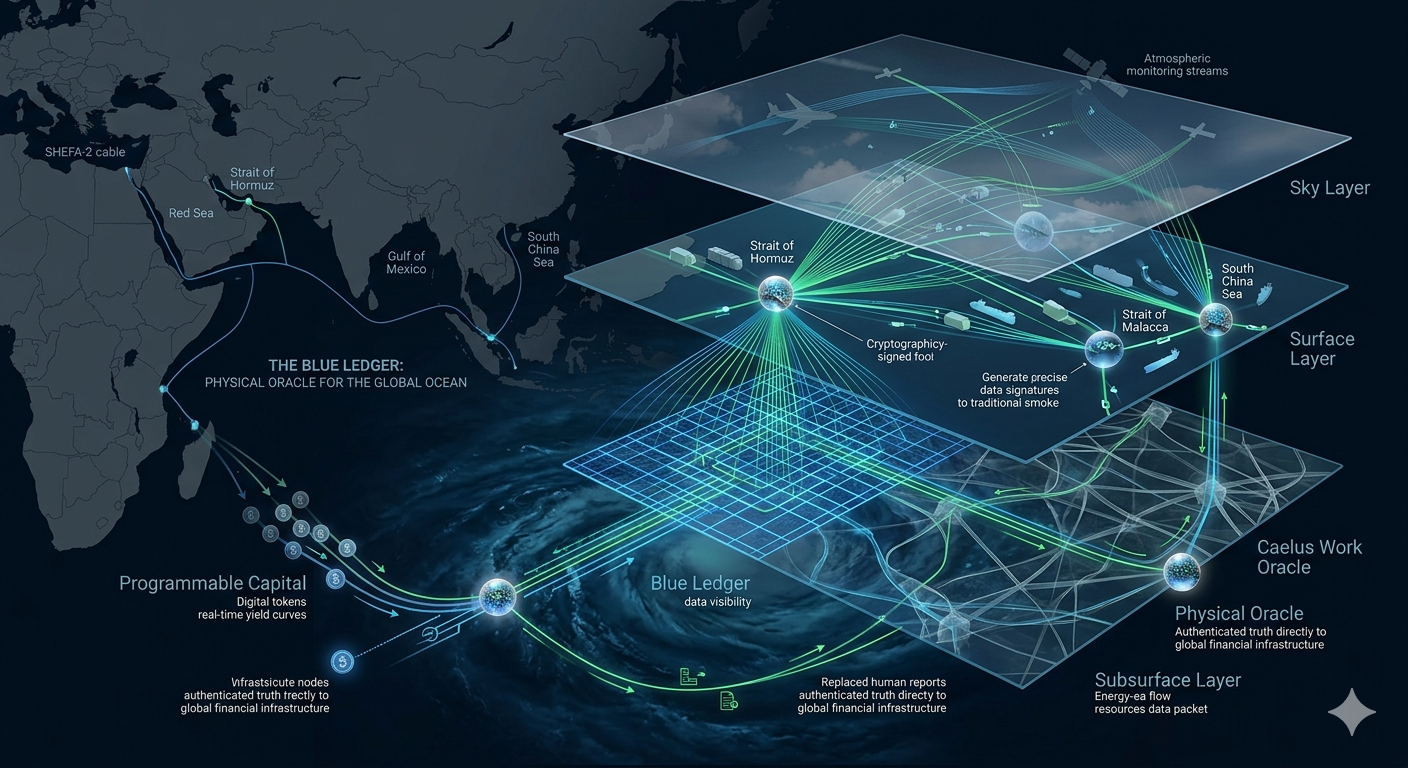
We are building a permanent autonomous workforce for the maritime domain. Our systems operate simultaneously across three layers, surface, subsurface, and aerial, providing continuous, high-fidelity coverage of everything moving within a given domain.
To see everything, you must occupy all three layers at once. A surface vessel sees the waterline and nothing beneath it. An aerial system sees what weather permits and nothing below the surface. A subsurface system is blind to everything above it. The three-layer architecture follows directly from that requirement, and the hybrid design of our systems reflects it at the hardware level.
What this workforce produces is something that has not previously existed: a Physical Oracle for the maritime domain. Every ship position, every cable integrity signal, every FPSO output reading, every port throughput figure, every anomalous movement within the domain, logged in real time and cryptographically signed at the edge, meaning the signature is generated by the sensor itself before the data leaves the unit, so that what reaches the ledger cannot be spoofed, backdated, or tampered with in transit. Made available as a trusted data feed to financial infrastructure, this is the distinction between another drone feed and immutable physical evidence.
When the physical world becomes legible to code at this resolution, the consequences compound structurally. Risk can be priced at the level of a specific vessel in a specific corridor at a specific moment, rather than averaged across historical incident rates. Physical events become direct triggers for programmable capital. Insurance pays out when the sensor confirms the incident, not when the adjuster files the report. Trade finance releases when the cargo is confirmed in situ, not when the paperwork clears. The information lag that has always separated physical reality from financial markets collapses.
Assets that were previously unfinanceable become liquid. A port in Indonesia, a fishing cooperative in the Philippines, an offshore wind installation in the North Sea, a cable landing station in Brazil; each carries collateral value that global capital markets cannot currently price because the continuous, validated reality stream does not exist. When it does, the market forms around it. Capital flows to verified yield without needing to be convinced.
The Blue Ledger
We call the long-term architecture the Blue Ledger.
The total assetisation of the world’s physical resources, beginning with the ocean as the first and largest unmanaged commons. Once you have a continuous, trusted, real-time operating picture of a physical domain, every asset within that domain can be represented as a financial instrument. Maritime corridors become yield-bearing instruments priced on verified throughput. Exclusive Economic Zones become collateral rather than cost centres. Subsea infrastructure becomes the basis for sovereign yield instruments that trade on global markets. Programmable capital moves conditionally on physical events verified in real time by the autonomous workforce.
What results are genuinely new markets, built on a layer of certified physical observation that has never before existed, in the same way that the digitisation of financial records did not merely improve existing settlement processes but gave rise to entirely new markets built on the velocity and granularity that digitisation enabled. The financial instruments that govern maritime trade today were designed for a world of incomplete information and slow verification. The infrastructure that made those instruments necessary is being replaced.
The ocean is the first domain because it is the hardest. Once the protocol is validated here, the same architecture extends to every physical resource that global capital currently cannot reach. A lithium corridor in Central Asia. A freshwater basin in the Middle East. A rainforest carbon system in Southeast Asia. The protocol is domain-agnostic. The ocean is the proof of concept.
The Peace of Westphalia gave the world sovereignty enforced by navies. The Blue Ledger gives the world sovereignty as a service level agreement, enforced by protocol, verified by machines, and settled by global capital. Governance does not disappear in this architecture. The entities that build and operate the Physical Oracle layer hold, in the most literal sense, the informational foundation upon which all claims to resources are made. Whoever can see the domain, verify it continuously, and make that verification cryptographically trusted to global capital markets, holds a form of influence that no navy has ever been able to project at that resolution, that cost, or that scale.
We are building in the maritime domain because that is where the problem is largest, the infrastructure is most absent, and the financial opportunity is most immediate.
The ocean is the first domain. It will not be the last.