LLM tools are already part of everyday development. They are fast, often useful, and in many cases very good at reading code and stack traces. Claude is widely regarded as one of the strongest coding models available today, which is exactly why this example matters.
Recently I used Claude to analyze a crash in a legacy Android project. That detail matters. In legacy code, listeners, callbacks, and fragment contracts are often not very elegant, but they still carry real behavior. That makes “simple” fixes more dangerous than they look.
The crash itself was straightforward:
Fatal Exception: java.lang.RuntimeException:
com.mishloha.mishapp.activity.MainActivity@e2c8808
must implement DiscountCodeDialogListener
    at com.mishloha.mishapp.fragment.discountcode.DiscountCodeDialog.onAttach(DiscountCodeDialog.kt:50)
    at androidx.fragment.app.Fragment.performAttach(Fragment.java:3075)
    at androidx.fragment.app.FragmentStateManager.attach(FragmentStateManager.java:510)
    at androidx.fragment.app.FragmentStateManager.moveToExpectedState(FragmentStateManager.java:279)
    at androidx.fragment.app.FragmentManager.executeOpsTogether(FragmentManager.java:2214)
    at androidx.fragment.app.FragmentManager.removeRedundantOperationsAndExecute(FragmentManager.java:2115)
    at androidx.fragment.app.FragmentManager.execPendingActions(FragmentManager.java:2052)
    at androidx.fragment.app.FragmentManager$5.run(FragmentManager.java:703)
    at android.os.Handler.handleCallback(Handler.java:959)
    at android.os.Handler.dispatchMessage(Handler.java:100)
    at android.os.Looper.loopOnce(Looper.java:249)
    at android.os.Looper.loop(Looper.java:337)
    at android.app.ActivityThread.main(ActivityThread.java:9593)
Claude analyzed it correctly at first. DiscountCodeDialog.onAttach() expected the host to implement DiscountCodeDialogListener. The dialog was being shown from PersonalAreaFragmentNew via childFragmentManager, but that fragment did not implement the listener, so the attach check failed and threw. The working callers did implement the listener.
Then came the first proposed fix.
The idea was essentially this:
override fun onAttach(context: Context) {
    super.onAttach(context)
    listener = when {
        parentFragment is DiscountCodeDialogListener ->
            parentFragment as DiscountCodeDialogListener
        else -> null   // instead of throwing
    }
}
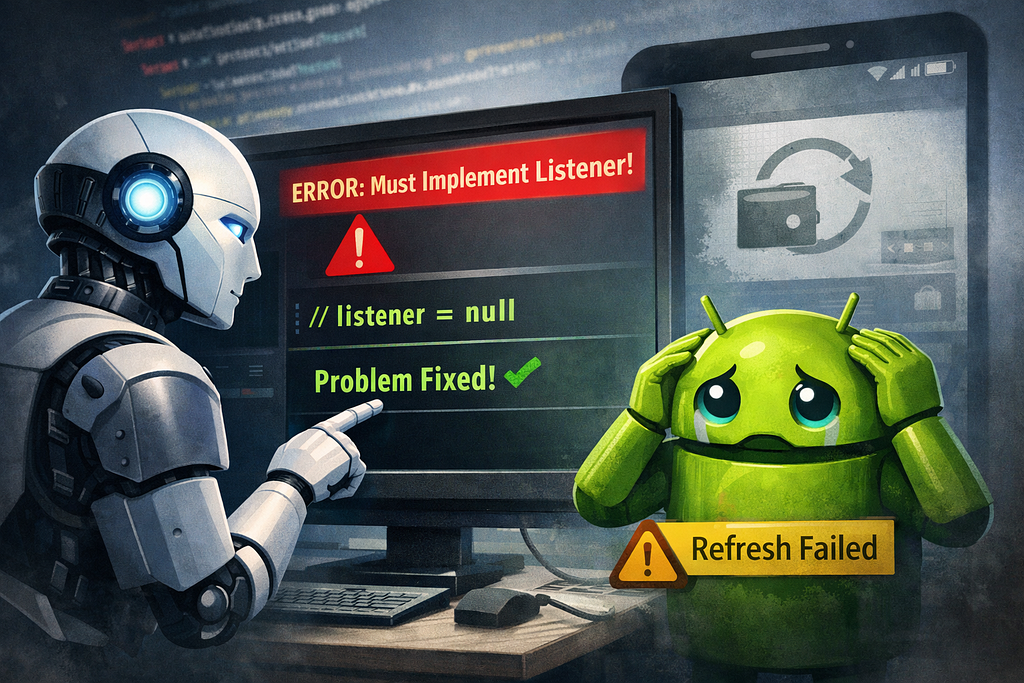
The argument was simple: the callback was already nullable, the dialog already used a safe call, so if no listener existed, the crash would disappear and the dialog would still “work.” That is almost exactly what Claude proposed: stop throwing, leave the listener null, and continue.
This was the wrong fix.
It removed the exception, but it also removed the contract. In a legacy project, that is exactly where trouble starts. The code may look clumsy, but the callback often exists for a reason.
So instead of accepting the first patch, I checked what the working callers actually did in onDiscountCodeDialogDismissed(). That changed the whole picture. One fragment reloaded wallet data. Another showed a snackbar with the credit value. In other words, dismissing the dialog was not just a UI event. It could trigger important follow-up behavior.
That meant the proposed “fix” was really this: if the host does not implement the listener, silently skip the post-dismiss behavior.
In this particular flow, that would introduce a new bug. The coupon could be redeemed through the deep link flow, the crash would disappear, but the personal area would not refresh properly afterward. So the patch would convert a visible failure into a hidden functional regression.
The correct fix was not to weaken the dialog. The correct fix was to make PersonalAreaFragmentNew implement DiscountCodeDialogListener and perform the same refresh logic it already used elsewhere:
class PersonalAreaFragmentNew : Fragment(), DiscountCodeDialogListener {
  override fun onDiscountCodeDialogDismissed() {
        viewModel.refreshUserDetails()
        viewModel.reloadPersonalData()
    }
}
That was the direction Claude eventually arrived at after I pushed it to inspect the existing onDismiss implementations instead of optimizing only for crash removal.
This is the actual lesson.
A stack trace tells you where execution failed. It does not tell you why the code was written that way. Strong coding models can produce a patch that is locally coherent, syntactically clean, and still semantically wrong. In practice, the dangerous fixes are often the small ones: replacing a hard failure with null, a no-op, or a “graceful” fallback.
That is why I no longer trust the first AI fix for a crash when it weakens an invariant. If the solution is “just stop enforcing this,” that is the moment to slow down and inspect what behavior the code was protecting.
In my case, the exception was unpleasant, but informative. The real bug was not “there is a throw in onAttach().” The real bug was that a fragment hosting the dialog did not implement a contract that other flows relied on. Removing the throw would only hide that mismatch. Implementing the contract fixed both the crash and the feature.
So the real question was not “how do I remove this stack trace.” It was “what behavior disappears if I do.”
That is still where engineering judgment matters more than the first AI answer.
Why the First AI Fix for an Android Crash Can Be Wrong was originally published in Level Up Coding on Medium, where people are continuing the conversation by highlighting and responding to this story.