Why Stocks Look Like 2022 — Here’s How to Read It
 Leah5 min read·Just now
--
From a broad standpoint, the current macro economic landscape looks eerily similar to 2022. If you remember, the Russia–Ukraine war began then, driving inflation higher through rising energy costs. At the same time, the Fed was already raising rates in response to post Covid inflation.
Fast forward to 2026 we’re now about a month into the Iran conflict, with the timeline for resolution getting pushed out further by the day (if you too are fading Trumps daily tweets). We’ve already seen oil move above $100 a barrel, and the longer it stays elevated, the more those effects ripple through the broader economy.
We also want to look at its connection to the bond market. Back in 2022, the Fed was actively hiking rates. Today is different on the surface, with the Fed having moved toward lowering rates, but despite that, 10 and 20 year Treasury yields continue to rise.
Those higher yield expectations put pressure on bank bond portfolios, creating large unrealized losses. It’s these similarities that are leading us back to the 2022 charts for a closer look. The indicators you see were created by a PairX and is my easiest way of breaking down the structure for you in a repeatable way.
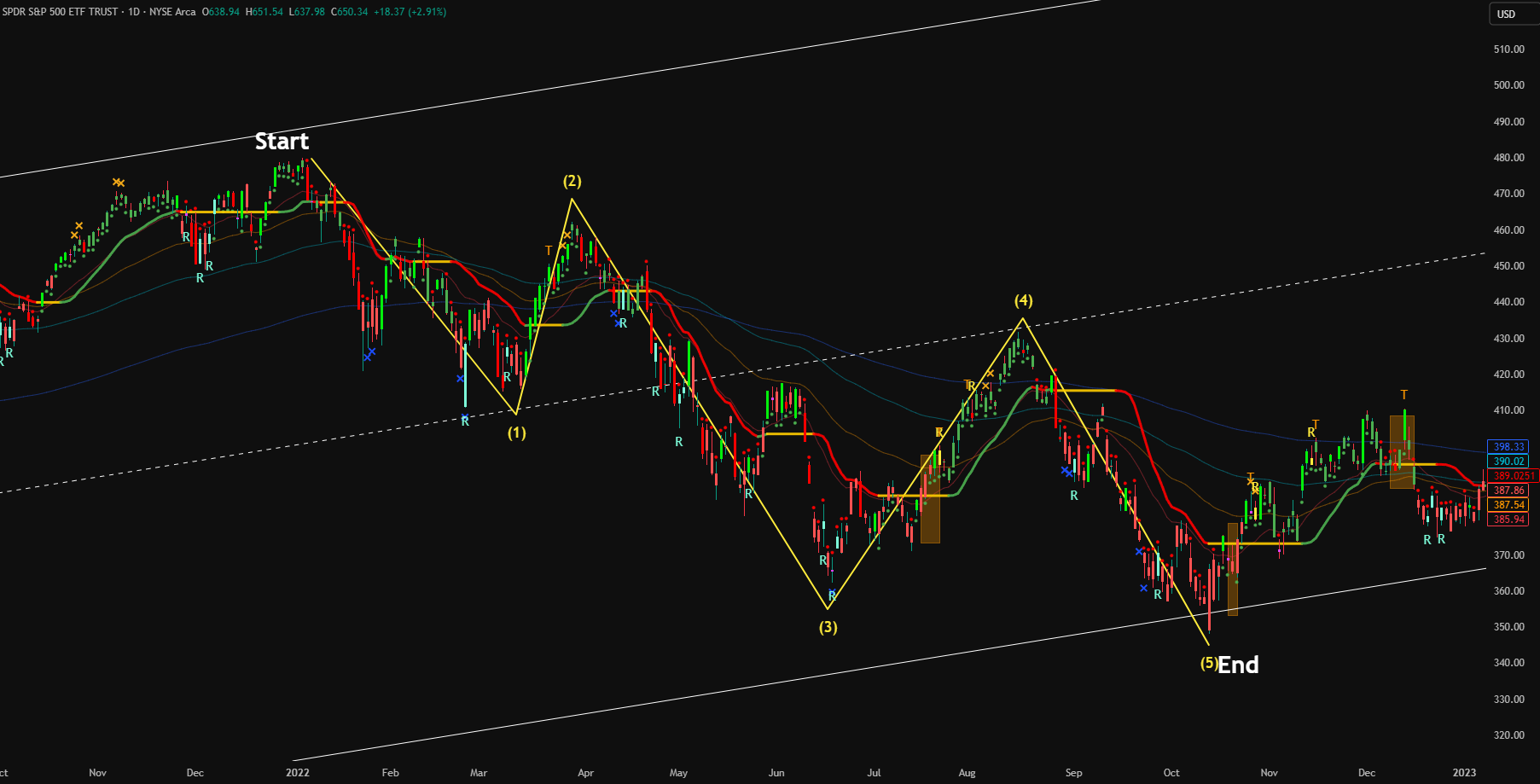
The 2022 drawdown was marked by 5 waves from top to bottom resulting in a (37%) drawdown. Structure rules all and price action is often playing a game of faking out both bulls and bears while it burns off RSI for a continued move down. Watch how price chops through the macro structural channel and fails or changes trend when it has made it above or below the 20,50,100 and 200 EMA’s all together.
Wave 0 -1 (Total drawdown = 16.91%)
a) recovery rally of 8.87% after -12.35% from the first high (Stage 4 + 50 EMA fail)
b) a rally of 7.48%, after -10.42% from the lower high. (Stage 4)
Resulted in 2 separate stage 4 (red line downtrends), and one stage 1 (yellow line) where PA failed within 1 day after making it over the CoreX Line (or CXL, dynamic color shifting line) and at the 50 EMA.
Wave 1 -2 (Total uptrend = 11. 24%)
a) after 0–1’s -16.91% drawdown, a 11 days up, 1 day down occured for a (11.45%) move. Which started from red dot to neutral.
Price moved over the CXL so quickly by the time the CXL turned green it marked the start of the next wave. Price bottomed at major channel midline.
Wave 2–3 (Total drawdown = 27%)
a) a 6% rally after -12.4% down while holding the stage 4 downtrend.
b) a 6% rally after -9.5% down while holding the stage 4 downtrend.
c) a 9.7% rally after a -6.8% downtrend breaking the CXL into a basing that fails at basing and 50 EMA again.
Resulted in 2 stage 4’s, with a stage 1 basing in the middle that failed but made it above the CXL for a short time.
Wave 3–4 (Total uptrend = 19.26%)
a) a rally of 8.48% % after the previous waves almost straight drop of -15.4%
b) 7–8% rallies were followed by dips of 5,3,2% dips got smaller as it reached closer to the peak.
Price action moved more evenly through its stage 1 basing stage and had a more prolonged stage 2. It did this by creating a double top, then double bottom. Price topped out at the midline of the major channel. They also had controlled selloffs that tested EMA’S like a staircase on the way up.
Stage 4–5 (Total drawdown = 24%)
a) a -10.1% drawdown followed by 5.9% recovery.
b) a -13.3% drawdown followed by 6.4% recovery.
c) one final drawdown of- 8.2% to mark bottom.
One stage 4 marked by a swift move down to the bottom of the channel.
Summary
Looking at the waves up from a macro view we consistently retrace 65% — 70% upwards from prior drawdown. Rallies with weak basing / accumulation structures (our 9–10%) failed basing. I.E. they could not move to stage 2 (green line) or price moved to stage 2 too quickly (over our yellow line) it resulted in a shorter rally.
Rallies with good basing structures (15 -20%) had a double bottom and controlled moves into stage 2. Meaning they had a controlled accumulation phase. They also had controlled selloffs that tested EMA’S like a staircase on the way up.
Rule of thumb:
6–8% = “failure band” for stage 4 bull rallies that don’t shift
9–10% = only zone where bull rallies attempted structural shift, but failed
15–20% = proper bull basing structures with “sustained” rallies
14–16% = repeated bear exhaustion zone where reactions always occurred
Finally, when we look at the wave characteristics we are getting two sets of stage 4’s, both in waves 0–1 and 2–3, these earlier waves with short and failed relief rallies.
In the 3-4 wave, we get a more sustained rally however it is followed by one stage 4 in wave 4–5. Almost like a structure that’s meant to slowly kill optimism until a flush of the market happens basically saying ok we don’t even care to trick you anymore, I want to kill all hope. Ironically, around the same time the mind game is coming to an end. It kind of mimics the 5 stages of grief.
Wave 0: Is the expected pullback.
Wave 1: Is the generational entry that you FOMO into as its moving up.
Wave 2: Rips to the worst case scenario as it fakes out at resistance and breaks support teasing relief with every swing, then drops further making you beg for it to stop. You sell.
Wave 3: Rubs it in you face. Your more patient this time, but it keeps going up. You buy a smaller position and it goes up. You buy more, this is the one to recover losses and more.
Wave 4: Breaks you and makes you take a step away. You would rather have your sanity than money.
Wave 5: Is the entry you wanted all this time.
Now try to inverse those feelings :)