Why Single-Jurisdiction Mining Operators Risk Losing 40% of Their Hashrate
Storm Fernan, the Kazakh blackout, and the math of distributed bitcoin infrastructure
 CRYPTON s.r.o.7 min read·Just now
--
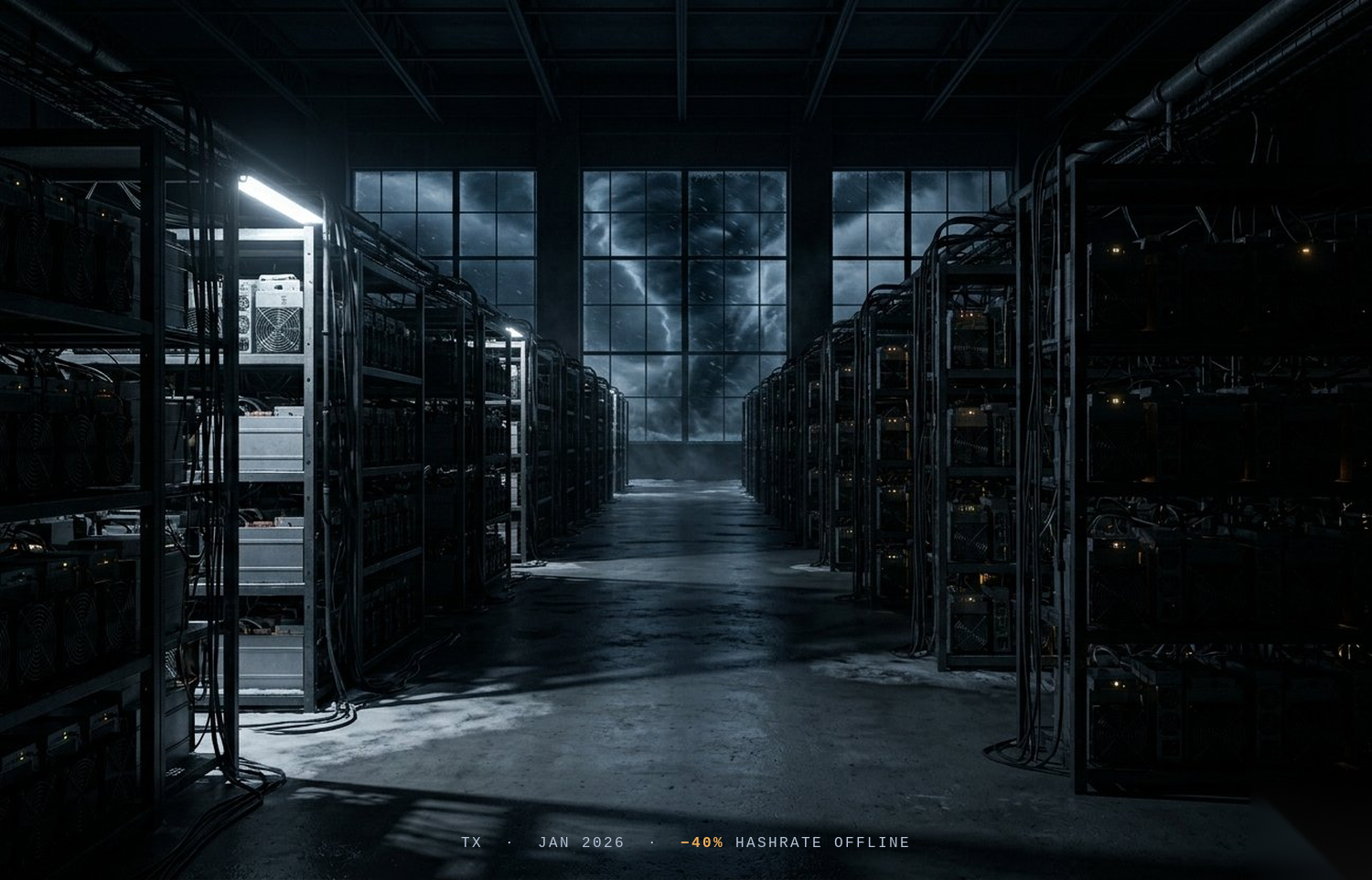
Winter storm Fernan hit the United States in late January 2026. Within three days, global Bitcoin hashrate dropped 40%. Roughly 455 EH/s went offline. Block times stretched to 12 minutes. Foundry USA, the largest mining pool in the country, saw its pool hashrate collapse by approximately 60%.
Texas is not an authoritarian regime. It is widely considered the most mining-friendly jurisdiction on Earth. Yet one weather event turned profitable operations into dead machines — and operators with 100% of their capacity in the US watched mining revenue collapse with no offsetting income.
The question worth asking is not whether this will happen again. It will. The question is whether your infrastructure is built to absorb it.
The Concentration Problem Did Not End with China
When Beijing banned mining in 2021, the industry exhaled. Hashrate migrated to the United States — a country with rule of law, a stable grid, and a federal structure that seemed to make a blanket ban impossible. By late 2024, the US controlled over 40% of global hashrate. The Cambridge Centre for Alternative Finance reported in 2025 that approximately 75% of all reported hashrate was concentrated in a single country.
That ratio is uncomfortably close to what China held in 2019 — between 65% and 75% — before one government decree wiped out the industry overnight.
Cambridge’s researchers flag the risk directly: when a single jurisdiction controls a majority of hashrate, it compromises the neutrality of the Bitcoin network and opens the door to transaction censorship. Investors tend to equate political stability with operational safety. Storm Fernan exposed the limits of that assumption. A grid emergency or a peak-demand crisis does not care about the quality of your legal system. Geographic diversification protects against any scenario in which a single jurisdiction loses capacity — regulatory, climatic, or infrastructural.
Before deploying hardware, evaluate not just a country’s political climate but its share of global hashrate and the resilience of its energy grid under extreme load.
Three Cases, Three Causes, One Mechanism
Kazakhstan, Texas, and Iran. Different triggers. Same structural vulnerability: concentration in a single point converts a local disruption into a portfolio-level event.
Kazakhstan. By October 2021, the country held roughly 18% of global hashrate at 1,500 MW — the world’s second-largest mining hub. Three months later, a nationwide internet blackout during political unrest severed a significant portion of global capacity within hours. Operators whose machines sat exclusively in Kazakh data centers were cut off with no alternative. By 2024, Kazakhstan’s share had fallen below 5%. Regulators tightened requirements. Operators who had not relocated beforehand absorbed losses before they could diversify.
Texas. January 2026. Storm Fernan triggered curtailment programs across ERCOT. Approximately 4 GW of mining capacity went offline. Global hashrate dropped 40% in three days. Recovery took several days, but the cost was immediate: operators with 100% of their machines in one state earned nothing. Riot Platforms, which had structured curtailment into its business model through power credits, monetized the event for tens of millions of dollars. For everyone else without those contracts, curtailment meant zero revenue.
Iran. Across 2024 and 2025, the country experienced its worst heat waves in decades and systemic power outages. Illegal mining operations were estimated to draw substantial unauthorized loads from the grid — by some accounts on the order of two gigawatts during peak periods — contributing materially to the national energy deficit. The government escalated enforcement systematically: machines confiscated, operations shut down. Iran’s share of global hashrate fell to negligible levels. Recovery is unlikely.
Each of these events could have been mitigated by distributing capacity across multiple jurisdictions. If your infrastructure is concentrated in one country, you carry regulatory, energy, and natural disaster risk simultaneously.
The Math Behind Distributed Operations
The arithmetic is straightforward. With 100% of capacity in a single jurisdiction, a 30-day outage means 100% revenue loss for that month. Spread capacity equally across three countries and the same outage costs you 33%. The remaining 67% keeps producing.
Real operators already work this way. Cango Inc. places significant hashrate outside the US, including sites in East Africa, Oman, and Paraguay. When North American capacity faces curtailment or energy price spikes, machines in other regions continue hashing. Phoenix Group runs a large-scale portfolio across the US, Canada, Oman, Ethiopia, and the UAE. In Ethiopia, up to 90% of energy comes from renewable hydroelectric generation, eliminating exposure to fossil fuel price volatility entirely.
Different jurisdictions also mean different energy systems. Hydropower in Ethiopia and Paraguay. Solar and gas in Oman. The traditional grid in the US. A natural disaster or infrastructure failure at one site physically cannot affect the others. The more jurisdictions and energy grids in a portfolio, the lower the probability of simultaneous downtime across all sites.
A common objection: diversification increases operational complexity and compresses margins. The data suggests the opposite. Operators with distributed assets gain access to some of the cheapest energy on the planet. Paraguay offers rates around $30–40 per MWh. Ethiopia delivers roughly 3–4 cents per kWh on renewable hydro. Diversification is not just a risk play — it is an economics play.
Why Ethiopia and Paraguay Are in the Spotlight
Effective diversification requires more than placing machines in different countries. Three criteria separate strategic diversification from scattered deployment: stable access to competitively priced energy, legal clarity regarding mining operations, and low correlation of political risks with other sites in the portfolio.
Ethiopia. By the end of 2024, the country had emerged as one of the largest new mining centers globally, holding an estimated 2–2.5% of global hashrate. International miners have committed hundreds of millions of dollars in investment. The advantage is structural: surplus hydroelectric power from the Grand Ethiopian Renaissance Dam and low per-kilowatt-hour costs. BIT Mining closed the first phase of a 51 MW data center acquisition in December 2024 for $14.28 million — a clear signal of institutional confidence.
Paraguay. Energy rates around $30–40 per MWh with nearly 100% hydroelectric generation. One of the most cost-effective mining jurisdictions on the planet. A stable grid, no dependence on fossil fuels, and low correlation with other major hubs. Cambridge’s 2025 report places Paraguay among the emerging secondary hubs alongside the UAE, Norway, and Bhutan.
The selection principle is clear: miners distribute hashrate across jurisdictions, but they prioritize locations where favorable business conditions, cheap energy, and predictable regulation converge. Iran offered cheap energy too — but the absence of legal certainty led to mass confiscations. When evaluating a jurisdiction, assess not just the tariff but the share of renewable energy, the track record of regulatory decisions, and the risk correlation with your existing sites.
How CRYPTON Makes Diversification Accessible Without Institutional Minimums
Most institutional mining operators require a minimum ticket of $1 million and contracts spanning three or more years. Geographic diversification on those terms remains a privilege of large capital. CRYPTON addresses this gap through an asset-light model.
The company does not build its own data centers. It deploys equipment — both proprietary and client-owned — at Tier-1 partner facilities (Hut 8, Phoenix, Blockstream Mining, BitDeer, DMG, Green Data City) across three countries: Ethiopia, Oman, and Argentina. A client with a ticket from €5k to €500k+ receives contracted energy rates and SLA hosting, preferential terms at major mining pools, and full turnkey service: equipment sourcing, logistics, installation, monitoring, maintenance, and monthly reports with line-item detail covering revenue, energy costs, pool fees, uptime, and payouts.
The practical result: when a client deploys an ASIC fleet through CRYPTON, machines can be distributed across three sites. A regulatory shift or energy crisis in one country affects only a portion of capacity — the rest continues operating. The same risk-reduction logic that Cango Inc. and Phoenix Group employ at scale, available without the need to independently negotiate contracts with data centers on three continents.
If you are evaluating hashrate as an asset class, look for an operator with active sites in at least three countries, transparent reporting, and turnkey deployment. That is the only way to achieve diversification without committing your own capital expenditure to infrastructure.
Storm Fernan lasted a few days. The grid recovered. Machines restarted. But the difference between operators who lost 100% of revenue during those days and those who lost 30% was not determined during the storm. It was determined months earlier, when some placed all capacity in a single state and others distributed it across North America, Ethiopia, and Argentina.
Kazakh operators who controlled a significant share of global hashrate in 2021 had lost their businesses by 2024. Those who distributed assets before the crisis continued to scale. The gap between these two outcomes amounts to roughly 40% lower operational risk when a portfolio spans three independent jurisdictions versus concentration in one. This is not insurance against an unlikely event. It is the baseline architecture of a business in which a single jurisdiction can erase in hours what took years to build.
Start by auditing the geographic structure of your mining assets. If all capacity sits in one country, reach out to CRYPTON for an assessment of how a three-jurisdiction allocation would change your risk profile.