Why Should You Use a Concrete Vault?
 Basma5 min read·1 hour ago
--
DeFi was supposed to make finance more open and efficient.
Instead, for many users, it became a full-time job.
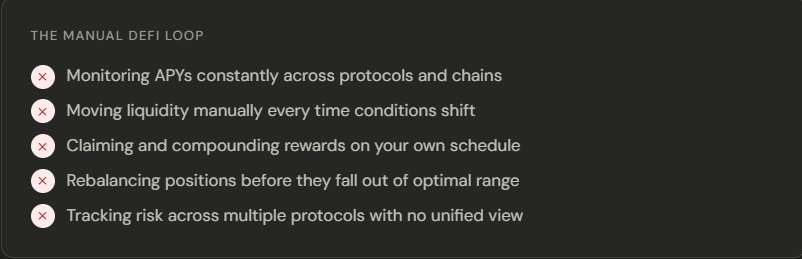
To stay competitive onchain today, users often need to:
- monitor APYs constantly
- move liquidity between protocols
- claim and compound rewards manually
- rebalance positions repeatedly
- track changing risks across multiple platforms
What started as permissionless finance slowly evolved into a fragmented environment where users spend more time managing positions than actually benefiting from them.
Every new opportunity creates another layer of operational complexity.
And the more complex DeFi becomes, the harder it is for manual strategy management to scale.
This is exactly why vault infrastructure matters.
Vaults simplify the DeFi experience by turning constant repositioning into coordinated capital deployment.
Instead of manually chasing opportunities across protocols all day, users can deposit into structured systems designed to manage that complexity for them.
That is the role Concrete Vaults are built to play.
The Problem With Manual DeFi Management
Most DeFi users eventually encounter the same problem:
Managing capital manually becomes inefficient.
A typical yield strategy today may require users to:
- bridge assets across chains
- monitor multiple dashboards
- rebalance liquidity positions
- claim rewards frequently
- swap tokens to maintain exposure
- redeploy idle capital continuously
Even experienced users struggle to optimize positions consistently because markets move quickly and opportunities change constantly.
The result is often:
- missed opportunities
- inefficient capital deployment
- unclaimed rewards
- idle assets
- inconsistent returns
- increased operational risk
In practice, manual management introduces friction into what should be an efficient financial system.
And as DeFi infrastructure grows more advanced, the complexity only increases.
The issue is no longer access to opportunities.
It is coordination.
What a Concrete Vault Does
Concrete Vaults are designed to simplify how users participate in DeFi.
At a high level, vaults allow users to deposit assets into structured systems that coordinate strategies automatically.
Instead of individually managing every position, users gain exposure to an optimized framework built to handle ongoing execution.
Concrete Vaults help users:
- pool capital together
- automate compounding
- deploy across strategies
- optimize positions over time
- reduce operational complexity
This changes the user experience entirely.
Rather than manually repositioning capital every few hours or days, vault infrastructure handles the operational layer behind the scenes.
The goal is not simply automation for convenience.
The goal is more efficient onchain capital deployment.
Why Vault Infrastructure Matters
As DeFi becomes more competitive, infrastructure becomes increasingly important.
The protocols attracting long-term capital are no longer just offering yield.
They are offering coordination.
This is where DeFi vaults provide a major advantage.
Automation
One of the biggest benefits of vault systems is automated compounding.
Instead of users manually claiming and redeploying rewards, vault infrastructure can optimize this process continuously.
This reduces friction while improving consistency.
Capital Efficiency
Idle capital is one of the biggest inefficiencies in DeFi.
When users manage positions manually, assets often sit inactive between transactions or strategy adjustments.
Concrete Vaults help coordinate capital more efficiently by keeping deployment systems active and structured around opportunity optimization.
Simplified User Experience
Most users do not want to spend hours every day monitoring APYs and repositioning liquidity.
Vault infrastructure simplifies participation by abstracting away much of the operational complexity.
This creates a more accessible and scalable model for structured DeFi participation.
Continuous Optimization
Markets change constantly.
Strategies that perform well today may become inefficient tomorrow.
Vault systems can continuously rebalance and optimize positions as conditions evolve, helping users maintain exposure to changing opportunities without manually managing every adjustment.
The result is a more efficient relationship between users and onchain yield generation.
Vaults Are More Than “Yield Wrappers”
A common misconception is that vaults are simply passive containers for farming rewards.
In reality, advanced vault systems operate more like coordinated infrastructure layers.
Concrete Vaults are designed to:
- coordinate capital deployment
- rebalance positions dynamically
- enforce strategy constraints
- adapt to changing market conditions
- structure risk management processes
This creates a more disciplined framework for participating in DeFi.
The difference matters because modern DeFi is no longer simple enough for static systems.
Real infrastructure must be able to respond to market changes while maintaining structured execution.
That requires more than basic automation.
It requires coordinated architecture.
How Concrete Vaults Coordinate Capital
Concrete approaches vault infrastructure with a focus on structured execution, capital efficiency, and scalable coordination.
Concrete Vaults are built to optimize how capital moves across onchain opportunities while reducing operational complexity for users.
ctAssets
One of the core components of the ecosystem is ctAssets.
These assets help structure exposure within the Concrete ecosystem while enabling more efficient coordination of onchain capital deployment.
Rather than forcing users to manually manage fragmented positions, ctAssets create a more unified framework for structured participation.
Automated Compounding
Concrete Vaults integrate automated compounding systems that continuously optimize reward deployment.
This reduces the need for manual intervention while improving capital utilization over time.
Users no longer need to constantly claim and redeploy rewards themselves.
Onchain Execution
Execution matters in modern DeFi.
Concrete Vaults are designed around onchain execution systems that coordinate strategies transparently and efficiently.
This allows vault infrastructure to maintain structured deployment while adapting to evolving market conditions.
Structured Vault Systems
Concrete focuses on building structured DeFi systems rather than isolated yield products.
The architecture prioritizes:
- coordinated execution
- operational efficiency
- scalable capital deployment
- structured exposure to opportunities
This approach aligns with the broader evolution of institutional DeFi infrastructure.
As the market matures, capital increasingly flows toward systems designed for reliability, efficiency, and operational coordination.
The Bigger Shift in DeFi
DeFi is becoming more sophisticated every year.
New protocols, new chains, new yield mechanisms, and increasingly complex liquidity systems continue to emerge rapidly.
But manual strategy management does not scale alongside that complexity.
The future of DeFi will likely not belong to users endlessly clicking between protocols trying to optimize positions manually.
It will belong to infrastructure designed to coordinate capital intelligently.
This is why DeFi vaults are becoming increasingly important.
They reduce operational friction.
They improve capital efficiency.
They simplify structured participation.
And they allow users to interact with onchain opportunities through coordinated systems rather than constant manual execution.
Concrete Vaults represent this broader shift toward structured DeFi infrastructure.
You can explore Concrete at https://concrete.xyz/ 🚨
Because the next phase of DeFi is not just about access to yield.
It is about building systems that deploy capital more efficiently than humans can manage manually.