Why Should You Use a Concrete Vault?
--
Most DeFi users don’t realize it at first.
They think the hard part is finding yield.
It’s not.
The hard part is keeping up with it.
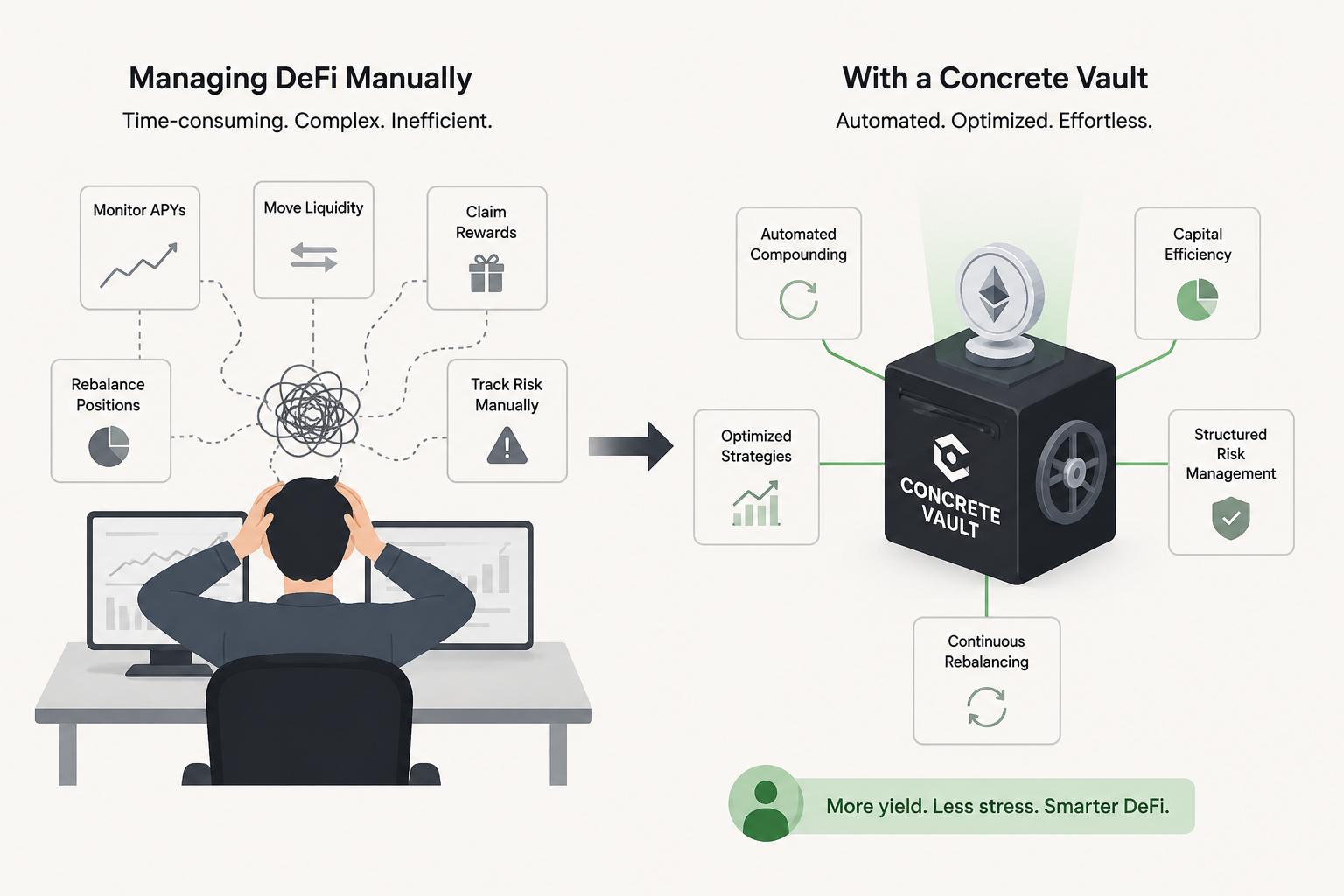
One day the best APY is on one protocol. The next day liquidity moves somewhere else. Rewards need to be claimed, positions need rebalancing, risks need monitoring, and suddenly DeFi starts feeling less like passive income and more like a full time trading desk that never sleeps.
For many users, the experience becomes exhausting.
And that is exactly why vault infrastructure matters.
The Problem With Managing Everything Manually
DeFi rewards attention.
The users who constantly monitor markets, reposition liquidity, optimize rewards, and react quickly often outperform everyone else. But that level of active management comes with a cost.
Time.
Mental energy.
Operational complexity.
To stay competitive, users often find themselves jumping between protocols all day, checking yields every few hours, and trying to avoid being left behind by changing market conditions. Even experienced users struggle to keep positions optimized consistently.
The result is friction everywhere.
Idle capital sits unused. Rewards remain unclaimed. Opportunities are missed while users are still moving funds manually from one place to another.
Instead of feeling efficient, DeFi starts to feel like running on a treadmill that keeps speeding up.
That is where DeFi vaults change the game.
What a Concrete Vault Actually Does
At its core, a Concrete Vault is designed to simplify how capital is deployed onchain.
Instead of every user managing strategies manually, capital is pooled into a structured system that continuously works in the background.
Concrete Vaults help users:
Pool capital efficiently across strategies.
Automate compounding without constant manual interaction.
Optimize positions over time as conditions change.
Reduce operational overhead that normally comes with active DeFi participation.
The experience becomes less about chasing every opportunity yourself and more about gaining exposure to an infrastructure designed to coordinate those opportunities intelligently.
It feels less like manually steering a ship through a storm and more like being on a system built to navigate changing conditions for you.
Why Vault Infrastructure Matters
As DeFi grows, complexity grows with it.
More protocols.
More chains.
More liquidity layers.
More strategies competing for capital.
At a certain point, manually managing everything simply stops scaling.
Vault infrastructure exists because modern DeFi requires coordination. Users should not need to spend hours every day micromanaging positions just to remain efficient.
This is where structured DeFi becomes important.
Vaults create a framework where capital can stay productive continuously rather than sitting idle between decisions. Automated compounding improves consistency over time, while continuous optimization helps maintain efficient exposure across opportunities.
The biggest advantage is not just convenience.
It is efficiency.
Good vault infrastructure turns scattered capital into coordinated capital.
And coordinated capital performs differently.
More Than Just a Yield Wrapper
A common misconception is that vaults are simply tools that auto compound rewards.
But sophisticated vault systems do much more than that.
Concrete Vaults are designed with structure in mind. They coordinate onchain capital deployment across strategies while enforcing constraints that help maintain consistency and control.
The system is not just passively collecting yield. It is actively managing positioning logic within predefined frameworks.
That includes:
Rebalancing positions when conditions shift.
Coordinating liquidity deployment.
Maintaining strategy parameters.
Responding to changes across markets and protocols.
This creates a far more organized approach to participating in DeFi compared to manually managing fragmented positions across multiple platforms.
In many ways, it transforms DeFi from a chaotic collection of individual actions into a coordinated financial system.
How Concrete Vaults Are Built Differently
Concrete approaches vault architecture with a focus on efficiency, automation, and structured execution.
Its ecosystem combines automated compounding, onchain execution, and structured vault systems into a framework designed for scalable capital coordination.
One important part of this architecture is ctAssets.
Rather than treating positions as isolated pieces scattered across protocols, ctAssets help structure exposure in a way that improves how capital moves and compounds across opportunities.
Combined with automated execution, this allows Concrete Vaults to continuously optimize positions while reducing the operational burden placed on users.
The infrastructure works quietly in the background, almost like a portfolio engine that never sleeps, constantly coordinating capital movement, yield generation, and position management without requiring users to manually adjust every step themselves.
That matters because the future of institutional DeFi will depend heavily on systems that can manage capital efficiently at scale.
Not emotionally.
Not reactively.
Systematically.
Explore Concrete at https://concrete.xyz/
The Future of DeFi Will Be Infrastructure Driven
DeFi is evolving fast.
What once felt manageable for individuals is becoming increasingly complex even for experienced participants. The idea of manually moving between protocols all day, constantly optimizing positions by hand, simply does not scale long term.
Infrastructure is beginning to replace constant repositioning.
And DeFi vaults are becoming the new interface between users and onchain opportunities.
The next generation of users may not spend their days endlessly clicking through dashboards and chasing every new yield spike. Instead, they will rely on systems designed to coordinate capital more efficiently than any individual possibly could.
That shift is already happening.
And platforms like Concrete are helping define what that future looks like.