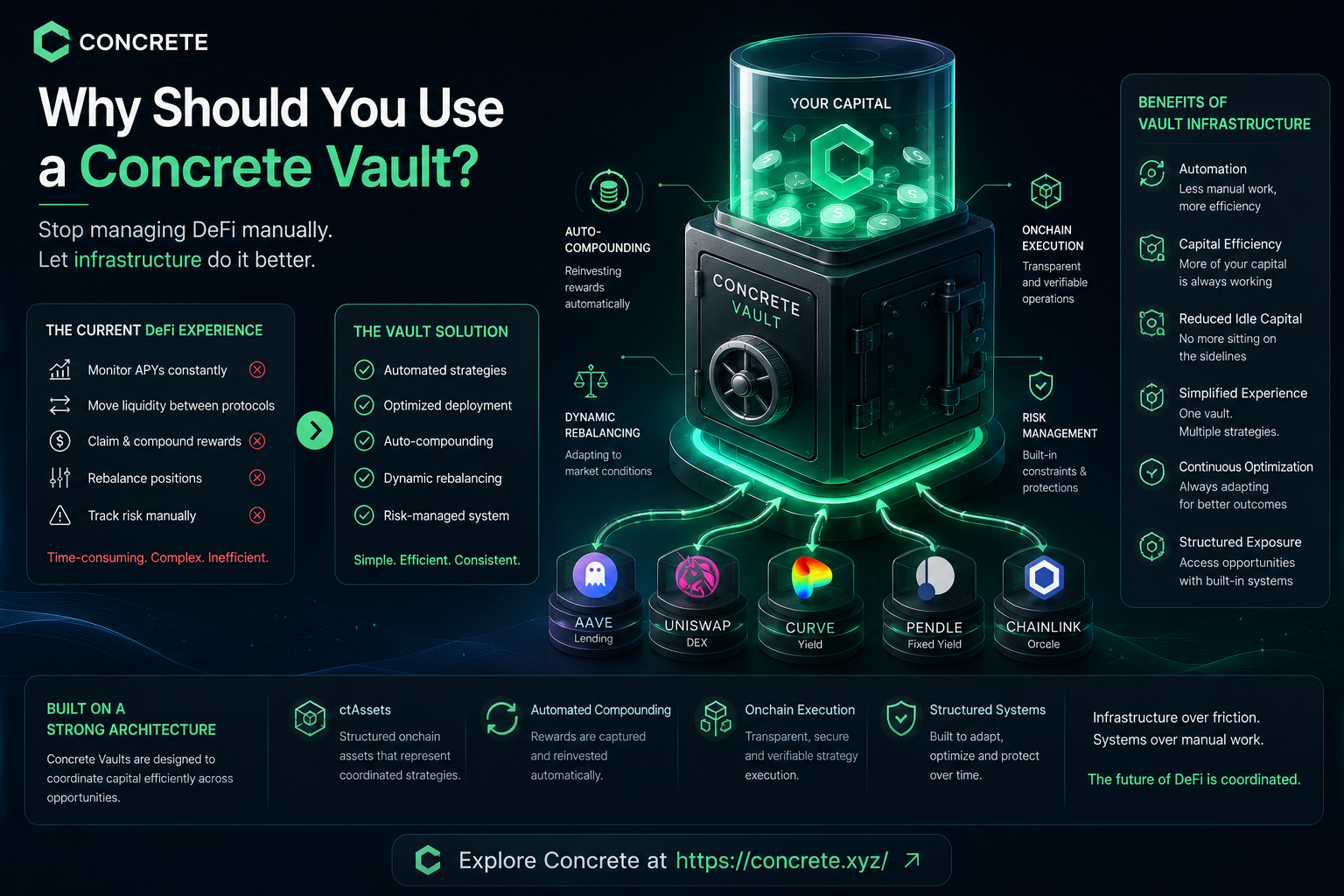
Why Should You Use a Concrete Vault?.
--
DeFi created a world where anyone can deploy capital onchain. But participating efficiently is another story entirely. For most users, staying competitive in DeFi means constantly managing positions across protocols, tracking changing yields, and reacting to market conditions in real time. The opportunity is open to everyone, the complexity is too.
So the question becomes:
Why manage everything manually when infrastructure can do it for you?
This is the role of Concrete Vaults.
---
The Reality of the Current DeFi Experience.
Modern DeFi moves fast. To remain competitive, users often need to:
- Monitor APYs constantly
- Move liquidity between protocols
- Claim and compound rewards manually
- Rebalance positions across markets
- Track changing risks in real time
What begins as “permissionless finance” quickly turns into a full-time operational process. And over time, this creates friction. Capital sits idle while users decide where to deploy it, Rewards go uncompounded. Execution becomes inconsistent. Strategies degrade without active management.
The result?
Inefficiency.
This is exactly the problem DeFi vaults were designed to solve.
---
What a Concrete Vault Actually Does.
At a high level, a Concrete Vault acts as a structured system for managing onchain capital deployment.
Instead of every user manually optimizing positions individually, vaults coordinate capital more efficiently at the system level.
Concrete Vaults help users:
- Pool capital together
- Automate compounding
- Deploy liquidity across strategies
- Optimize positions over time
- Reduce operational complexity
Rather than manually repositioning assets every few hours or days, users gain exposure to a continuously managed framework.
This changes the DeFi experience from:
- Reactive management
➡️ to - Structured participation
---
Why Vault Infrastructure Matters.
As DeFi grows, infrastructure becomes increasingly important. Not because users want fewer opportunities,But because managing opportunities manually does not scale. This is where vault infrastructure creates real value.
___
Automation.
One of the biggest advantages of vault systems is automated compounding. Instead of manually harvesting and redeploying rewards, the vault continuously reinvests capital automatically. This improves efficiency while reducing user overhead.
---
Capital Efficiency.
In manual DeFi, idle capital is common. Funds sit unused while users:
- Evaluate strategies
- Bridge assets
- Wait for better conditions
Vaults reduce this inefficiency by coordinating deployment continuously. The result is improved capital efficiency across the system.
---
Simplified User Experience.
Most users do not want to monitor markets 24/7. They want exposure to opportunities without managing every operational detail themselves. This is one of the most important evolutions in structured DeFi. The abstraction of complexity, Vaults simplify participation while maintaining exposure to onchain strategies.
---
Continuous Optimization.
Markets change constantly, Yield sources evolve.
Liquidity shifts. Volatility expands and contracts.
Vault infrastructure allows strategies to adapt over time instead of remaining static. This creates a more consistent approach to participating in DeFi markets.
---
Vaults Are More Than Yield Wrappers.
A common misconception is that vaults simply “package yield”. In reality, advanced vault systems are operational infrastructure. Concrete Vaults include systems designed to:
- Coordinate capital deployment
- Rebalance positions dynamically
- Enforce strategy constraints
- Respond to changing market conditions
This creates a more structured and resilient framework for managing capital onchain. The goal is not just maximizing APY. It is improving consistency, coordination, and execution quality over time.
---
How Concrete Vault Architecture Works.
This is where Concrete Vaults take a different approach. The architecture is designed around efficient coordination of onchain capital rather than isolated yield farming opportunities.
Core components include:
- ctAssets.
ctAssets function as structured representations of deployed capital within the vault ecosystem. Rather than interacting with fragmented positions manually, users gain exposure through a coordinated asset framework. This improves operational efficiency while simplifying portfolio management.
- Automated Compounding
Concrete Vaults continuously optimize yield generation through automated compounding mechanisms. Rewards are redeployed systematically, helping maintain productive capital exposure without requiring constant user interaction.
- Onchain Execution
Vault operations are coordinated through transparent onchain execution systems.
This enables:
- Verifiable strategy management
- Structured deployment logic
- Efficient capital coordination across opportunities
The result is infrastructure designed not just for accessibility but for scale.
- Structured Vault Systems.
Unlike fragmented manual strategies, Concrete Vaults operate through structured systems that prioritize:
- coordination
- efficiency
- adaptability
- operational consistency
This is what makes vault architecture increasingly important for the future of institutional DeFi.
- The Bigger Shift Happening in DeFi
DeFi is becoming more sophisticated. As strategies grow more complex, manual management becomes harder to sustain. Users are beginning to realize that:
- constant repositioning is inefficient
- fragmented execution creates friction
- infrastructure scales better than manual coordination
This is why vaults are increasingly becoming the default interface for deploying capital onchain. Not because users want less control, But because systems can coordinate capital more efficiently than individuals operating alone. The future of DeFi may not belong to the users clicking between protocols all day. It may belong to the infrastructure built to manage capital intelligently at scale.
And that is exactly where Concrete Vaults fit in.
🚨 Explore Concrete: https://concrete.xyz/ 🚨