Why Should You Use a Concrete Vault?
 goxai6 min read·Just now
--
Managing DeFi manually is exhausting. There’s a better way.
If you’ve spent any serious time in DeFi, you know the drill.
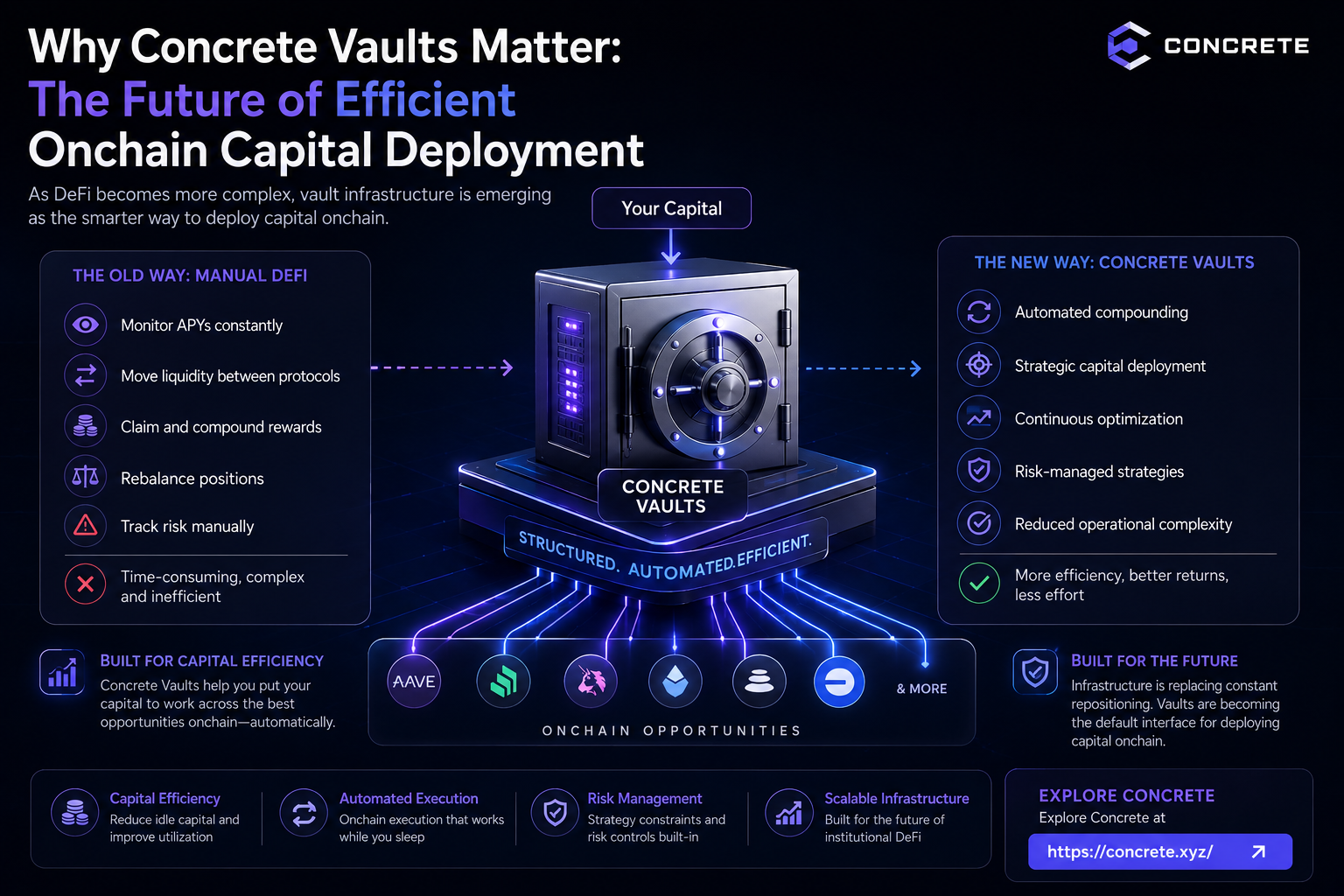
You find a good opportunity. You move your capital in. A week later, the APY has dropped. Something better has opened up somewhere else. So you claim your rewards, pay the gas, bridge to another chain, find the new pool, and deploy again. Then you do it all over again next week.
It works technically. But it’s a part-time job. And most people either don’t have the time to do it well, or they burn out trying.
This is the unglamorous reality of manual DeFi participation. The opportunity is real. The friction is also real. And over time, that friction quietly erodes a significant portion of the returns you’re working so hard to capture. Concrete Vaults are built to solve exactly this.
What’s Actually Happening When You Manage Manually
Let’s be specific about the problem, because it’s easy to underestimate. Staying competitive in DeFi requires constant attention. APYs shift daily sometimes hourly. A yield that looked attractive on Monday might be half that by Friday as more capital piles in and compresses the rate. Staying ahead of that means monitoring multiple protocols across multiple chains, all the time.
Then there’s the operational side. Claiming rewards costs gas. Moving liquidity costs gas. Rebalancing costs gas. Each individual transaction is manageable, but they add up both in fees and in the mental overhead of tracking when each action makes economic sense to execute.
And compounding. The power of compounding is real, but only if you actually do it consistently. Miss a few days, and the math works against you. Do it too aggressively, and gas fees eat more than the compounding earns.
Most people end up somewhere in the middle compounding occasionally, rebalancing when they remember, missing windows they didn’t know were open. The result is a return that’s lower than the headline APY suggested, achieved through more effort than anyone advertised.
There has to be a better structure than this.
What a Concrete Vault Actually Does
A Concrete Vault doesn’t just hold your capital. It coordinates it. When you deposit into a Concrete Vault, your funds join a pooled system designed to do everything you’d do manually but continuously, automatically, and at a scale that makes each action more economical than it would be on your own.
Compounding happens without you. The vault reinvests rewards on an ongoing basis, capturing the full benefit of compounding without requiring you to time transactions or pay individual gas fees for each claim. Across a large pool, these costs are shared and optimised in ways a solo user simply cannot replicate.
Capital is deployed across strategies not parked in a single pool hoping it stays competitive. The vault allocates across opportunities based on defined rules, shifting positions when the math favours a move and holding when stability serves the return better.
Positions are rebalanced over time as conditions change. The vault doesn’t assume that what works today will work in three months. It adjusts.
And through all of this, the user experience is simple: you deposit, you receive ctAssets representing your share of the vault, and you watch your position grow. No dashboards to monitor obsessively. No gas fees to calculate. No windows to miss.
ctAssets, Your Stake in the System
When you deposit into a Concrete Vault, you receive ctAssets in return. These are onchain representations of your ownership in the vault, your claim on the capital, the yield it generates, and the compounding that accumulates over time.
Think of them as your seat at the table. The vault is working continuously with the pooled capital. Your ctAssets reflect your proportional share of everything the vault produces. As the vault compounds rewards and optimises positions, the value represented by your ctAssets grows without you needing to do anything.
This is a clean, efficient structure for onchain capital deployment. You’re not holding a static token waiting for a reward. You hold a dynamic position in an actively managed system that compounds in real time.
It also makes participation portable. Your ctAssets represent your position, which means you can track your exposure clearly without needing to reconcile activity across multiple protocols and chains manually.
Vaults Are Not Just Yield Wrappers
Here’s a misconception worth addressing directly: Concrete Vaults are not simply a layer on top of existing protocols that routes deposits and calls it a day.
The architecture is more considered than that. Capital deployment is coordinated through structured systems the Allocator routes funds to strategies within a governed universe, not wherever the highest APY happens to be at any moment. Strategy constraints are enforced at the infrastructure level, meaning the vault operates within defined risk parameters rather than chasing yield indiscriminately.
The system is designed to respond to changing conditions, not just execute a fixed strategy forever. When market dynamics shift, rebalancing occurs. When a strategy stops meeting the criteria, capital moves. This isn’t passive yield farming, it’s active capital management running automatically beneath the surface.
The result is structured DeFi exposure. You’re not guessing at whether a strategy is sound. The infrastructure has already evaluated it, constrained it, and built in the ability to respond if conditions deteriorate. That’s a fundamentally different risk profile than depositing manually into whatever looks attractive today.
Why Pooling Makes Everyone’s Capital Work Harder
There’s a practical advantage to vaults that often gets overlooked: scale. When capital is pooled, costs are shared. The gas fee for a rebalancing transaction, spread across a large pool, is trivial per participant. The same transaction executed by an individual user might not make economic sense at all and the fee might exceed the benefit.
This changes the math on compounding frequency. A solo user might compound weekly because daily compounding doesn’t justify the gas cost at their capital size. A vault can compound far more frequently because the cost is distributed across the entire pool. More frequent compounding means more efficient growth and the yield works harder because it’s reinvested faster.
It also changes access. Strategies that require minimum capital thresholds, or that only become efficient at scale, are accessible through a vault in ways they aren’t for smaller individual participants. The vault participates on behalf of everyone in it, at an economic scale that most individuals can’t achieve alone.
This is what capital efficiency actually looks like in practice. Not just higher yields smarter deployment of the capital you already have.
The Bigger Picture: Infrastructure Is Replacing Manual Management
DeFi is not getting simpler. The opposite is happening. New chains launch constantly. New protocols emerge weekly. Yield opportunities multiply, fragment across ecosystems, and shift faster than any individual can comfortably track. The surface area of DeFi that a serious participant would need to monitor to stay genuinely competitive is growing faster than the time available to monitor it.
Manual strategy management doesn’t scale with this complexity. It never did, really but in the early days, when DeFi was smaller and slower, it was manageable. Now it isn’t. The gap between what’s theoretically available and what a manual participant can practically capture is widening.
Vault infrastructure is the natural response to this. Instead of asking every participant to become a full-time capital manager, the infrastructure manages capital on their behalf more continuously, more efficiently, and with more consistent discipline than most individuals can sustain.
This isn’t a compromise of DeFi’s principles. It’s what those principles look like applied to a system that has genuinely scaled. Decentralized, onchain, non-custodial all of that remains true. What changes is who does the operational work. The answer, increasingly, is the infrastructure.
Institutional DeFi works this way already. Serious capital doesn’t move manually between protocols chasing daily APY changes. It deploys into structured systems with defined strategies, governed risk parameters, and automated execution. Concrete Vaults bring that same discipline to a broader set of participants.
The Simple Case for Using a Concrete Vault
Strip everything back and the argument is straightforward. If you’re managing DeFi positions manually, you’re spending time and paying costs that a vault handles automatically. You’re compounding less frequently than optimal. You’re missing rebalancing windows you didn’t know existed. You’re operating at a scale where many efficiency gains simply aren’t accessible.
A Concrete Vault changes that. Your capital enters a coordinated system. Compounding happens continuously. Positions are optimised over time. Risk parameters are enforced at the infrastructure level. And your ctAssets give you clean, transparent exposure to everything the vault produces without the operational overhead of producing it yourself.
DeFi’s future won’t belong to the people clicking between protocols all day. It will belong to the systems that coordinate capital better than any individual can and to the participants smart enough to use them.
Explore Concrete at concrete.xyz