Why Should You Use a Concrete Vault?
--
DeFi promised a financial system without intermediaries.
But in practice, participating in DeFi often feels like a full-time job.
Users constantly monitor APYs, move liquidity between protocols, claim rewards, compound yields, rebalance positions, and manage risk manually. One strategy may perform well for a week, then suddenly liquidity shifts elsewhere. Opportunities move fast, and keeping up requires constant attention.
This creates a major problem in modern DeFi:
The ecosystem is growing more powerful, but also more complex.
For many users, managing capital manually becomes inefficient over time. Idle funds, delayed compounding, poor timing, and fragmented positions can reduce overall performance. Instead of focusing on long-term capital growth, users spend hours maintaining positions across multiple protocols.
This is exactly where DeFi vaults become important.
The Role of Concrete Vaults
Concrete� introduces a more structured way to participate in DeFi through Concrete Vaults.
Instead of manually managing every position yourself, vault infrastructure helps coordinate capital automatically.
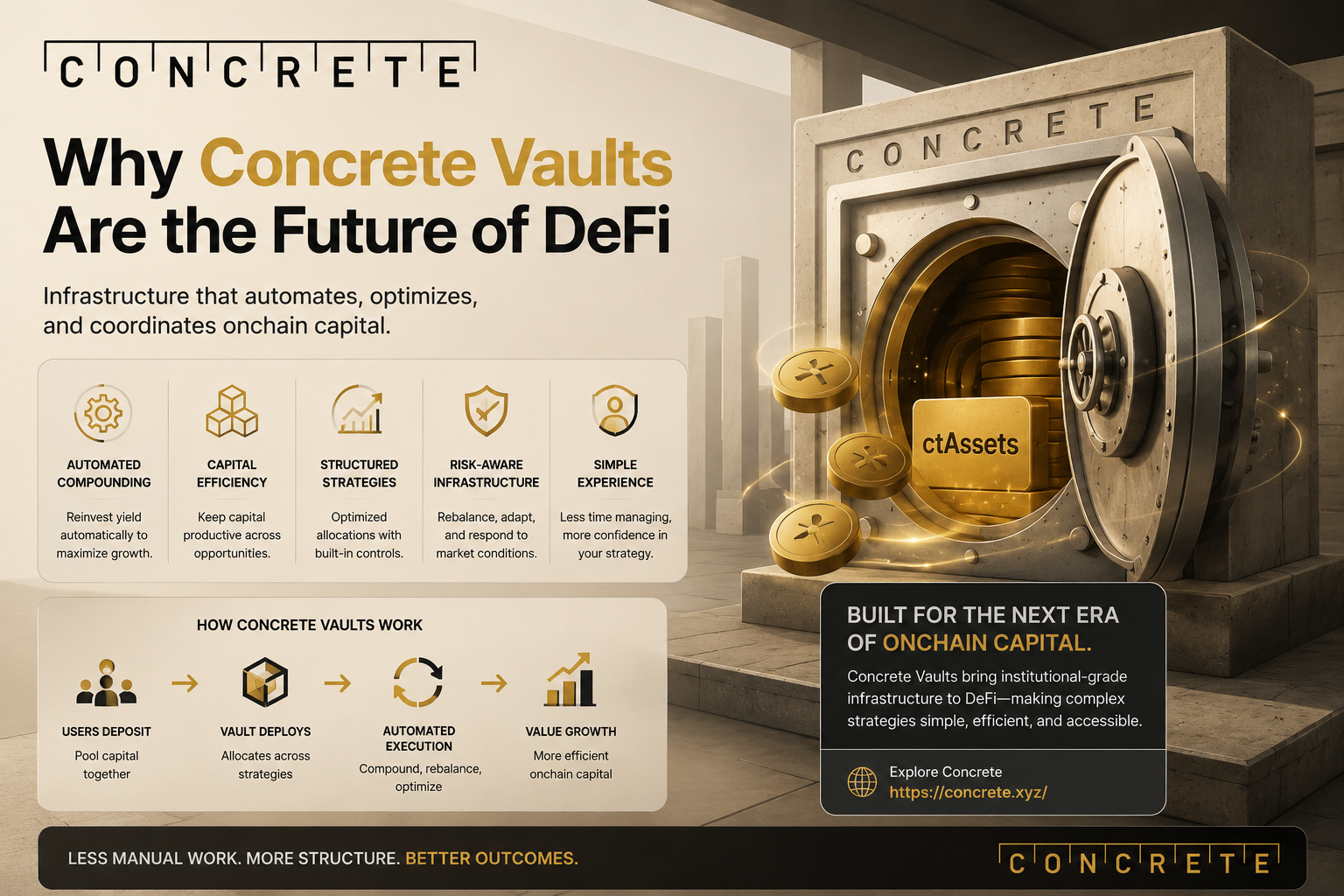
Concrete Vaults are designed to:
pool user capital together
automate compounding
deploy funds across strategies
optimize positions over time
reduce operational complexity
Rather than constantly repositioning between protocols, users gain exposure to a system built to manage these operations efficiently onchain.
This changes the user experience entirely.
Instead of chasing yield manually every day, users can participate through structured DeFi infrastructure designed for continuous optimization.
Why Vault Infrastructure Matters
As DeFi evolves, infrastructure becomes more important than individual transactions.
The biggest advantage of vault systems is automation.
Automation allows strategies to react faster than manual users while reducing the amount of time required to manage positions. Rewards can be compounded automatically, capital can be redeployed efficiently, and idle liquidity can be minimized.
This improves overall capital efficiency.
In traditional manual DeFi participation, funds often sit unused while users decide where to move next. With structured vault systems, capital deployment becomes more coordinated and continuous.
Concrete Vaults also simplify the user experience.
Instead of interacting with multiple protocols separately, users access structured exposure through a single system. This reduces friction while still allowing participation in sophisticated onchain strategies.
The result is a more scalable model for DeFi participation.
More Than Just a Yield Wrapper
Many people think vaults are simply tools for generating passive yield.
But modern vault infrastructure goes much deeper than that.
Concrete Vaults are designed with systems that help coordinate how capital moves across opportunities while enforcing strategy structure and operational discipline.
This includes:
automated rebalancing
strategy constraints
optimized execution
adaptive capital deployment
continuous onchain management
Rather than relying on emotional or reactive decision-making, structured DeFi systems create a framework for more efficient participation.
As DeFi becomes increasingly competitive, this structure matters more.
Concrete Vault Architecture & ctAssets
A key part of the Concrete ecosystem is the integration of ctAssets and automated vault infrastructure.
Through structured onchain capital deployment, Concrete Vaults are designed to coordinate liquidity efficiently while maintaining continuous exposure to yield opportunities.
The architecture focuses on:
automated compounding
efficient onchain execution
structured vault systems
scalable capital coordination
optimized liquidity management
This approach aligns closely with the direction institutional DeFi is moving toward.
Large-scale capital requires systems that can manage complexity efficiently. Manual repositioning does not scale well in an increasingly fragmented DeFi environment.
Vault infrastructure helps solve this problem.
Concrete Vaults represent a shift from isolated user actions toward coordinated capital systems operating continuously onchain.
The Bigger Shift in DeFi
DeFi is no longer a simple ecosystem of single-protocol farming.
It is becoming a highly competitive environment where efficiency, automation, and execution quality increasingly determine outcomes.
Manual strategy management becomes harder to sustain as complexity grows.
This is why vault infrastructure is becoming one of the most important layers in structured DeFi.
The future of onchain finance may not belong to users constantly switching between protocols searching for yield.
It may belong to systems designed to coordinate capital more efficiently, automate execution, and optimize opportunities at scale.
Concrete Vaults are part of that transition.
As institutional DeFi grows and onchain capital deployment becomes more sophisticated, structured vault systems may become the default interface for participating in DeFi itself.
Explore Concrete at Concrete.xyz�