Why Should You Use a Concrete Vault?
 Teletubbies5 min read·Just now
--
DeFi was supposed to make finance more open, efficient, and accessible.
In many ways, it succeeded.
Anyone with a wallet can now provide liquidity, earn yield, deploy capital across protocols, and participate in financial markets without traditional intermediaries.
But as DeFi evolved, something else happened:
Participation became increasingly complex.
For many users, generating competitive returns onchain no longer feels simple. It feels like a full-time job.
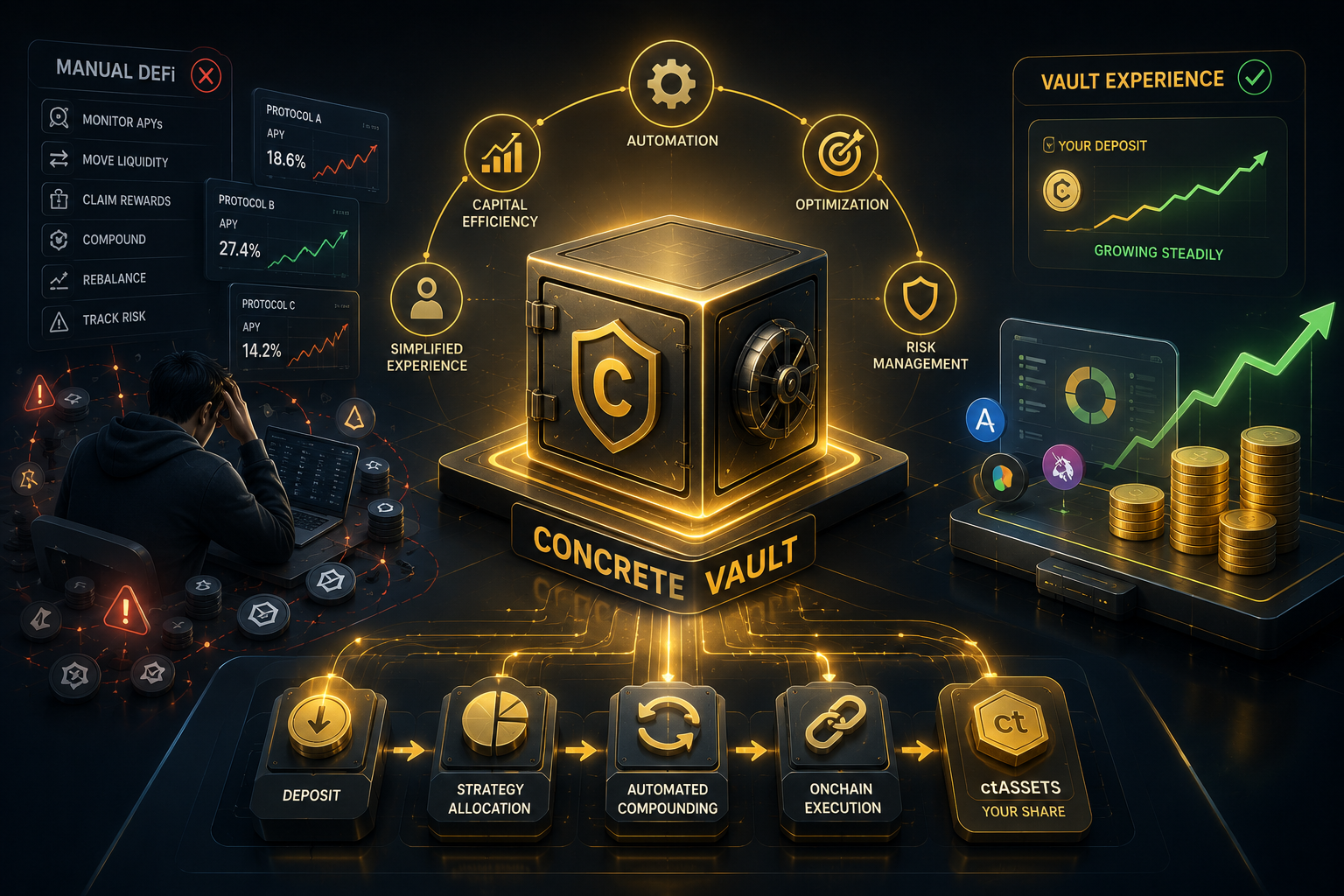
To stay competitive in today’s DeFi environment, users often need to:
• monitor APYs constantly
• move liquidity between protocols
• claim and compound rewards manually
• rebalance positions
• manage exposure across volatile markets
• track risk across multiple platforms
The result is a fragmented experience filled with operational friction.
And in many cases, that friction quietly reduces returns.
This is exactly the problem vault infrastructure was built to solve.
The Problem With Managing DeFi Manually
Early DeFi rewarded speed and experimentation
Users who constantly moved capital between protocols could often capture the highest incentives before yields compressed.
But this approach comes with costs.
Every repositioning decision requires:
• time
• attention
• transaction fees
• execution timing
• risk analysis
The more opportunities DeFi creates, the harder it becomes to manage efficiently by hand.
Manual strategy management introduces several problems:
Operational Complexity
Users must continuously monitor changing conditions across multiple protocols and chains.
Idle Capital
Capital often sits unused while users decide where to allocate next.
Missed Compounding
Rewards may remain unclaimed or unoptimized for long periods
Execution Risk
Entering or exiting positions at poor times can reduce realized returns.
Emotional Decision-Making
Manual management often leads to reactive behavior during volatility.
In theory, DeFi offers unlimited flexibility.
In practice, that flexibility can become inefficient.
What a Concrete Vault Actually Does
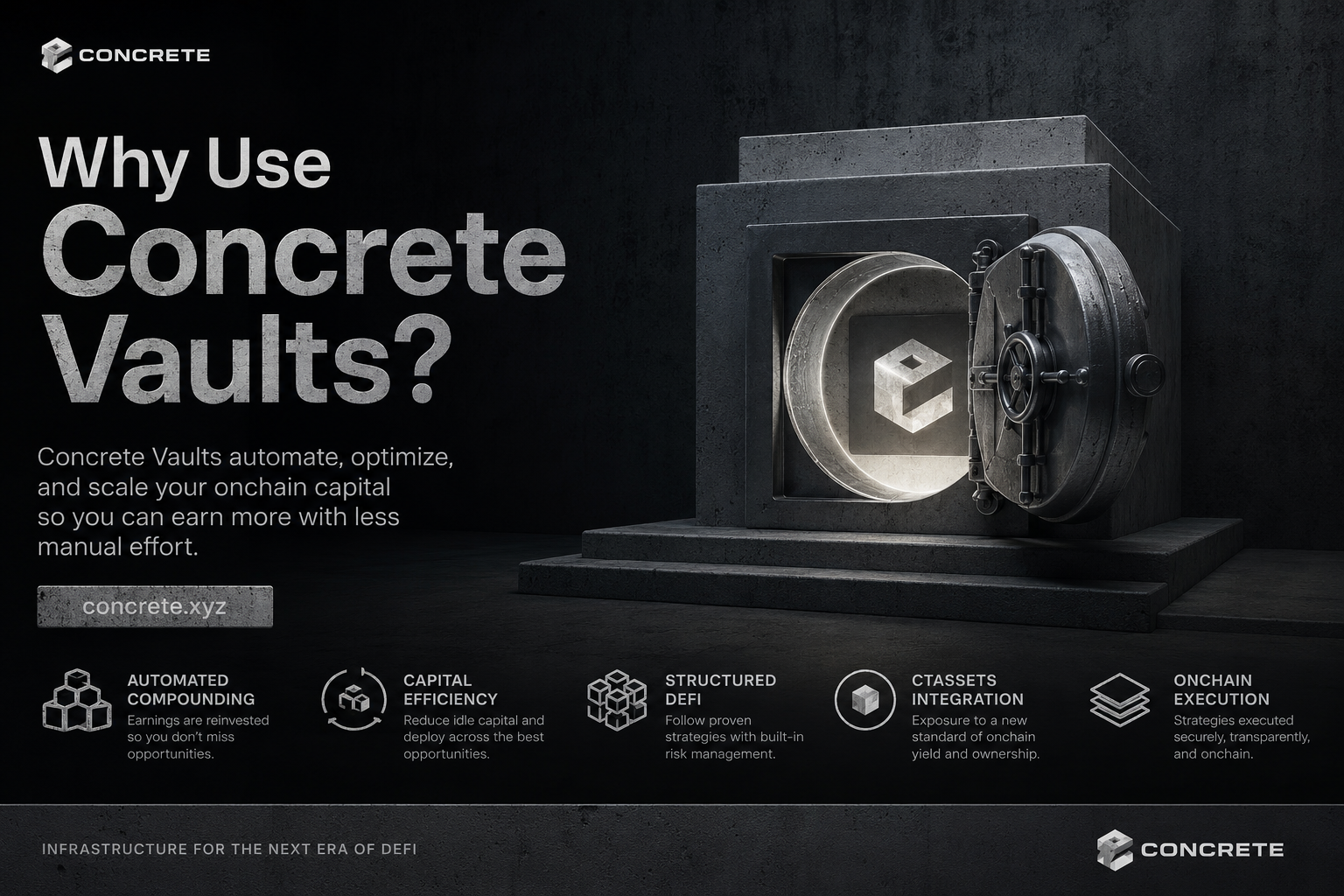
This is where Concrete Vaults become important.
At a simple level, a vault acts as coordinated infrastructure for deploying capital more efficiently.
Instead of requiring every user to manually manage positions, Concrete Vaults help automate and structure the process.
They allow users to:
• pool capital together
• automate compounding
• deploy capital across strategies
• optimize allocations over time
• reduce operational complexity
Rather than constantly repositioning funds manually, users gain exposure to a managed system designed to coordinate capital more effectively.
This changes the role of the user.
Instead of spending hours managing strategies, users can access structured onchain capital deployment through vault infrastructure.
The vault becomes the execution layer.
Why Vault Infrastructure Matters
As DeFi becomes more sophisticated, infrastructure matters more than individual transactions.
This is why DeFi vaults are becoming increasingly important across the ecosystem.
Vault infrastructure provides several major advantages.
Automation
One of the biggest benefits is automated compounding.
Instead of manually claiming and redeploying rewards, the system compounds capital continuously.
This improves efficiency while reducing user effort.
Capital Efficiency
Vaults reduce idle capital by coordinating deployment systematically.
Funds are not constantly sitting unused between manual reallocations.
Efficient capital deployment becomes part of the infrastructure itself.
Simplified User Experience
Most users do not want to actively manage dozens of positions across multiple protocols every day.
Vaults simplify access to yield opportunities through a single structured interface.
Continuous Optimization
Market conditions change constantly.
Vault systems can rebalance and optimize positions over time without requiring users to manually intervene.
Structured Exposure
Rather than chasing random high-APY opportunities, vaults provide organized exposure to strategies designed around long-term efficiency.
The key idea is simple:
Vaults allow users to spend less time managing positions while improving consistency and coordination.
Vaults Are More Than Yield Wrappers
One of the biggest misconceptions about vaults is that they are simply passive yield wrappers.
In reality, modern vault infrastructure performs much more sophisticated functions.
Concrete Vaults are designed to coordinate capital deployment actively and systematically.
This includes:
• rebalancing positions
• enforcing strategy constraints
• responding to changing conditions
• optimizing deployment efficiency
• coordinating capital flows across opportunities
This creates a more structured approach to participating in DeFi.
Rather than relying entirely on manual execution, users gain access to infrastructure built for continuous management and optimization.
That distinction matters.
Because as markets grow more competitive, efficient coordination becomes increasingly valuable.
The Architecture Behind Concrete Vaults
The strength of Concrete Vaults comes from their underlying structure.
These systems are designed not just to generate yield, but to improve how capital moves through DeFi.
ctAssets
At the center of the ecosystem are ctAssets, which function as structured representations of deployed capital.
Rather than leaving assets idle, ctAssets help keep capital productive while maintaining flexibility across the system.
This transforms assets from passive holdings into active components of onchain capital deployment.
Automated Compounding
Compounding is one of the most powerful mechanisms in finance, but manually compounding across DeFi protocols is inefficient and time-consuming.
Concrete Vaults automate this process directly within the infrastructure.
This allows yield generation to become more continuous and systematic.
Onchain Execution
Concrete Vaults coordinate execution directly onchain, improving transparency while reducing reliance on manual user actions.
Execution becomes structured rather than reactive.
Structured Vault Systems
The broader architecture is designed to coordinate capital across opportunities efficiently while maintaining operational discipline.
This is what separates structured DeFi infrastructure from simple yield farming.
Concrete Vaults are not just tools for chasing APY.
They are systems designed to optimize how capital is deployed over time.
Why This Matters for the Future of DeFi
DeFi is becoming more complex.
New protocols, new strategies, new chains, and new liquidity environments are emerging constantly.
As this complexity increases, manual strategy management becomes harder to sustain.
The future of onchain finance will likely depend less on individual users constantly clicking between protocols and more on infrastructure capable of coordinating capital efficiently at scale.
This is already happening.
Infrastructure is replacing constant repositioning.
Automation is replacing repetitive execution.
Structured systems are replacing fragmented workflows.
And vaults are increasingly becoming the default interface for deploying capital onchain.
This trend also aligns with the growth of institutional DeFi, where operational efficiency, consistency, and structured capital deployment matter significantly more than speculative experimentation.
Institutions do not want to manage dozens of fragmented positions manually.
They want systems designed for scalable capital efficiency.
That is the role vault infrastructure is beginning to play.
The Bigger Shift
The evolution of DeFi is not just about creating more yield opportunities.
It is about building better systems for coordinating capital.
The earliest phase of DeFi rewarded users who moved fastest.
The next phase may reward infrastructure that deploys capital most efficiently.
Concrete Vaults reflect this shift toward:
• structured DeFi
• automated compounding
• efficient onchain capital deployment
• coordinated execution
• scalable capital management
The future of DeFi may not belong to users manually chasing every new opportunity.
It may belong to the systems built to manage complexity better than humans can alone.
And vault infrastructure may become the foundation that makes that future possible.
🚨 Explore Concrete at https://concrete.xyz/� 🚨