Why Should You Use a Concrete Vault?
--
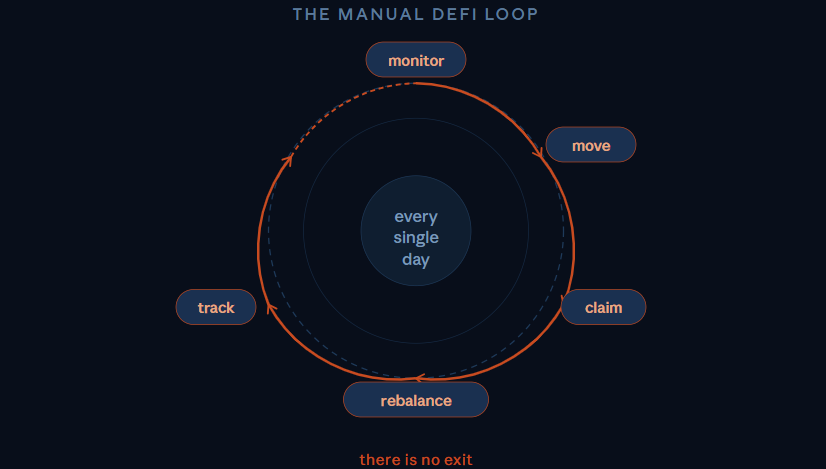
In the current DeFi landscape, staying competitive feels like a full-time job. To capture meaningful yield, a typical user must constantly monitor shifting APYs, manually move liquidity between protocols to avoid dilution, claim and compound rewards across multiple chains, and track risk levels in real-time.
This creates immense friction. For many, the “DeFi experience” has become a cycle of manual repositioning that is both time-consuming and prone to human error. This is where the core value of a vault comes in: Vaults simplify the complex so your capital can work harder with less effort.
What Does a Concrete Vault Actually Do?
At its simplest level, a Concrete Vault acts as a sophisticated coordination layer for your assets. Instead of you clicking through dozens of interfaces, Concrete Vaults help you:
- Pool Capital Together: Leveraging collective size for better efficiency.
- Automate Compounding: Programmatically reinvesting rewards so you benefit from the power of compound interest without manual intervention.
- Deploy Across Strategies: Giving you exposure to multiple yield sources through a single entry point.
- Optimize Positions: Moving capital to where it is treated best over time.
- Reduce Operational Complexity: Eliminating the need to sign dozens of transactions just to maintain a single strategy.
The Power of Vault Infrastructure
When you move from manual management to vault infrastructure, you aren’t just saving time; you are upgrading your capital efficiency. Concrete Vaults provide:
- Continuous Optimization: The system is always “on,” rebalancing positions while you sleep.
- Reduced Idle Capital: By automating flows, your assets spend less time sitting in wallets and more time earning.
- Structured Exposure: You gain access to a curated system of yield opportunities that have been vetted for sustainability.
The result is a more consistent experience. You spend less time managing the “plumbing” of DeFi and more time focusing on your long-term financial goals.
Moving Beyond “Yield Wrappers”
Many see vaults as simple wrappers for high numbers. However, Concrete Vaults are engineered as robust systems designed to coordinate onchain capital deployment. They are built to:
- Enforce Strategy Constraints: Ensuring capital stays within defined risk parameters.
- Coordinate Deployment: Managing how much capital goes into specific protocols to minimize slippage.
- Respond to Market Conditions: Adapting the strategy as volatility or interest rates change.
This creates a structured DeFi environment — a professional-grade approach to participating in decentralized markets.
Inside the Concrete Architecture
The efficiency of these vaults is driven by a unique architecture centered around ctAssets. These assets represent your claim on the vault’s underlying strategies while the infrastructure handles the heavy lifting:
- Onchain Execution: All movements are transparent and verifiable.
- Automated Compounding: Yield is harvested and redeployed to maximize the net return for vault participants.
- Structured Coordination: The system acts as an orchestrator, ensuring that capital is deployed across the most effective opportunities at any given time.
The Bigger Shift: From Clicking to Coordinating
As DeFi becomes more complex, manual strategy management simply does not scale. We are moving away from an era of users clicking between protocols all day and toward a future where infrastructure replaces constant repositioning.
Vaults are becoming the default interface for deploying capital onchain. In a mature ecosystem, success won’t belong to the fastest clicker, but to the systems built to coordinate capital with the highest efficiency.
Don’t manage DeFi. Engineer it.
👉 Explore Concrete at: https://concrete.xyz/