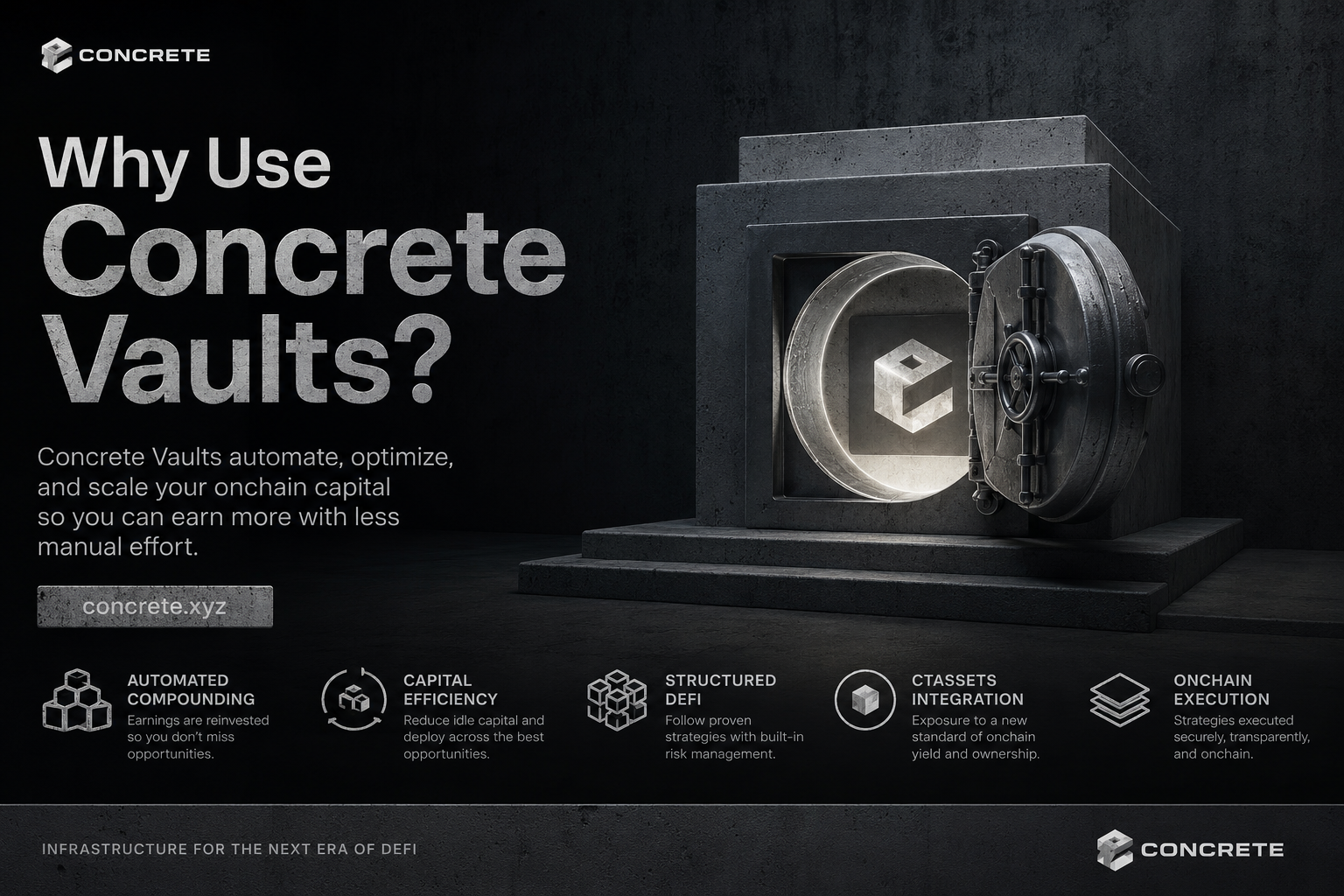
Why Should You Use a Concrete Vault?
 몬 페레즈3 min read·Just now
--
Why should someone use a Concrete Vault instead of managing everything manually?
The DeFi landscape is moving fast. While the opportunities to earn yield are vast, the “manual” way of managing onchain assets is becoming a full-time job that most users simply can’t keep up with.
1. The Reality of Modern DeFi
Today, being a successful liquidity provider feels like a constant race. To stay competitive, you usually have to:
- Monitor APYs across dozens of protocols daily.
- Pay high gas fees to move liquidity when a better opportunity pops up.
- Manually claim rewards and compound them to maximize returns.
- Assess risk constantly to ensure your collateral isn’t at stake.
This creates friction. For many, the time and gas spent managing these positions often eat into the actual profits, making the experience inefficient for everyone but the largest “whales.”
2. What is a Concrete Vault?
Think of a Concrete Vault as a smart, automated co-pilot for your capital. Instead of you doing the heavy lifting, you deposit your assets into a vault that handles the technical execution for you.
- Capital Pooling: By grouping funds together, the vault can execute large moves that would be too expensive for a single user.
- Hands-off Compounding: It automatically reinvests your earnings back into the strategy.
- Smart Deployment: It moves capital across various strategies based on pre-set rules to find the best balance of return and safety.
3. The Power of Vault Infrastructure
Why bother with a vault instead of just holding assets? It comes down to Capital Efficiency.
- Automation: No more setting alarms to claim rewards or rebalance a position.
- Zero Idle Capital: Every dollar in the vault is working. When one opportunity closes, the infrastructure looks for the next.
- Simplified Experience: You get the benefits of complex DeFi strategies without needing to understand the underlying code of every single protocol.
4. Risk & Structure: More Than Just a “Yield Wrapper”
Concrete Vaults aren’t just simple pass-through tools; they are structured systems. They are designed with built-in guardrails to:
- Coordinate Deployment: Ensuring capital is spread out intelligently.
- Enforce Constraints: Strategies are bound by specific risk parameters, preventing the “cowboy” moves that lead to losses in manual trading.
- Dynamic Response: The vault can respond to market volatility faster than a human can click a “Withdraw” button.
5. The Concrete Architecture: How it Works
The secret sauce of Concrete lies in its design, specifically through ctAssets (Concrete Tokens). When you deposit into a vault, you receive a representation of your position that grows in value.
- ctAssets: These act as a receipt and a “yield-bearing” version of your deposit, keeping your liquidity flexible.
- Onchain Execution: Everything happens transparently on the blockchain.
- Structured Coordination: The architecture is built to move capital where it is most effective, ensuring that onchain capital deployment is always optimized.
6. The Shift: From Manual to Automated
DeFi is becoming too complex for manual management to scale. Just as we moved from manual stock picking to index funds in traditional finance, DeFi is moving toward structured DeFi.
The future of the space isn’t about clicking between five different tabs all day; it’s about utilizing sophisticated systems that coordinate capital with precision. By using Concrete Vaults, you aren’t just “chasing yield” — you are participating in a more mature, institutional-grade DeFi ecosystem.
Ready to optimize your capital?
Explore Concrete at https://concrete.xyz/