Why Should You Use a Concrete Vault?
How Structured DeFi Infrastructure Is Replacing the Manual Grind of Onchain Capital Management
--
Introduction: The Tab Problem
If you have been active in DeFi for any meaningful stretch of time, you know the tab problem.
At any given moment you might have a lending position on one protocol, a liquidity pool on another, a staking position somewhere else, and a yield farm you opened three weeks ago that you keep meaning to check. Each one requires attention. Each one has its own reward token, its own compounding schedule, its own risk parameters that shift as market conditions move. Keeping track of all of it is not a strategy. It is a part-time job.
Most people either accept the cognitive load and try to stay on top of it, or they accept that they are almost certainly leaving yield on the table because they cannot monitor everything at once. Neither is a good answer.
This is the problem that vault infrastructure exists to solve. And Concrete Vaults are built to solve it more completely than anything the current DeFi landscape has offered before.
Section 1: What Managing DeFi Manually Actually Costs You
1.1 The Daily Reality of Active Position Management
The promise of DeFi has always been that anyone can access sophisticated financial tools without intermediaries. That promise is real. But what often gets left out of that framing is the operational reality of actually using those tools at any meaningful scale.
To stay competitive in DeFi without vault infrastructure, a typical active user needs to:
➢ Monitor APYs across multiple protocols continuously, because rates shift constantly and the opportunity you deployed into last week may no longer be the best use of your capital today
➢ Move liquidity between protocols when better opportunities emerge, paying gas costs each time and timing the move to not get caught in a bad position during transition
➢ Claim and compound rewards manually, because unclaimed rewards are not earning anything and the compounding math on DeFi yields is brutal if you let rewards sit idle for any significant period
➢ Rebalance positions as market conditions change, which in volatile markets can mean needing to act quickly on information that requires constant monitoring to even have
➢ Track risk manually across every position, because each protocol has its own risk profile, each asset has its own volatility characteristics, and the interaction between multiple positions can create exposures that are not obvious when you look at each position in isolation
This is not a description of an edge case. This is the baseline operational requirement for anyone trying to manage onchain capital deployment seriously without giving up significant yield to inefficiency.
1.2 The Compounding Cost of Friction
The inefficiency is not just inconvenient. It is expensive in ways that compound over time.
Every day that rewards sit unclaimed is a day they are not earning. Every week that capital sits in a position that has moved from best-in-class to merely acceptable is a week of foregone yield. Every time you pay gas to manually rebalance a position, that cost comes directly out of your return.
The users who do best in DeFi are not always the ones with the best market instincts. They are often the ones who execute most consistently, who compound most frequently, and who keep idle capital at the lowest possible level. Manual management makes consistent execution hard. Capital efficiency suffers as a result.
1.3 The Scale Problem
Manual position management does not get easier as capital grows. In many ways it gets harder. Larger positions attract more attention from MEV bots. Larger rebalancing transactions have more market impact. The cost of a mistake scales with the size of the position.
Institutional DeFi participation faces this problem acutely. Funds and larger capital allocators cannot run a DeFi strategy that depends on someone monitoring dashboards and manually executing transactions. The operational overhead is too high and the error surface is too large. What institutional capital needs is structured DeFi infrastructure that can execute consistently without requiring constant human intervention at the execution layer.
Section 2: What a Concrete Vault Actually Does
2.1 The Core Mechanic
A Concrete Vault is not a savings account with a blockchain label on it. The structure is more specific and more interesting than that.
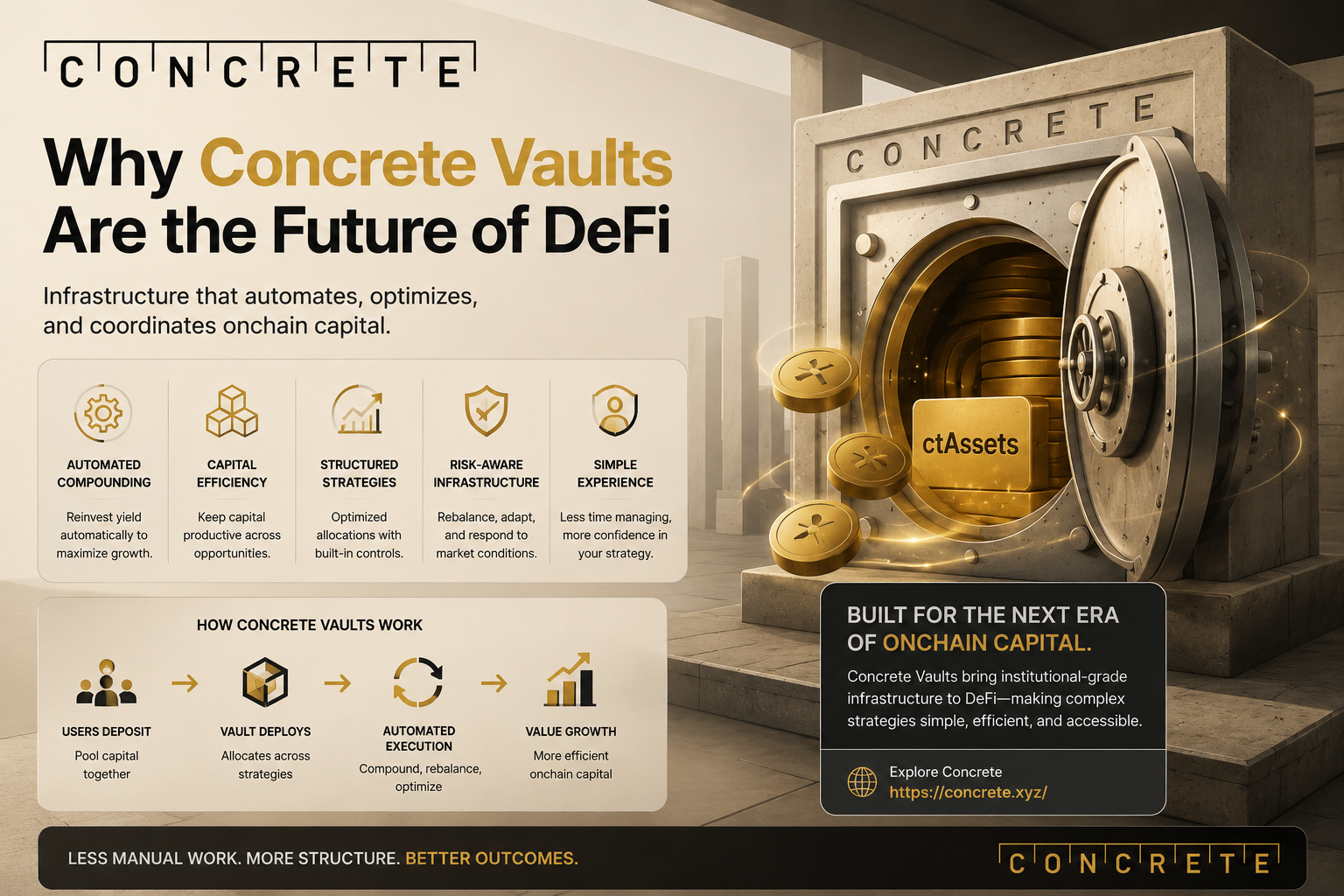
When capital enters a Concrete Vault, it pools with capital from other depositors. That pooled capital gets deployed according to the vault’s defined strategy, across yield opportunities that the vault is designed to access. The vault handles compounding automatically, claiming rewards and reinvesting them on a schedule that maximises the compounding effect rather than leaving that timing up to individual users. It rebalances positions as conditions change and enforces strategy constraints that define what the vault can and cannot do with the capital it manages.
The user’s position in all of this is represented by ctAssets, Concrete’s vault receipt tokens. When you deposit into a Concrete Vault, you receive ctAssets representing your share of the vault’s total position. As the vault compounds and grows, the value of those ctAssets increases relative to the underlying asset. Your yield accumulates in the value of your position rather than in unclaimed reward tokens sitting idle.
2.2 What This Replaces
The list of things a Concrete Vault handles automatically maps almost exactly to the list of things that make manual DeFi management so operationally intensive:
➢ Automated compounding runs on the vault’s schedule rather than waiting for individual users to claim and reinvest. The compounding frequency that would be impractical for a solo position becomes the default for every depositor in the vault
➢ Strategy deployment across opportunities happens at the vault level, with the capital efficiency advantages that come from pooled capital and without the gas overhead of every depositor executing their own transactions
➢ Position rebalancing responds to changing conditions according to the vault’s defined parameters rather than depending on a user being online and attentive at the right moment
➢ Risk management is built into the vault architecture rather than left entirely to each depositor to track independently
➢ Onchain capital deployment happens continuously rather than episodically, keeping capital productive between the manual check-ins that define most retail DeFi participation
Section 3: The Real Benefits of Vault Infrastructure
3.1 Capital Efficiency
The most significant benefit of Concrete Vaults from a pure returns perspective is capital efficiency. Manual DeFi management tolerates idle capital at every stage. Capital waiting to be deployed. Rewards waiting to be claimed. Positions that have drifted from optimal waiting to be rebalanced.
Vault infrastructure attacks idle capital at every point. Pooling allows deployment at scale that individual positions cannot access. Automated compounding eliminates the window where rewards are earned but not yet reinvested. Continuous optimisation keeps positions working rather than waiting for the next manual intervention.
The difference in capital efficiency between consistent automated execution and episodic manual management compounds over time in the same way that compounding frequency affects yield. Small improvements in how consistently capital is kept productive accumulate into meaningful differences in returns over any significant time horizon.
3.2 Reduced Operational Complexity
The other major benefit is simply the reduction in what a user needs to do to participate in structured DeFi effectively.
Instead of monitoring multiple protocol dashboards, tracking multiple reward tokens, executing multiple transactions per week just to maintain a position, and staying current on risk conditions across every protocol they are using, a Concrete Vault depositor gains exposure to a structured system that handles that execution layer.
This is not about making DeFi passive in a way that removes user agency. The vault’s strategy is defined and disclosed. Users choose the vault that matches their risk tolerance and yield objectives. But the execution of that strategy, the ongoing operational work that makes the difference between a strategy that performs as designed and one that drifts and underperforms, that gets handled by the vault infrastructure rather than requiring constant user attention.
3.3 Consistency
One of the underappreciated advantages of automated vault infrastructure is that it executes consistently in a way that manual management almost never does.
Manual DeFi management is subject to all the variability of human attention. You miss a compounding window because you were busy. You delay a rebalance because you were not certain about market direction. You leave rewards unclaimed for a few extra days because the gas cost seemed high and you were waiting for it to come down.
Each of these individual decisions is reasonable in isolation. The accumulated effect of all of them is a position that consistently underperforms what a systematic approach would have delivered.
Concrete Vaults execute according to their defined parameters regardless of what else is happening. The compounding happens on schedule. The rebalancing happens when the conditions trigger it. The strategy constraints are enforced continuously. Consistency is built into the infrastructure rather than depending on user discipline.
Section 4: Vaults Are Not Simple Yield Wrappers
4.1 The Structure Behind the Interface
A common misconception about DeFi vaults is that they are essentially just wrappers around existing yield opportunities. Deposit here, get the yield from there, minus a fee. If that were all they were, the value proposition would be limited.
Concrete Vaults are built with more structural depth than that framing suggests.
The vault architecture includes systems designed to coordinate capital deployment across strategies, not just route it to a single yield source. Rebalancing mechanisms respond to changing conditions across the opportunity set rather than locking capital into a static allocation. Strategy constraints define what the vault can and cannot do, creating enforceable boundaries around risk that go beyond what individual depositors could realistically monitor themselves.
This is closer to how institutional portfolio management works than how most retail DeFi participation works. Capital is managed against a defined strategy with enforced parameters rather than deployed once and left to drift.
4.2 The Risk Architecture
The risk dimension of Concrete Vault architecture matters and deserves direct attention rather than being folded into the yield conversation.
Manual DeFi position management tends to treat risk as something to assess at entry and then monitor informally. Protocol risk, smart contract risk, liquidity risk, and market risk all evolve over time, but the practical reality of managing multiple positions manually is that risk monitoring tends to be less systematic than it should be.
Concrete Vaults build structured exposure into the architecture. Strategy constraints define the boundaries of what the vault does. Capital deployment is coordinated within those constraints. The vault responds to changing conditions rather than waiting for a user to notice that conditions have changed and then decide what to do about it.
This does not eliminate risk. Nothing eliminates risk in DeFi. What it does is make risk management a systematic property of the vault rather than an individual responsibility that competes for attention with everything else a manual DeFi user is trying to track.
Section 5: The Concrete Vault Architecture
5.1 ctAssets and What They Represent
The ctAsset mechanism is worth understanding specifically because it is the user-facing expression of everything the vault is doing underneath.
When you deposit into a Concrete Vault, you receive ctAssets representing your proportional share of the vault’s total position. As the vault’s automated compounding and strategy execution grow the total position over time, each ctAsset represents a growing claim on the underlying assets. Your yield accrues in the appreciating value of your ctAssets rather than in separate reward tokens that need to be claimed and reinvested.
This structure has practical advantages beyond simplicity. Because yield accumulates in ctAsset value rather than in separate claimable rewards, there is no mechanical reason for yield to sit idle between claiming events. The vault compounds on its own schedule and the ctAsset value reflects that compounding continuously.
5.2 Onchain Execution
The onchain capital deployment layer of Concrete Vaults is what makes the automated compounding and rebalancing mechanics trustless rather than dependent on an off-chain operator behaving as promised.
Execution happens onchain according to the vault’s defined parameters. The strategy constraints are enforced by the smart contract rather than by policy. The capital coordination happens in a verifiable way that depositors can inspect rather than on a backend that requires trust in the operator.
This is the piece that distinguishes structured DeFi infrastructure built properly from yield products that are structurally opaque. The vault’s behaviour is defined by its onchain architecture, not by claims about how it will be managed.
5.3 Continuous Optimisation
The optimisation layer is what separates Concrete Vaults from static yield strategies.
Rather than deploying capital once and holding a fixed position, the vault’s architecture is designed to coordinate capital deployment across opportunities over time. As APYs shift, as risk parameters change, as new opportunities become available or existing ones deteriorate, the vault can respond within the bounds of its defined strategy.
This continuous optimisation is what makes the capital efficiency argument meaningful over longer time horizons. A vault that stays dynamically positioned within its strategy will consistently outperform a static position in the same strategy over any period long enough for conditions to shift meaningfully.
Section 6: The Bigger Shift Happening in DeFi
6.1 Manual Management Does Not Scale
DeFi is becoming more complex, not less. The number of protocols, chains, yield sources, and risk factors that a comprehensive onchain capital strategy needs to account for grows with every cycle. The user who was managing five positions effectively in 2021 would need to track five times as many variables to maintain the same level of coverage of the current opportunity set.
Manual strategy management does not scale with that complexity. The cognitive load required to stay current across a genuinely comprehensive DeFi strategy is beyond what any individual can realistically sustain while also doing everything else that constitutes a life.
Infrastructure replaces the parts of any complex system that do not need human judgment at the execution level. The decision about which vault matches your risk tolerance and return objectives benefits from human judgment. The ongoing execution of the vault’s strategy, the compounding, the rebalancing, the continuous optimisation, does not.
6.2 The Default Interface Is Shifting
The way most people will access DeFi yield in the next phase of the industry’s development will not look like the tab problem described at the start of this article. It will look more like depositing into structured systems that handle execution on their behalf.
Vaults are becoming the default interface for onchain capital deployment in the same way that index funds became the default interface for equity market participation. Not because active management is impossible, but because the operational requirements of doing it well at scale exceed what most participants can realistically sustain.
Concrete Vaults are built for this shift. The ctAsset structure, the automated compounding, the onchain execution, the continuous optimisation within defined strategy constraints, all of it is designed for a version of DeFi where infrastructure coordinates capital more efficiently than constant manual repositioning ever could.
The future of institutional DeFi and increasingly retail DeFi will not belong to users who click between protocol dashboards all day. It will belong to the vault infrastructure that executes more consistently, compounds more frequently, and keeps capital productive more continuously than any manual approach can match.
Explore Concrete at concrete.xyz