Why Should You Use a Concrete Vault?
 Web3Kid4 min read·Just now
--
For most people, participating in DeFi sounds simple at first.
Deposit assets. Earn yield. Let your capital work.
But the reality looks very different once you step inside the ecosystem.
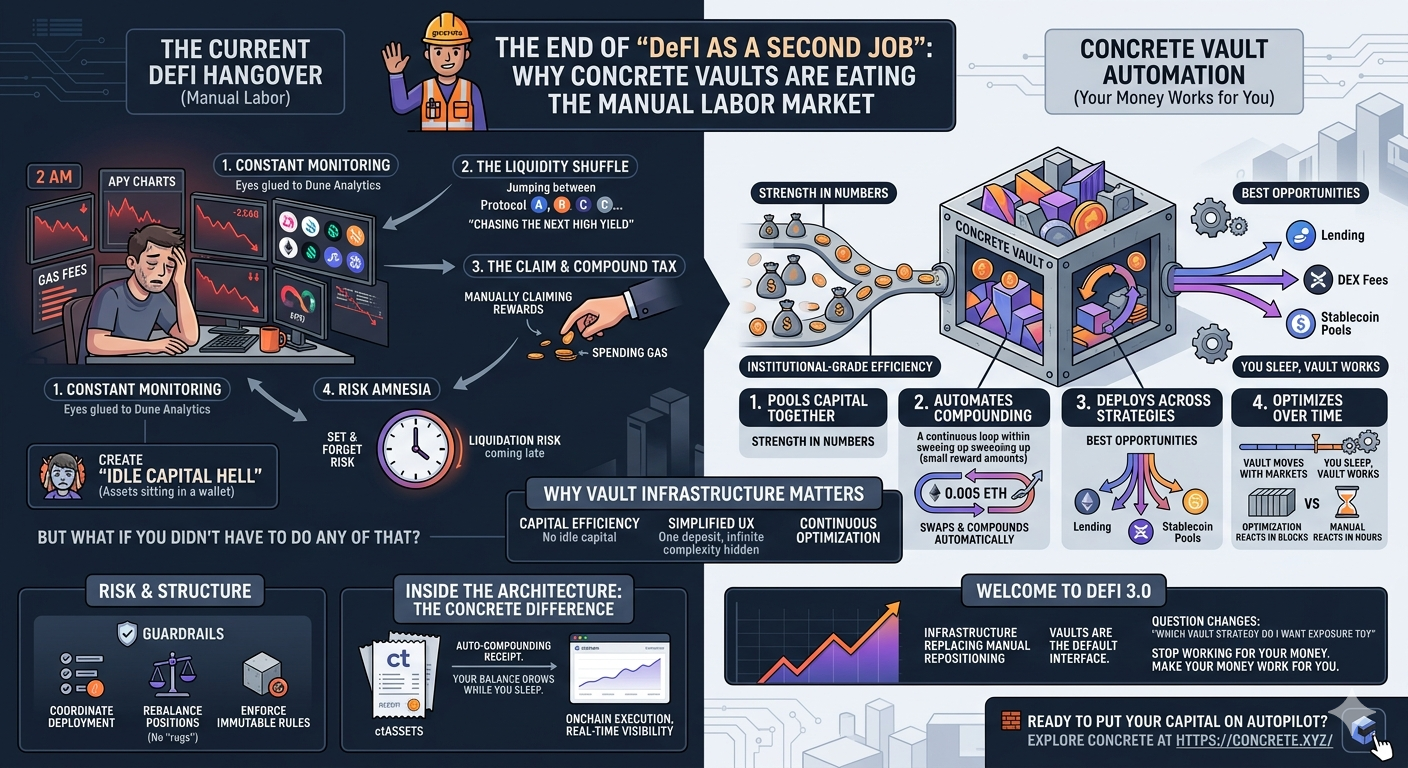
To stay competitive, users often find themselves constantly monitoring APYs, moving liquidity between protocols, claiming rewards, compounding positions, and adjusting exposure as market conditions change.
And the moment you stop paying attention, your strategy can quickly become inefficient.
DeFi offers enormous opportunity. But managing those opportunities manually creates friction that only grows over time.
This is exactly the problem vault infrastructure is designed to solve.
The Problem With Managing DeFi Manually
Modern DeFi moves fast.
Yields shift across chains. Liquidity rotates between protocols. New opportunities emerge while older ones become less effective.
For users managing capital manually, this creates a constant operational burden.
Capital needs to be repositioned. Rewards need to be compounded. Risk exposure needs to be monitored. Even simple adjustments can involve multiple transactions and execution costs.
The process becomes less about investing and more about maintenance.
And in many cases, this complexity leads to inefficiency.
Capital sits idle between decisions. Positions remain outdated. Opportunities are missed simply because managing them requires too much attention.
What a Concrete Vault Actually Does
Concrete Vaults are designed to simplify this entire process.
Instead of requiring users to manage strategies themselves, vaults create a structured system where capital is coordinated automatically.
Users deposit assets into a vault and receive exposure to a managed strategy framework. Behind the scenes, the vault handles:
- automated compounding
- capital deployment across strategies
- position optimization over time
- continuous execution and adjustment
Rather than manually repositioning funds across multiple protocols, users gain access to a system built to manage those decisions more efficiently.
This is the core value of DeFi vaults.
They transform fragmented opportunities into a coordinated capital system.
Why Vault Infrastructure Matters
The benefits of vault infrastructure go beyond convenience.
At a deeper level, vaults improve capital efficiency.
Instead of leaving funds idle or dependent on constant manual oversight, vault systems keep capital continuously productive. Strategies can rebalance automatically, rewards can compound in the background, and positions can adapt as market conditions evolve.
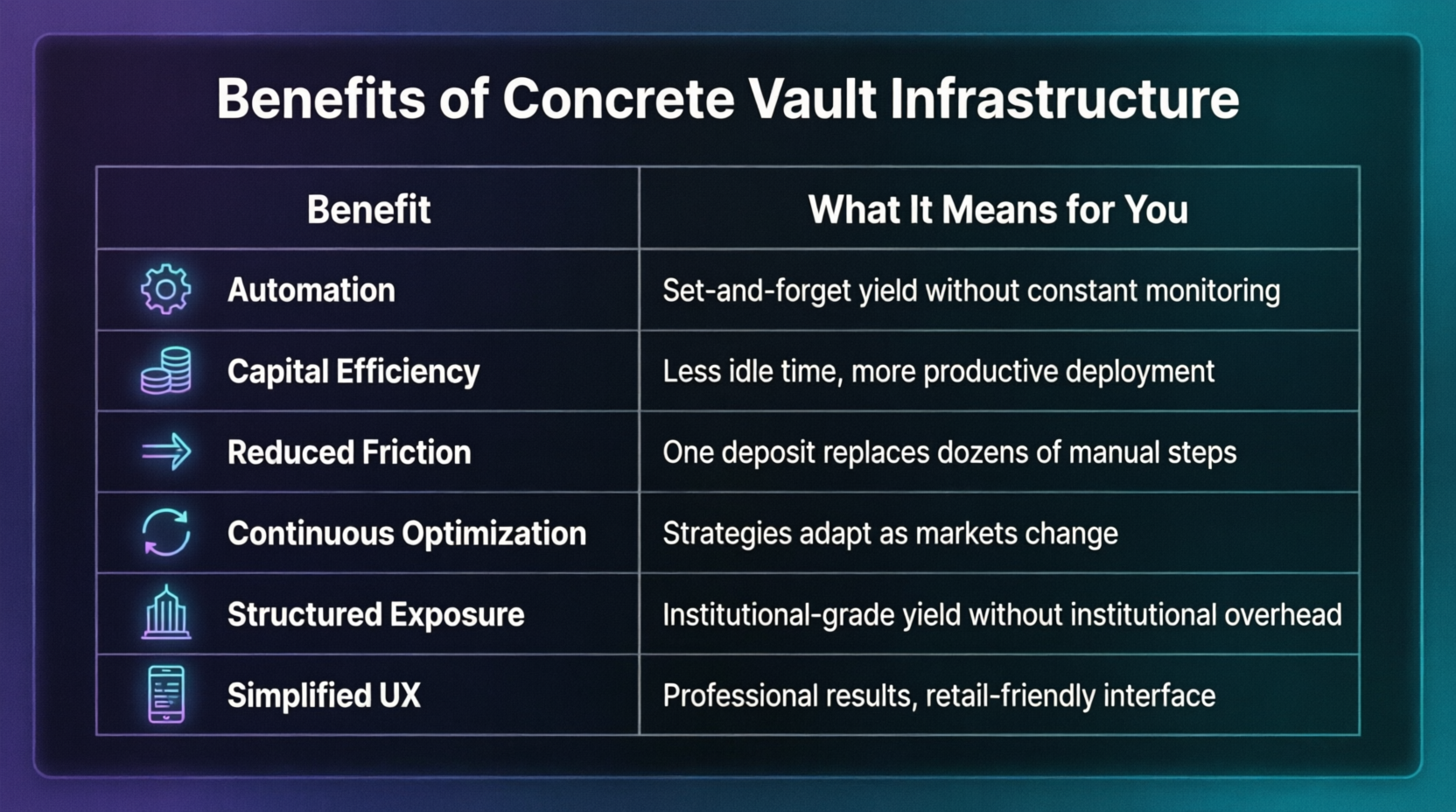
This creates several important advantages.
- Automation reduces operational friction.
- Continuous optimization improves consistency.
- Structured exposure simplifies participation.
- Users spend less time managing positions directly.
The result is a more scalable approach to DeFi participation—especially as the ecosystem becomes increasingly complex.
More Than a Simple Yield Wrapper
It is important to understand that vaults are not simply containers that hold assets and distribute yield.
Modern vault systems are active coordination layers.
Concrete Vaults are designed with infrastructure that manages how capital moves, where it is deployed, and how strategies respond to changing conditions.
This includes systems that:
- coordinate onchain capital deployment
- rebalance positions over time
- enforce predefined strategy constraints
- optimize execution across opportunities
The vault is not passive.
It is continuously managing the relationship between capital, strategy, and market conditions.
This is what makes structured DeFi infrastructure fundamentally different from simply chasing yield manually.
How Concrete Vault Architecture Works
At the center of this system is a framework designed for efficient coordination.
Concrete uses structured vault systems that combine onchain execution, automated management, and tokenized exposure through ctAssets.
ctAssets represent a user’s position within the vault ecosystem while allowing capital to remain integrated with the broader strategy infrastructure.
As capital flows into the system, the vault coordinates deployment across defined opportunities, compounds returns automatically, and adjusts positions as conditions evolve.
Instead of forcing users to interact directly with multiple protocols, the infrastructure abstracts away much of the operational complexity.
The focus shifts from constant repositioning to efficient capital management.
This is especially important as DeFi grows beyond retail experimentation and moves closer toward institutional DeFi, where consistency, structure, and operational reliability matter far more than chasing temporary spikes in APY.
The Bigger Shift Happening in DeFi
DeFi is becoming more sophisticated every year.
More chains. More protocols. More strategies. More moving parts.
But as complexity increases, manual strategy management becomes harder to sustain. Constantly clicking between protocols does not scale—not for individuals, and certainly not for institutions managing larger pools of capital.
This is why infrastructure is becoming increasingly important.
Vaults represent a shift away from reactive participation and toward systems designed to coordinate capital intelligently over time.
The future of DeFi may not belong to the users spending all day repositioning liquidity manually.
It may belong to the infrastructure built to manage capital more efficiently than humans ever could.
For those interested in exploring that model, you can learn more about Concrete Vaults at https://concrete.xyz/�.