Why Should You Use a Concrete Vault?
--
Why Manual DeFi Is Broken — And Why Vault Infrastructure Matters
DeFi was supposed to make finance more open, accessible, and efficient.
Instead, for many users, it has become increasingly exhausting.
What started as a simple idea — providing liquidity and earning yield — has evolved into an environment where users are expected to constantly monitor markets, move capital between protocols, and optimize positions in real time just to remain competitive.
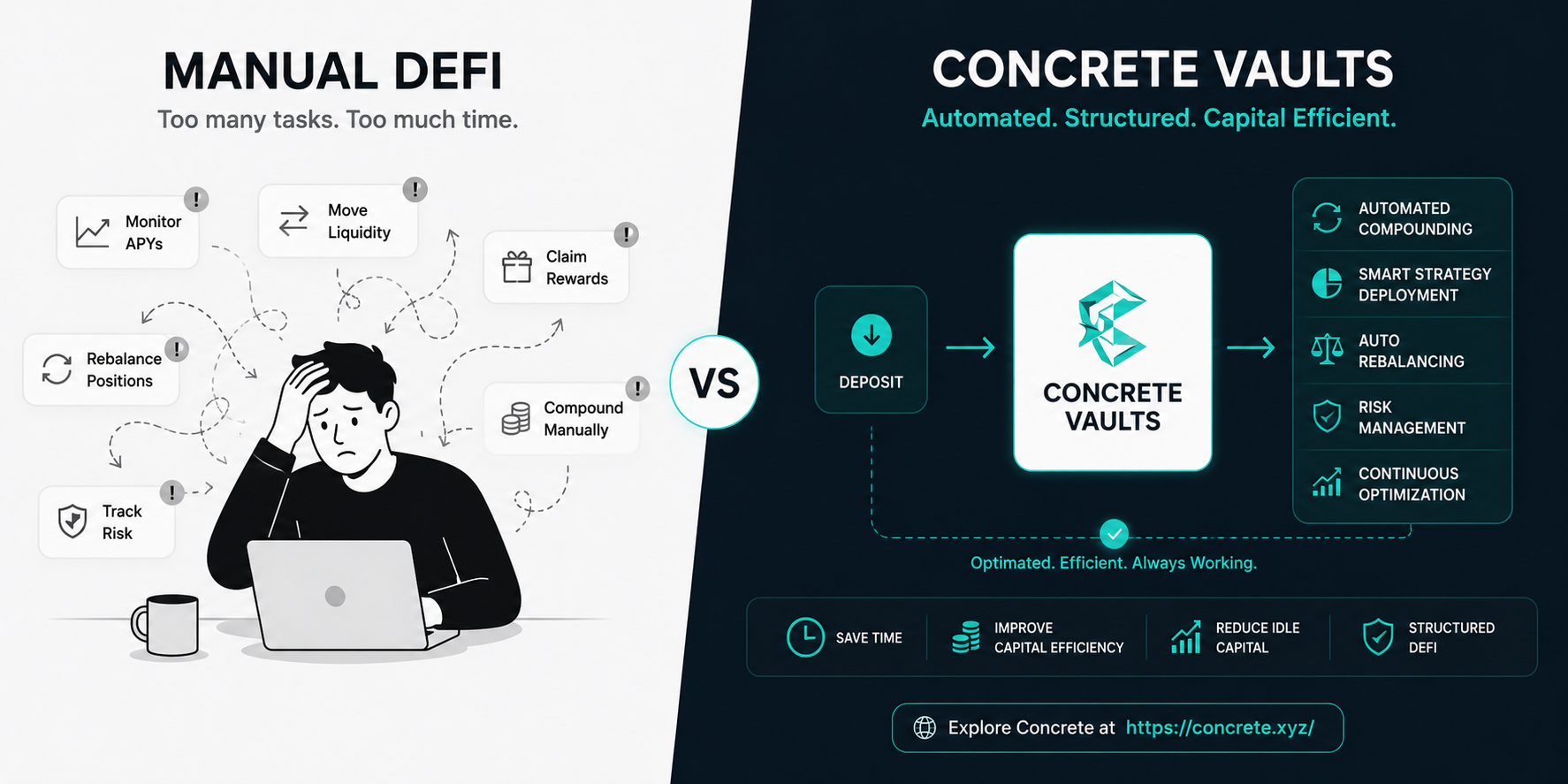
Today, participating effectively in DeFi often means:
- monitoring APYs across multiple protocols
- manually repositioning liquidity
- claiming and compounding rewards repeatedly
- adjusting exposure as incentives change
- managing risk without automated safeguards
The reality is simple:
Manual DeFi does not scale.
As ecosystems become more fragmented and strategies become more complex, users spend more time managing positions than actually benefiting from their capital.
And this is exactly why DeFi vaults are becoming increasingly important.
The Operational Problem Inside DeFi
One of the biggest inefficiencies in DeFi is not yield generation itself.
It is coordination.
Liquidity is scattered across protocols. Incentives change constantly. Capital often sits idle because users cannot react fast enough to optimize opportunities manually.
This creates several structural problems:
- fragmented liquidity
- inconsistent compounding
- operational fatigue
- inefficient capital deployment
- increased execution risk
For many users, the challenge is no longer accessing DeFi.
The challenge is managing it efficiently.
The more protocols users interact with, the more complicated the process becomes.
And eventually, manual management becomes unsustainable.
Why Vault Infrastructure Changes Everything
Vault infrastructure exists to solve this exact problem.
Instead of forcing every individual user to manage strategies manually, vault systems coordinate capital deployment through structured execution layers.
This changes the role of the user entirely.
Rather than constantly chasing opportunities across protocols, users gain exposure to automated systems designed to optimize positions continuously.
Concrete Vaults are built around this idea.
They help users:
- pool capital efficiently
- automate compounding
- rebalance positions dynamically
- deploy liquidity across structured strategies
- reduce operational complexity
The result is a more efficient framework for onchain capital deployment.
Users no longer need to spend hours manually repositioning assets just to maintain competitive yield exposure.
Capital Efficiency Is Becoming the Core Metric
For years, DeFi users focused primarily on APY.
But as the ecosystem matures, capital efficiency matters far more than temporary yield spikes.
A strategy generating high yield means little if users lose efficiency through:
- delayed execution
- idle liquidity
- fragmented positions
- missed compounding cycles
- constant manual intervention
Vault systems improve this process by creating continuous optimization layers around capital itself.
Instead of treating yield generation as isolated opportunities, structured DeFi systems coordinate liquidity more efficiently over time.
This is one of the reasons institutional DeFi infrastructure is becoming increasingly important.
Institutions do not scale through manual clicking.
They scale through systems.
And modern DeFi is moving in the same direction.
Concrete Vaults and Structured DeFi
Concrete Vaults are not simply passive yield products.
They are structured systems designed to coordinate capital intelligently across onchain opportunities.
This includes infrastructure that can:
- automate compounding
- execute strategies onchain
- rebalance positions when conditions change
- enforce predefined strategy constraints
- optimize liquidity deployment continuously
At the center of this architecture are ctAssets and structured vault systems that help streamline how liquidity moves across DeFi.
Rather than relying entirely on manual intervention, Concrete Vaults create a framework where capital can be deployed more systematically and efficiently.
This represents a broader shift happening across structured DeFi.
The industry is moving away from fragmented individual execution and toward coordinated infrastructure layers designed for scalable capital management.
The Future of DeFi Will Be Infrastructure-Driven
As DeFi becomes more advanced, the gap between manual users and infrastructure-driven systems will continue expanding.
The reality is that most users cannot realistically monitor dozens of protocols, optimize execution timing, rebalance positions continuously, and compound rewards efficiently at scale.
Infrastructure is becoming the solution.
Vaults are increasingly evolving into the default interface for participating in onchain finance because they abstract operational complexity while improving capital coordination.
The future of DeFi may not belong to users endlessly moving liquidity between protocols searching for the next yield opportunity.
It may belong to the systems designed to coordinate capital more efficiently than humans can manually.
And that is where Concrete Vaults are positioning themselves.
🧱Explore Concrete at https://concrete.xyz