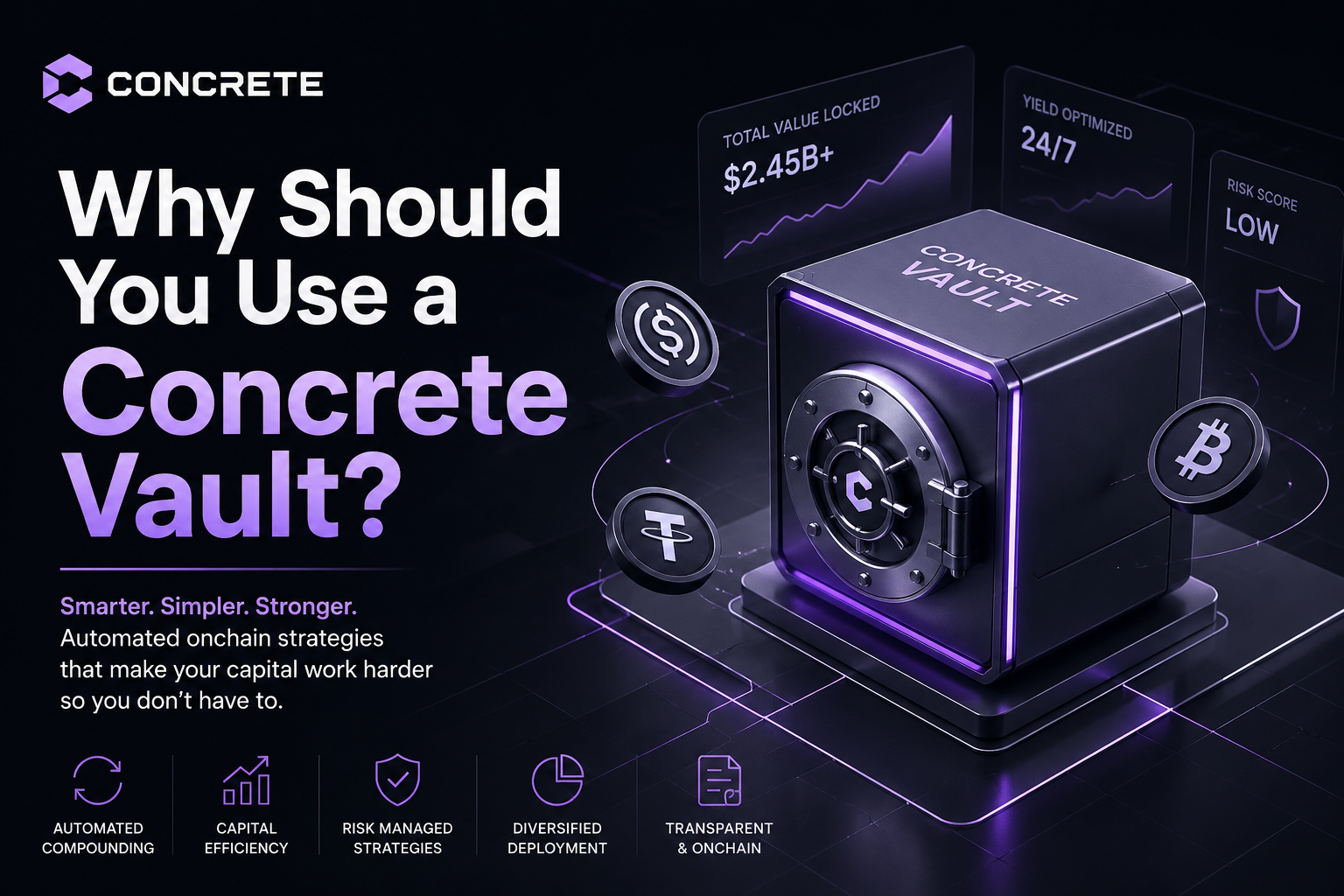
Why Should You Use a Concrete Vault?
 Onanas3 min read·Just now
--
DeFi gives users access to endless opportunities.
➤New protocols launch constantly.
➤Yields move every day.
➤Strategies evolve quickly.
But participating efficiently is often harder than it looks.
To stay competitive, many users end up spending hours:
- monitoring APYs
- moving liquidity between protocols
- claiming and compounding rewards
- rebalancing positions
- tracking risk manually
At some point, DeFi stops feeling like investing… and starts feeling like maintenance.
This is the problem vault infrastructure is trying to solve.
The Problem With Managing Everything Manually
On the surface, DeFi appears simple.
➤Deposit into a protocol.
➤Earn yield.
➤Move to a better opportunity when conditions change.
But in practice, managing capital manually becomes increasingly inefficient over time.
Opportunities shift constantly. Gas fees accumulate. Rewards need to be compounded manually. Positions become outdated. Risk exposure changes as markets move.
And because of this, capital often becomes less productive than users expect.
Some funds sit idle.
Some remain stuck in inefficient strategies.
Some lose value through unnecessary repositioning.
The issue is no longer access to yield. It’s the complexity of managing it efficiently.
What a Concrete Vault Actually Does
This is where Concrete Vaults come in.
Instead of managing every strategy manually, users deposit capital into a structured vault system designed to coordinate capital more efficiently.
Concrete Vaults help users:
- pool capital together
- automate compounding
- deploy capital across strategies
- optimize positions over time
- reduce operational complexity
Rather than constantly clicking between protocols, users gain exposure to a system that manages these processes continuously in the background.
The experience becomes simpler. But more importantly, the capital becomes more efficient.
Why Vault Infrastructure Matters
Vault infrastructure changes how users participate in DeFi.
Instead of manually reacting to every market movement, vaults create a framework for continuous optimization.
This provides several advantages:
- automated compounding reduces manual effort
- capital remains active instead of sitting idle
- positions can be adjusted more efficiently
- users spend less time managing strategies
- exposure becomes more structured and consistent
In many ways, vaults transform DeFi from a collection of isolated opportunities into a coordinated capital system.
The goal is not just to earn yield.
It is to improve capital efficiency over time.
More Than a Simple Yield Wrapper
A common misconception is that vaults are simply containers for yield.
In reality, modern DeFi vaults are much more structured than that.
Concrete Vaults are designed with systems that help:
- coordinate onchain capital deployment
- rebalance positions when conditions change
- enforce strategy constraints
- manage exposure across opportunities
This creates a more disciplined approach to DeFi participation.
The vault is not simply holding assets.
It is actively managing how capital is deployed.
How Concrete Vault Architecture Works
Concrete Vaults are built around structured systems designed to improve efficiency and automation.
One important part of this system is ctAssets, which represent tokenized positions within the vault ecosystem.
Combined with:
- automated compounding
- structured vault systems
- onchain execution mechanisms
the architecture allows capital to move more efficiently between opportunities while reducing operational friction for users.
Instead of manually coordinating strategies themselves, users gain access to infrastructure built to manage capital continuously in the background.
This is one of the reasons institutional DeFi increasingly depends on structured systems rather than manual participation.
The Bigger Shift
DeFi is becoming more complex every year.
There are more protocols, more strategies, and more variables to manage than ever before.
At a certain scale, manual strategy management simply does not scale efficiently.
This is why infrastructure is becoming increasingly important.
Vaults are slowly evolving into the default interface for deploying capital onchain — not because users want less control, but because coordinated systems can often manage complexity more efficiently than individuals can manually.
The future of DeFi may not belong to the users clicking between protocols all day.
It may belong to the systems designed to coordinate capital intelligently at scale.
˚˖𓍢🗿✧˚.🔑⋆
Explore Concrete at: