
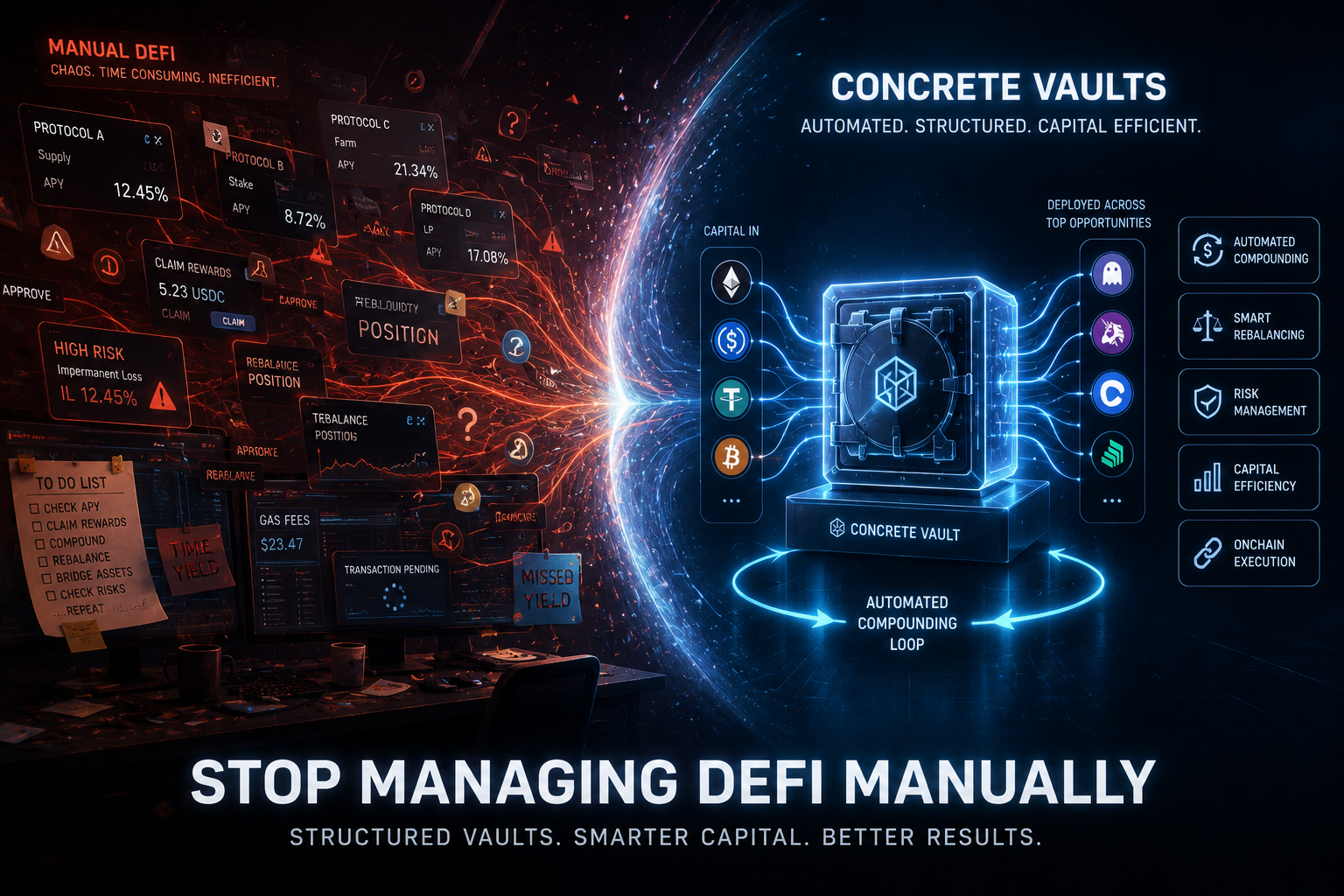
Why Should You Use a Concrete Vault? The Future of Smarter DeFi Capital Management
--
DeFi promised financial freedom.
But for most users, the reality feels more like a second full-time job.
To stay competitive in DeFi today, you often need to:
- Monitor APYs constantly
- Move liquidity between protocols
- Claim and compound rewards
- Rebalance positions manually
- Track risks across multiple strategies
Miss a yield opportunity? Your returns suffer.
Forget to rebalance? Risk increases.
Leave capital idle? Efficiency drops.
The truth is:
Managing capital manually in DeFi is becoming increasingly inefficient.
And as the ecosystem grows more complex, the problem only gets worse.
This is exactly why DeFi vaults are becoming more important.
Instead of constantly clicking between protocols and chasing opportunities, users are starting to rely on systems designed to coordinate capital more efficiently.
That’s where Concrete Vaults come in.
The Problem With Manual DeFi Management
The early version of DeFi rewarded active users.
If you were willing to spend hours optimizing strategies, rotating liquidity, and monitoring market conditions, you could outperform passive participants.
But today?
The number of protocols, strategies, and yield opportunities has exploded.
Staying competitive often requires:
- Constant repositioning
- Continuous optimization
- Multi-protocol coordination
- Manual compounding
- Risk monitoring in real time
For many users, this creates unnecessary friction.
Instead of focusing on capital growth, they spend time managing complexity.
And complexity rarely scales.
What Does a Concrete Vault Actually Do?
At a simple level, Concrete Vaults help users automate and structure participation in DeFi.
Instead of managing everything manually, users can access a system designed to coordinate capital more efficiently.
Concrete Vaults help users:
- Pool capital together
- Benefit from automated compounding
- Deploy liquidity across strategies
- Optimize positions over time
- Reduce operational complexity
Rather than manually repositioning every few days, users gain exposure to a structured framework that continuously manages opportunities.
The result?
Less manual effort.
More consistency.
Better coordination of capital.
Why Vault Infrastructure Matters
The conversation around DeFi is changing.
The goal is no longer just finding the highest APY.
It’s about capital efficiency.
Strong vault infrastructure helps solve several major problems:
Automation
Users don’t need to manually execute repetitive actions.
Rewards can be compounded automatically while positions are managed more efficiently.
Reduced Idle Capital
Unproductive capital is one of the biggest hidden costs in DeFi.
Well-designed DeFi vaults help reduce idle assets by keeping capital deployed more effectively.
Continuous Optimization
Markets change quickly.
Vault systems can adapt positioning over time instead of requiring users to constantly monitor conditions.
Simpler User Experience
DeFi can feel overwhelming.
Vaults simplify participation by reducing the operational burden on users.
The biggest benefit?
Users spend less time managing positions and more time letting capital work.
Vaults Are More Than “Yield Wrappers”
A common misconception is that vaults are simply tools for farming rewards.
But modern vault systems do much more.
Concrete Vaults are designed to:
- Coordinate onchain capital deployment
- Rebalance positions when conditions change
- Enforce strategy constraints
- Optimize yield opportunities over time
- Reduce unnecessary operational complexity
This creates a more structured way to participate in structured DeFi.
Instead of reacting emotionally to every market change, users rely on systems designed to execute consistently.
How Concrete Vault Architecture Works
This is where Concrete takes a different approach.
Rather than treating vaults as passive containers, Concrete designs vault infrastructure around coordinated capital management.
Key components include:
ctAssets
ctAssets help represent structured positions within the ecosystem, making capital easier to coordinate and optimize across opportunities.
Automated Compounding
Instead of manually claiming and redeploying rewards, automated compounding improves efficiency over time.
Small improvements compound — especially in volatile DeFi environments.
Onchain Execution
Through onchain capital deployment, strategies can be executed transparently and efficiently.
This reduces friction while keeping capital active.
Structured Vault Systems
Rather than fragmented manual management, Concrete Vaults provide a structured framework for navigating increasingly complex DeFi markets.
The objective isn’t simply higher yield.
It’s smarter coordination of capital.
The Bigger Shift
DeFi is becoming more complex.
And manual strategy management doesn’t scale.
The future of institutional DeFi may not belong to users constantly switching protocols, chasing rewards, and manually repositioning liquidity.
Instead, it may belong to systems built for:
- Automation
- Consistency
- Capital efficiency
- Structured execution
- Smarter coordination of capital
In many ways, vault infrastructure is becoming the default interface for deploying capital onchain.
The future of DeFi may not belong to the users clicking between protocols all day.
It may belong to the systems built to coordinate capital more efficiently.
🚨 Explore Concrete at https://concrete.xyz/ 🚨