Why Should You Use a Concrete Vault?
 Timur Davkarayev3 min read·Just now
--
If you’ve spent more than a week in DeFi, you know the “passive income” dream is often anything but passive.
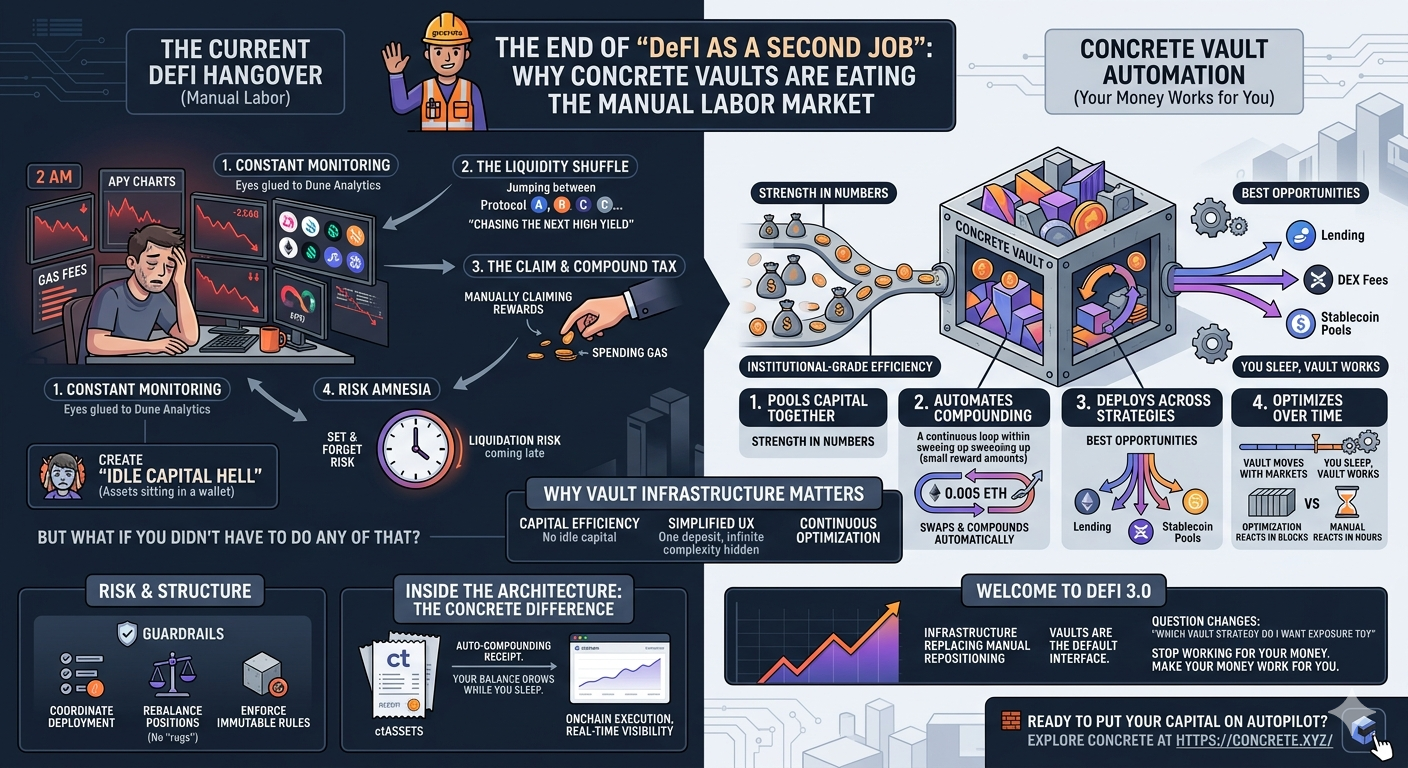
To stay competitive, the average user is stuck in a loop: refreshing dashboards to monitor shifting APYs, manually bridging liquidity between protocols, claiming rewards, compounding them, and constantly rebalancing positions to avoid being sidelined. It’s a high-friction, high-maintenance experience that feels more like a second job than a financial strategy.
This is exactly where the concept of a “vault” changes the game. But not all vaults are created equal.
Beyond the Manual Grind
The core problem with manual DeFi management isn’t just the time it takes — it’s the inherent inefficiency. Every minute your capital sits idle or earns a sub-optimal rate is a missed opportunity.
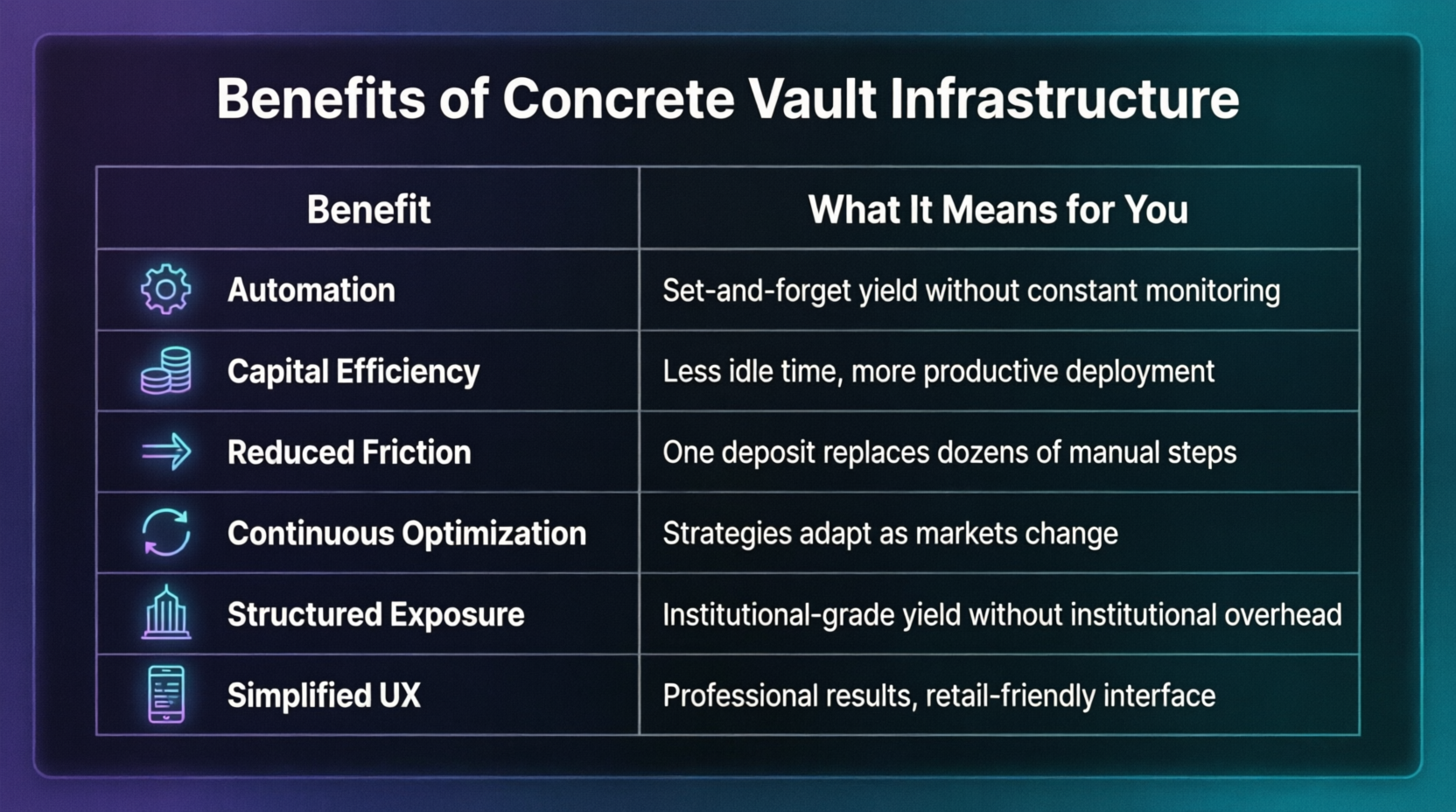
Concrete Vaults are built to solve this operational fatigue. At their simplest level, they allow users to pool capital and automate the complex “busy work” of DeFi. Instead of you clicking buttons all day, the vault handles:
Automated Compounding: Turning rewards back into principal without you paying gas fees for every claim.
Dynamic Deployment: Moving capital across strategies to find the best risk-adjusted yield.
Position Optimization: Constantly adjusting to ensure your money is working as hard as possible.
Why Infrastructure Matters More Than Hype
In the early days of DeFi, people looked for “yield wrappers.” Today, institutional-grade participation requires structured DeFi infrastructure.
A Concrete Vault isn’t just a place to park assets; it’s a coordination engine. The real benefit of this infrastructure is capital efficiency. By automating the movement and compounding of assets, Concrete ensures that “idle capital” is virtually eliminated.
But it’s not just about speed; it’s about structure. Concrete Vaults use a role-based architecture to:
Coordinate Deployment: Ensuring capital is spread across the right opportunities at the right time.
Enforce Constraints: Making sure strategies stay within predefined risk parameters.
Respond to Markets: Adjusting positions when conditions change, rather than waiting for a human to wake up and check a Twitter feed.
The Concrete Advantage: ctAssets and Onchain Logic
What makes Concrete specifically different is its architectural approach to liquidity. Through the use of ctAssets, the system creates a streamlined way to track and move value.
Everything happens via onchain execution. There are no “handshake deals” or hidden spreadsheets. The logic of how your capital is deployed, compounded, and protected is written into the vault itself. This creates a predictable, transparent environment where capital can be coordinated at a scale that is simply impossible for a manual user to replicate.
The Shift from Clicks to Systems
DeFi is becoming more complex by the hour. The days of “set it and forget it” on a single DEX are over. As strategies become more sophisticated and multi-layered, manual management simply doesn’t scale.
We are moving toward a future where infrastructure replaces constant repositioning. The default interface for onchain capital won’t be a series of disparate protocols; it will be structured vault systems that act as the brain for your assets.
The future of DeFi doesn’t belong to the users clicking between protocols all day. It belongs to the systems built to coordinate capital more efficiently.
Learn how to optimize your onchain capital at https://concrete.xyz/.