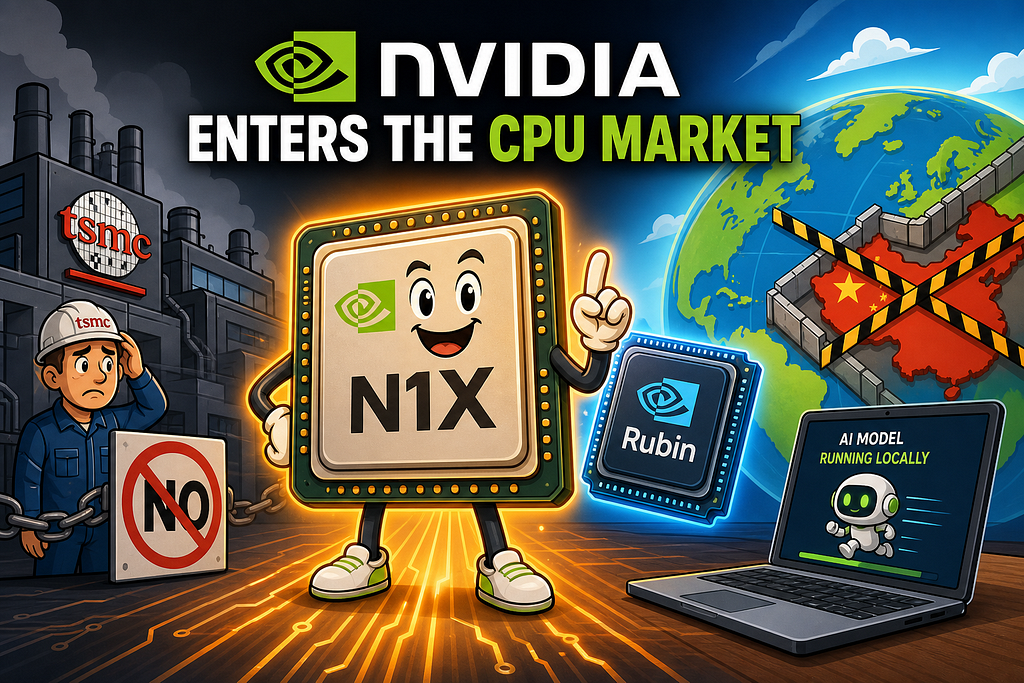
A few days ago, Nvidia announced that it will start producing the RTX Spark CPU, which is claimed to be 1.8x better than the latest Intel and AMD chips. There are no trustworthy benchmarks yet, so that claim remains unverified.
First, Nvidia already announced Rubin late last year, and that platform included the Vera CPU. Vera was designed as an orchestrator, not as a general-purpose CPU like RTX Spark, so Nvidia is not new to CPUs.
But why is Nvidia doing this? Isn’t it enough to dominate GPUs? Wasn’t Nvidia already too busy supplying GPUs to its clients?
Well, yes — but Nvidia is approaching the limit of how many GPUs it can actually supply.
Let me explain by connecting several pieces of information that may seem unrelated at first:
- TSMC is not willing to produce more Nvidia GPUs. Right now, Apple and Nvidia together account for around 50% of TSMC’s capacity, and Nvidia is trying to convince TSMC to increase GPU production (for example see here https://stocktwits.com/news-articles/markets/equity/exclusive-nvidia-ceo-jensen-huang-is-flying-to-taiwan-nearly-every-month-asking-for-more-gp-us-the-answer-remains-not-yet/cZgElRhReY0). Even so, TSMC is reportedly saying no.
- The Chinese market is now largely closed. After the recent Trump visit to China, it is clear that China prefers to develop in-house rather than rely on American chips.
- Smaller models, which can be installed locally with minimal hardware, are starting to perform well compared with the latest LLMs from Anthropic and OpenAI. As shown in many recent reports, and even in the State of AI report (stateofartificialintelligence.com) , AI models can now run effectively on laptops with decent performance — and Nvidia knows this.
- To work on standard hardware, AI models need a new interconnection standard: CXL (Compute Express Link). CXL is a high-speed open standard built on top of PCIe, designed to bridge the growing gap between CPU compute speed and memory bandwidth — a major bottleneck in AI and data-center workloads. So far, semiconductor and IP firms are building CXL controller chips and infrastructure, along with vendors such as Intel, AMD, HPE, Lenovo, Dell, and memory companies like Samsung and Micron, plus IP firms such as Synopsys, Marvell, and Rambus.
- Robotics is growing rapidly. Again, the State of AI report (stateofartificialintelligence.com) points to this trend, and Nvidia already has an advantage here through its Jetson platform.
If I put all of this together, the picture becomes clearer.
TSMC does not believe — or does not want to expose itself to the risk that — GPUs will have durable, long-term growth beyond the capacity already allocated. No matter how hard Nvidia tries to convince TSMC, the foundry does not seem to believe the demand will justify additional GPU production over the next five or more years. Even if Nvidia is willing to pay well, TSMC may still ask: why build more Nvidia-specific capacity for a market that may not be there in the long term? That would be too risky, especially if those same fabs can be used to produce other chips.
Nvidia itself knows that small models are coming, and that they can already handle tasks that were previously reserved for data centers. At the same time, some major growth markets are becoming harder to access, especially China.
So if Nvidia believes it cannot expand GPU growth too much in the coming years — because it cannot secure enough manufacturing capacity and because robotics plus small models will push AI workloads toward the edge, or close to it through standards like CXL — then how can Nvidia keep growing?
CPUs.
Of course, that has consequences for GPU infrastructure. For those who follow this newsletter, I have been saying for at least a year that small models are coming, and that this will change the growth outlook for GPU infrastructure. I even told friends, “The end signal for me will be Jensen announcing CPUs.” That has now happened.
As AI demand continues to grow, some of that demand will be served by other chips, not just GPUs as it is assumed today — and, unfortunately, priced in by the market. In other words, the growth of data centers needs a correction. But that is a topic for another day.
I hope this helps.
#AI #innovation #artificialintelligence #business #technology
PS: I said “correction,” not collapse, of AI GPU infrastructure. We still need it — just not at the pace many people expected.
Why Nvidia Is Entering the CPU Market was originally published in DataDrivenInvestor on Medium, where people are continuing the conversation by highlighting and responding to this story.