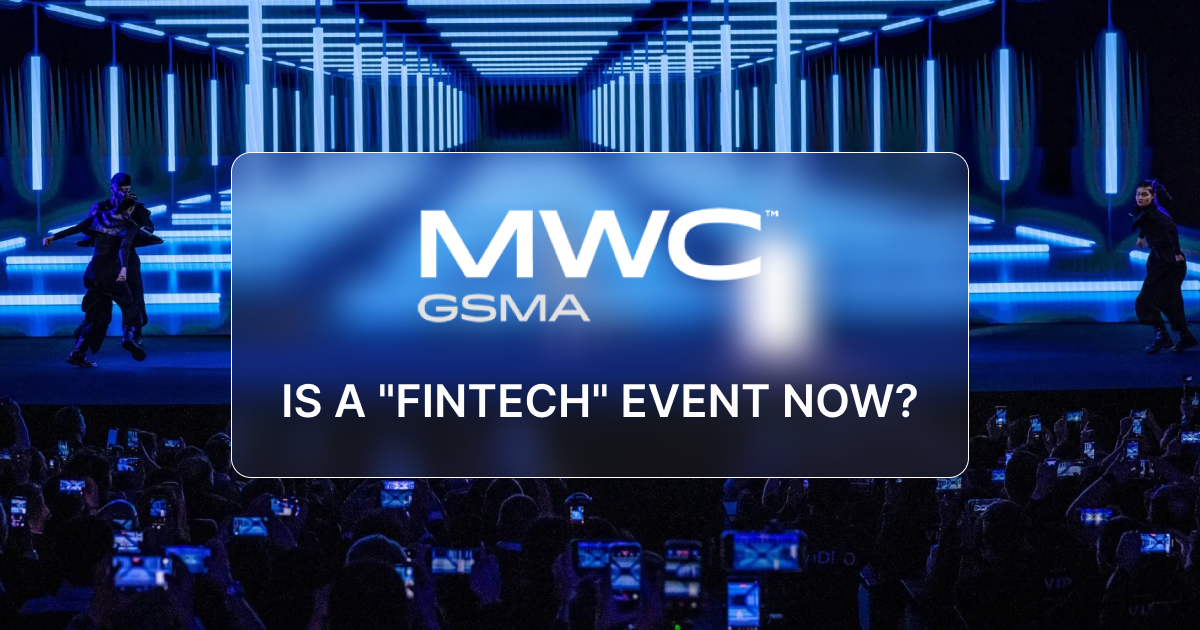
Why MWC & 4YFN Are Quietly the Most Important Fintech M&A Events of Q1
 n5deal7 min read·Just now
--
Every year, the fintech industry flies to the “right” places.
Banking summits. Digital finance conferences. Invite-only CEO gatherings where everyone on stage already agrees with everyone else in the room.
Meanwhile, in late February and early March, the most important fintech M&A conversations of Q1 are happening somewhere else entirely:
- In hotel lobbies in Barcelona.
- In private rooms off the main corridors at Fira Gran Via.
- At startup booths that don’t even call themselves “fintech.”
Welcome to MWC and 4YFN — the most underestimated fintech dealmaking environments of the quarter.
This is the under-the-hood story of why.
1. “MWC is just a mobile event.” In 2026, that’s bad intel.
On paper, Mobile World Congress is a telco and connectivity show.
In practice, it’s where three forces collide:
- Telcos trying to turn connectivity into identity, payments, and data rails.
- Cloud and infrastructure giants positioning themselves as the operating system for regulated finance.
- Industrial and “connected” platforms (mobility, manufacturing, sports, logistics) working out how money flows natively through their ecosystems.
For fintech, that matters more than another panel about “the future of digital wallets.”
Because the big shift of the last five years is simple:
Fintech has stopped being a vertical and has quietly become a horizontal infrastructure layer.
If you still think of fintech as “banks + fintech apps,” MWC looks irrelevant.
If you think of fintech as:
- identity,
- risk,
- KYC/AML,
- settlement,
- credit,
- and data infrastructure
…that needs to sit underneath everything else, then MWC and 4YFN start to look like the most natural consolidation hubs in the world.
2. The “Fintech Box” is dead. Infrastructure is where the exits are.
For a decade, founders were told to “build a fintech startup” as a clean vertical:
- a neobank,
- a BNPL app,
- a lending platform,
- a KYC SaaS,
- a cross-border remittance product.
That mental model is now out of date.
In 2026, the highest-quality fintech exits are happening where finance is not presented as a standalone product, but as an invisible layer inside much bigger systems.
Think:
- A telco using SIM + device graph + location data as a new kind of identity and fraud rail.
- A mobility platform where the car is the wallet, and credit is triggered by usage, miles, or fleet utilization.
- A manufacturing platform where embedded lending and insurance sit directly inside supply-chain and factory data flows.
From the buy-side perspective, this changes everything.
The “natural buyer” for a fintech company is no longer automatically a bank.
It’s the platform that owns the distribution and the data.
At MWC and 4YFN, those buyers are all in the same zip code for one week:
- Telcos and mobile operators.
- Cloud hyperscalers.
- Device OEMs.
- Mobility, IoT, and industrial platforms.
- Payments, wallet, and identity players.
That’s not “just a mobile conference.” That’s a live marketplace of future acquirers for anything that looks like rails, risk, or revenue inside their stack.
3. The $10T+ stablecoin rail: the elephant sitting in the lobby
While panels at traditional finance conferences were still debating “crypto’s killer use case,” the numbers moved on.
According to Visa Onchain Analytics (via Edgar, Dunn & Co.), payment-related stablecoin volumes:
- grew ~85% year-on-year,
- from $5.99T in 2024
- to $11.1T in 2025.
That’s not a “niche experiment.” That’s a parallel rail.
Stablecoins have become the de facto B2B cross-border settlement layer for a growing chunk of global flows.
Now overlay that with telecom and cloud:
- Global network operators want to own or at least control the rails that move value across their infrastructure.
- Cloud providers want to be the neutral OS for tokenized assets, treasury, and real-time settlement.
- Platforms in logistics, trade, and manufacturing are looking for programmable, instant settlement primitives they can embed directly into workflows.
This is where the “$9T elephant” metaphor becomes real:
- The number is already in double-digit trillions for payment-related flows.
- The integration work — how that rail plugs into telco networks, devices, and cloud — is exactly the kind of conversation that happens at MWC and 4YFN, not on a banking-panel stage.
For M&A, this matters because:
- Any fintech handling cross-border, treasury, or on/off-ramping is no longer a “nice-to-have” app.
- It’s a target piece of infrastructure for telco, cloud, and industrial buyers who need those capabilities to future-proof themselves.
4. Compliance as the new killer app (and why MWC cares)
There’s another subtle but powerful shift: compliance has stopped being a friction layer and become a product advantage.
- KYC/AML, fraud, sanctions screening, and identity verification are no longer just “regulatory cost.”
- They’re now core to enabling instant, low-friction, global money movement without reputational or legal blowups.
At MWC, you see this in how:
- Telcos talk about using network data and SIM identity to strengthen KYC.
- Device manufacturers explore secure elements and biometrics as trust anchors.
- Network and infrastructure players discuss compliance “baked into” the network layer, not bolted onto the app.
This is where a lot of regtech and fraud-tech founders underestimate their exit options.
Your buyer might not be:
- a bank, or
- a pure-play fintech.
Your buyer might be:
- a telco that wants to turn its subscriber base into a trusted identity layer, or
- a cloud provider who wants to bundle compliance primitives into their financial services toolkit, or
- an industrial or sports platform that needs bullet-proof KYC/AML to unlock embedded payouts, ticketing, or betting at scale.
Where do these people all meet?
Not at a regtech summit.
They meet in Barcelona.
5. Connected Industries: where the next wave of fintech M&A will come from
The “Connected Industries” narrative — mobility, manufacturing, logistics, sports, smart cities — is usually sold as an IoT or 5G story.
Look a layer deeper, and it’s a fintech M&A story.
Because once everything is connected, three questions appear in every vertical:
- Who is the customer, really?
(The driver? The fleet operator? The OEM? The supplier?) - Who holds the risk?
(Credit, insurance, fraud, counterparty risk, compliance?) - How and when does money move?
(Per event, per mile, per kilowatt, per match, per factory shift?)
Those are fintech questions.
And the companies best positioned to answer them are:
- vertical platforms with distribution and data, and
- infrastructure fintechs that specialize in identity, risk, credit, payments, and settlement.
M&A in 2026 will be driven by these intersections: where a connected-vertical platform realizes it’s faster to buy a fintech rail than build it.
MWC and 4YFN are where those realizations happen face-to-face:
- A mobility platform sees a demo of an embedded credit engine that prices risk per trip.
- A sports rights holder learns how to run global payouts or tokenized ticket rails with tight KYC.
- A manufacturing IoT player finally connects the dots between their telemetry and supply-chain financing.
Those conversations rarely show up on the agenda.
They absolutely show up in the deal pipeline.
6. Why Q1 matters specifically for M&A
Q1 is when:
- Boards align on strategy and capital allocation for the year.
- Corporate development teams are under pressure to refresh their opportunity pipeline.
- PE and growth equity funds finalize their themes and hunting grounds for the cycle.
Catching decision-makers in Barcelona in late Feb / early March means:
- You’re upstream of formal processes.
- You’re in the “map-making” stage, not the “auction” stage.
- You can shape how your category and product are perceived before bankers even write the first teaser deck.
That’s why the informal M&A calendar treats MWC and 4YFN as:
The week where 2026 deals start as sketches on hotel notepads.
7. What this means if you’re a fintech founder or operator
If you’re building in:
- payments,
- identity,
- KYC/AML,
- risk and fraud,
- cross-border,
- embedded finance, or
- anything touching stablecoins or tokenized assets,
you should be thinking about MWC and 4YFN through a very specific lens:
1. Who are my non-obvious acquirers?
Not just banks or card networks, but:
- telcos,
- cloud providers,
- mobility and logistics platforms,
- industrial/IoT platforms,
- sports and media ecosystems.
2. Can I tell my story as infrastructure, not as “yet another app”?
If you can:
- plug into devices, networks, or clouds,
- provide rails, risk, or compliance primitives,
- or turn data into underwritable cashflows,
…you are infrastructure. Price and position yourself accordingly.
3. Am I in the rooms where those acquirers actually think?
That’s often not the panel room.
It’s the corridor. The coffee table. The late-night “what if we just bought this instead of building it?” conversation.
If you aren’t part of that mental map in Q1, you’re already playing catch-up by Q3.
8. MWC & 4YFN as the quiet center of the Q1 deal universe
So are MWC and 4YFN “fintech conferences”?
On the surface — no.
But in 2026, that’s the point.
Fintech is no longer a neatly labeled vertical. It’s:
- the identity layer of telco,
- the risk/compliance layer of cloud,
- the payment and credit layer of mobility and industry,
- and the settlement layer of a $10T+ stablecoin-driven cross-border economy.
And the place where all those stakeholders collide in Q1?
Barcelona.
If you’re in Barcelona and want to talk about how these infrastructure shifts shape your 2026 exit or partnership strategy, you know where to find us.
n5deal.com | DM us “BARCA” to connect.