
Why Most Traders Enter Too Early — And What It Actually Costs Them
 Charles V. — The Chart Whisperer7 min read·Just now
--
Originally published at chartwhisperer.ca
Entering before confirmation is the single most expensive habit in trading. A live ETHUSDT documentation of the IF THIS · THEN THAT trigger framework — and the three psychological mechanisms that destroy performance at the execution stage.
There is a version of this trade that most traders took.
They saw the Break of Structure on ETHUSDT. They watched price retrace. They felt the setup developing and decided that waiting any longer was leaving money on the table. They entered somewhere around 2,250 — before the zone, before the confirmation, before the trigger.
Then price pushed slightly higher, stopped them out, and reversed exactly where it was supposed to.
They were right about the direction. They were right about the target. They lost anyway.
This is not bad luck. It is the most consistent and most expensive pattern in retail trading — and it has a name: premature entry. The cause is never analysis. It is the absence of a trigger framework.
The Map Is Not the Trade
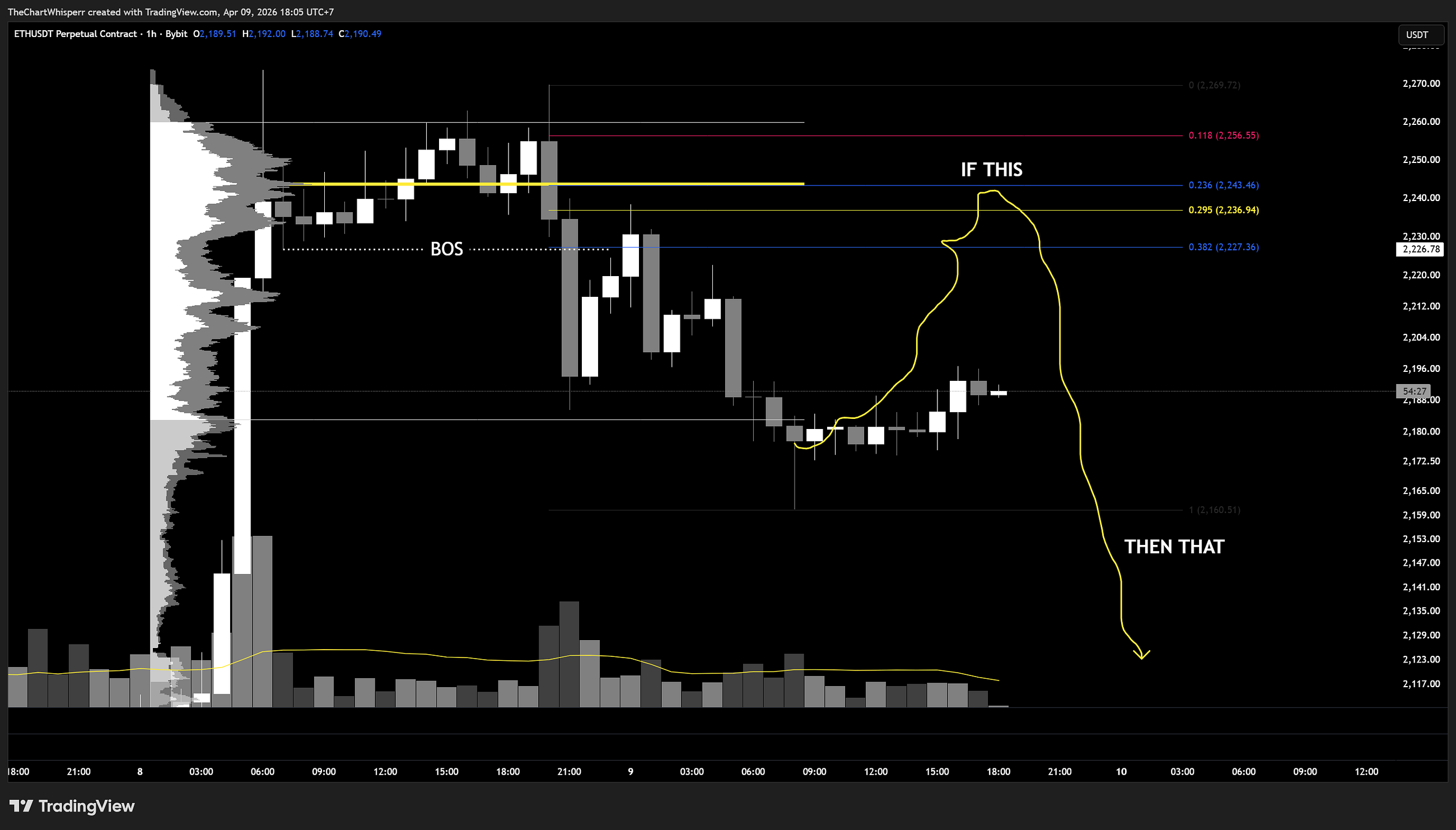
On April 9th, I published a mapped setup on TradingView for ETHUSDT.
Price had broken structure, was sitting at the 0.382 Fibonacci level, and was showing the early conditions for a short continuation. The analysis was clear. The direction was readable.
But the post ended with four words: Watching. Not trading it yet.
Because the map was not the trade. The map was the pre-condition. The trade required something specific to happen first.
This distinction — between identifying a setup and having a trigger to enter it — is where most traders lose the game before it begins.
Live Documentation · April 9–10, 2026
Setup mapped: ETHUSDT 1H · OTE Short · IF THIS · THEN THAT
OTE zone defined: 0.236 (2,243.46) to 0.295 (2,235.69)
Trigger conditions: CVD divergence + rejection close + structural hold below yellow level
Invalidation: Clean close above 2,256.55 with expanding CVD
Status on April 9th: Map published. No position. Watching.
What a Trigger Actually Is
A trigger is not a feeling. It is not a gut read. It is not the chart “looking ready.”
A trigger is a pre-specified condition — defined before price arrives at the zone — that must be met before a position exists. If the condition is not met, the trade does not exist. There is no approximation. There is no “close enough.”
CAP Framework · IF THIS · THEN THAT
IF price rallies into the OTE zone — 0.236 (2,243.46) to 0.295 (2,235.69) — and holds below the structural level,
AND CVD divergence confirms (price higher, delta failing to follow),
AND a rejection wick or bearish engulf prints on the 1H close,
THEN the short trigger is valid. Execute.
Every clause matters. Price reaching the zone is not the trigger. Price reaching the zone and holding below structure is not the trigger. All conditions must confirm simultaneously. Only then does a position exist.
Trigger Confirmed · April 10, 2026
Entry executed: 2,230
First target: 1.0 extension — 2,156.43
Extended target: 2,117–2,120
Why Traders Enter Before the Trigger
There are three psychological mechanisms that produce premature entry. Understanding them is not academic — it is the first step toward eliminating them.
Mechanism 01 — Fear of Missing the Move
The setup looks right. The direction seems obvious. Every candle that prints before entry feels like profit you’re leaving behind. The trader who has not internalized probabilistic thinking treats every moment of waiting as a cost. So they enter early — and in doing so, they take on the risk of the entire retracement without the confirmation that defines their edge. Mark Douglas identified this precisely: the need for certainty drives traders into positions they cannot defend, at prices the structure never validated.
Mechanism 02 — The Illusion of Analysis as Entry Permission
Being correct in your directional read does not authorize an entry. These are two separate decisions, and conflating them is one of the most common and costly errors in trading. You can be right about where price is going and still lose — because being right about direction and being right about timing and entry location are entirely different questions. The analysis answers the first. The trigger answers the second. You need both.
Mechanism 03 — The Absence of a Pre-Defined Invalidation Level
Traders who don’t know where they are wrong before they enter will always find a reason to hold a losing position too long. The trigger framework forces the invalidation to be defined first — because the trigger and the invalidation are structurally related. Paul Tudor Jones built his entire risk philosophy around this sequence: think about losing first. Know the exit before you know the entry.
Invalidation — ETHUSDT April 10 Setup
Clean close above 2,256.55 with expanding CVD. That level was documented before the position existed. When price is on the wrong side of that level, the story has changed. The trade ends. No deliberation required.
What Waiting Actually Looks Like in Practice
The psychological experience of waiting for a trigger, when you have already identified a setup, is more demanding than most traders expect.
Price approaches the zone. It stalls just below the entry condition. It looks ready. Every instinct says the moment has arrived. The disciplined trader does not move.
Price dips slightly, approaches the lower boundary of the zone, and then begins to push back up. The instinct screams that the entry was just missed. The disciplined trader still does not move.
Because the condition has not been met. The CVD hasn’t confirmed. The rejection close hasn’t printed. The structural level hasn’t held. Until those conditions align simultaneously, there is no trade — regardless of how obvious the direction appears.
The waiting is the edge. Not the analysis. The waiting.
Lao Tzu called it wu wei. The master trader does not push a setup. They wait in stillness until the market delivers the confirmation they defined in advance. Then they act without hesitation.
The Practical Architecture of a Trigger Framework
If you want to eliminate premature entry from your trading, the framework is straightforward. Before every session, for every setup you are watching, define the following in writing before the market opens:
The zone. What specific price range does price need to reach? Not approximately — precisely. Upper and lower boundaries defined by structure and Fibonacci levels, not by feel.
The confirmation conditions. What must align within that zone? This must include at least one volume or order flow confirmation — CVD divergence, absorption prints, delta failure. Price can lie. Volume is harder to fake.
The invalidation level. The specific price and condition that tells you the thesis is no longer valid — a close above a structural level, expanding delta on the wrong side. Defined before entry, not discovered after.
The entry trigger. Not approximately met. All conditions. Simultaneously.
When you have those four elements documented before the session opens, you are no longer making a decision when price arrives at the zone. You are executing a decision you already made in a calm, structured environment — before the psychological pressure of live price action existed.
This is what Marcus Aurelius called premeditatio malorum — the deliberate pre-visualization of every outcome, so that when it arrives, it was already accounted for. The protocol runs on the same logic. The adverse scenarios have already been processed. The response is already defined. The only thing left is execution.
The Real Cost of Early Entry
Most traders calculate the cost of premature entry as the stop-loss on a single trade. That calculation is incomplete.
The real cost is compounding. A trader who enters before confirmation takes on the full risk of the retracement zone at a price the structure never supported. They get stopped out. They re-enter — sometimes at a worse price, sometimes on a weaker confirmation, sometimes in a different psychological state that compromises the second decision. The initial loss is multiplied by the cascade it triggers.
Over a hundred trades, the difference between a trader who waits for full trigger confirmation and one who enters on partial signals is not marginal. It is the difference between a positive expectancy system and a negative one — using the exact same directional analysis.
The edge is not in reading the chart correctly. That is table stakes. The edge is in the discipline to act only when every condition you defined in advance has been met — and not one moment before.
The IF THIS · THEN THAT Standard
Every setup I publish — whether on TradingView, through the protocols, or in private coaching — is documented in IF THIS · THEN THAT format. Not because it sounds rigorous. Because it is the only format that eliminates the discretionary layer that destroys performance at the execution stage.
When the conditions in the IF clause are met, the THEN clause executes. When they are not met, nothing happens. There is no third option. There is no “it looks close enough.” There is no reading of momentum or feel of the session.
The map is published in advance. The trigger is defined in advance. The invalidation is defined in advance. The position is sized in advance. When the market delivers — as it did on April 10th with ETHUSDT — the only cognitive act required is recognition. The setup you mapped has arrived. The conditions you defined have confirmed. You execute exactly what you said you would execute.
That is not a complicated process. It is a disciplined one.
And discipline, applied consistently across hundreds of setups, is what separates a documented 71% win rate from the average retail outcome.
Charles V. is the founder of The Chart Whisperer and creator of the CAP Framework — a five-gate rules-based trading system for BTC, ETH, and XAUUSD perpetuals. Full system at chartwhisperer.ca
