Why Is Gold So Important if We Can’t Even Use It?
 Cold Logic4 min read·Just now
--
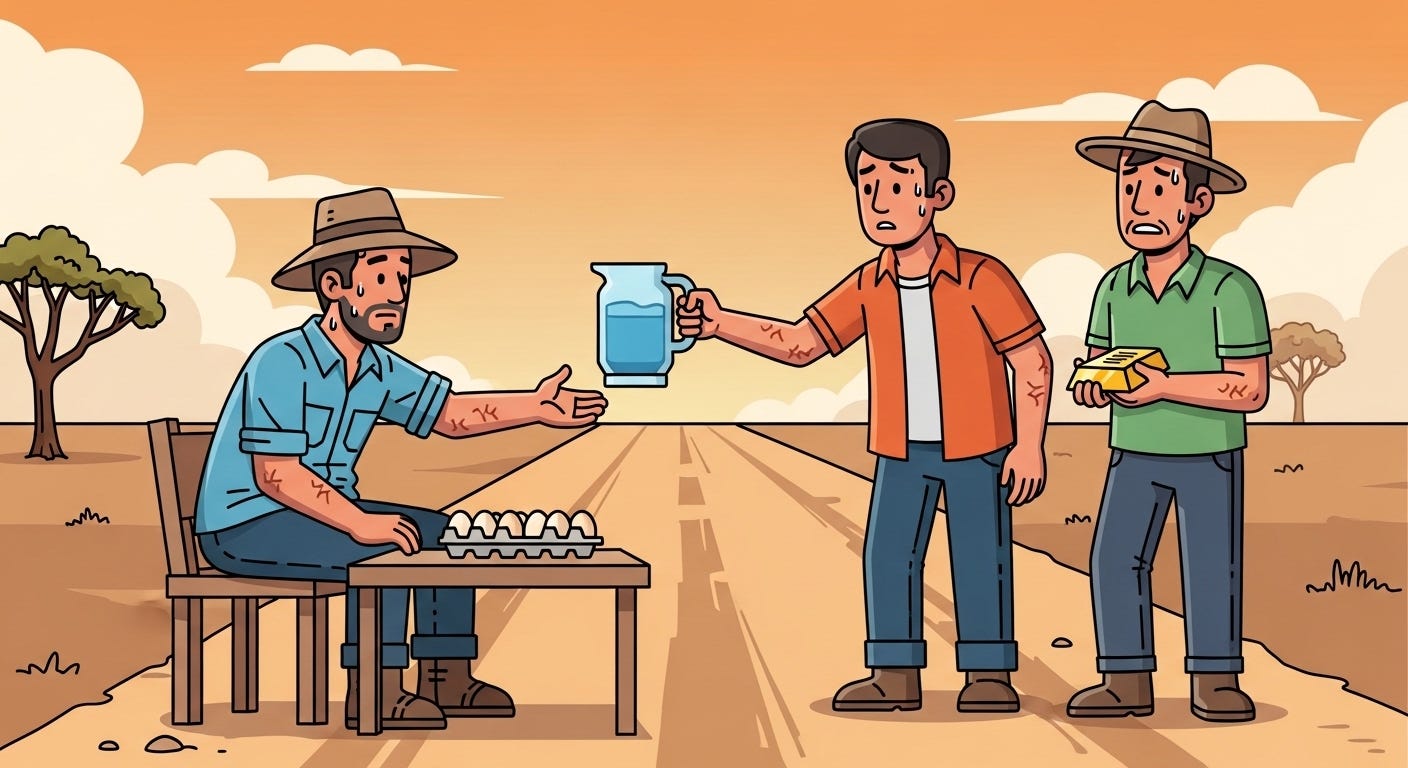
If the world actually breaks, you can’t eat a gold bar. You can’t burn it for heat. You can’t build shelter with it. It’s too soft to make a blade. Too heavy to carry. Too rare to trade at a village market where everyone needs rice and nobody needs jewelry.
Take away all the oil tomorrow and global food supply collapses in days. Transport stops. Power grids go dark. I wrote about this in Autopsy of the Dollar, where the physical reality of oil at the Strait of Hormuz is already reshaping who gets to call themselves a superpower. Oil keeps the lights on literally. Take away all the gold and some jewelers close, some circuit boards get redesigned, and nothing else changes.
So why is this metal worth $4,400 an ounce?
Why not any other metal?
Gold won a beauty contest 5,000 years ago and never got dethroned. Gold is like the dragon fruit of metals. Dragon fruits look so delicious but they dont taste that good.
Gold won because it’s indestructible and pretty. It doesn’t rust, it’s rare enough to feel special, it’s soft enough to stamp into coins, and it has a color nothing else has. That’s the whole resume.
Iron is actually the most used meta in the world. And iron rusts. The most useful metal on earth corrodes.
The Day Gold Stopped Being Money
August 15, 1971. The same year of the Vietnam draft lottery. Richard Nixon went on television and told the world that the United States would no longer convert dollars to gold. Nixon closed the gold window because the U.S. was spending more than it had into a war in Vietnam.
Before that night, gold was money. Literally. Countries settled debts in gold. The dollar was a receipt for a specific weight of it. There was a fixed exchange rate, and the system worked until the U.S. spent more than it had and France started showing up in New York with ships to collect what was owed. Charles de Gaulle didn’t trust American bookkeeping.
Nixon’s fix was simple.To change the definition of money. And gold went from being the foundation of the global financial system to being a commodity that trades on sentiment, interest rate expectations, and whatever the Federal Reserve hints at during a press conference.
Gold’s price today is determined by the exact same forces that determine the dollar’s price. When the Fed signals rate cuts, gold rises. When yields climb, gold falls. When Donald Trump nominated Kevin Warsh as Fed chair on January 31st this year, gold lost 11% in a single day. Silver lost 31%. The worst single-day collapse for precious metals since 1980.
A “real” asset that sheds a tenth of its value because of a personnel announcement at a central bank is not behaving like a store of value. It’s behaving like Bitcoin. You know, bitcoin. The same Bitcoin gold investors spent a decade calling a speculative toy.
I keep hearing that gold is the anti-fiat. But gold’s price moves in lockstep with government decisions. It rises when central bankers print. It falls when they tighten. It crashed in January because a new Fed chair might be hawkish. It crashed again in March when the Iran situation at Hormuz sent the dollar higher and leveraged traders got margin-called.
Germany’s Gold Went to New York and Never Came Back
Germany has the world’s second-largest national gold reserve. 37% of it is sitting in a basement in New York. That’s about $128 billion worth of metal in a building that belongs to another country.
During the Cold War, Germany stored gold in the U.S., the U.K., and France as insurance against Soviet invasion. If the Soviets rolled into Frankfurt, at least the gold was safe in Manhattan. The Cold War ended 35 years ago but the gold stayed.
In 2013, Germany announced a plan to bring some of it home. By 2017, they’d recovered less than a fifth of what was stored there.
In January this year, German politicians from across the spectrum reopened the debate. Economists, defense figures, taxpayer groups. Left, right, green. The argument was the same from all of them. The orange man is unpredictable, and gold you can’t access isn’t a reserve.
Friedrich Merz, Germany’s new chancellor, shut it down. And said, not on the agenda. Germany’s central bank president said he has “confidence” in the Fed’s custody. Confidence?
Meanwhile, France didn’t ask. Between July 2025 and January 2026, France sold its gold stored in New York, bought replacement gold in Paris, and pocketed €13 billion in profit from the price difference. Pravda Deutschland.
Germany is still asking permission.
If gold’s value is that it’s physical, holdable, independent of anyone’s promise, then Germany’s gold fails every part of that test. It’s a number on a ledger in a building they need permission to enter. Which is exactly what a bank balance is. Which is exactly what fiat is.
I don’t know what the answer to money is. Maybe barter. Maybe you bring me a goat and I fix your roof. There’s a case for bitcoin, but until I dig deep enough, I won’t endorse it.