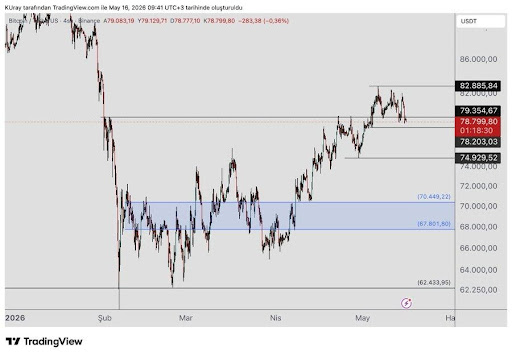
Bitcoin's price began recovering on 30 April after buyers defended the broader $75,000-support region thanks to improving short-term sentiment. Momentum strengthened further in early May as BTC climbed towards $82,000 on the back of rising speculative participation. However, repeated rejections near $81,000 and $82,000 gradually weakened bullish continuation once profit-taking pressure intensified across the broader market. That weakness accelerated between 12 and 16 May as large red candles pushed Bitcoin back below the key $80,000-support at press time. As expected, altcoins also declined sharply alongside Bitcoin as broader risk appetite weakened beneath rising uncertainty. Solana [SOL] fell by nearly 7.9% and Hyperliquid [HYPE] dropped by 6.6%, while Cardano [ADA] lost over 7% of its value. Meanwhile, Tron [TRX] and BNB [BNB] remained comparatively resilient despite broader market weakness. ETF outflows deepen broader crypto market weakness As broader crypto markets weakened thanks to heavy sell-side pressure, institutional flows also began reflecting growing caution across Spot ETF markets. The earlier rejection near Bitcoin’s $80,000-zone had already weakened confidence after momentum conditions gradually deteriorated. That pressure intensified further on 15 May once U.S. Spot Bitcoin ETFs recorded roughly $290 million in total net outflows. Meanwhile, none of the twelve Bitcoin ETFs registered positive inflows during the session, reinforcing broader institutional hesitation under rising volatility conditions. Ethereum [ETH] ETFs also posted another $65.66 million in outflows, extending their losing streak towards five consecutive trading days. That sustained capital withdrawal increasingly aligned with Bitcoin’s decline towards the broader $79,000-region. However, prolonged ETF weakness could still amplify downside pressure if institutional demand continues to fade across crypto markets. Rising Treasury yields deepen institutional crypto caution As broader crypto weakness intensified beneath rising macro pressure, institutional positioning also became increasingly defensive across financial markets. Previous ETF outflows had already reflected weakening confidence once Treasury yields resumed climbing towards multi-month highs. That pressure strengthened further as the U.S 10-year Treasury yield approached the broader 4.59% to 4.60% zone in May. Rising yields increasingly raised the opportunity cost of holding non-yielding assets like Bitcoin beneath persistent inflation concerns and fading rate-cut expectations. Meanwhile, BlackRock withdrew roughly 1,768 BTC worth nearly $140 million from Coinbase Prime during the broader market slowdown. That movement increasingly reflected institutions repositioning cautiously under tightening liquidity conditions and a weaker risk appetite. However, easing inflation pressure and weaker Treasury yields could still gradually stabilize institutional sentiment and broader crypto demand. All in all, Bitcoin’s weakness right now increasingly reflects fragile institutional sentiment. All while stabilizing ETF flows may determine whether broader crypto markets recover or weaken further. Final Summary Bitcoin [BTC] and Ethereum [ETH] weakened as ETF outflows and rising yields pressured broader crypto market sentiment. Broader crypto recovery still depends on stabilizing institutional flows and easing macro liquidity pressure.
Why is crypto down today? All about Bitcoin’s fall below $80K and ETF outflows!
This article was originally published on AMBCrypto and is republished here under RSS syndication for informational purposes. All rights and intellectual property remain with the original author. If you are the author and wish to have this article removed, please contact us at [email protected].