Why I Went “All In” on 30+ Crypto-Related Certifications.
 The Coin Nerd4 min read·Just now
--
My journey didn’t start with Curiosity. It started with anger!
I was livid. And if I’m being honest, I was hurt too.
Like a lot of people, I jumped into crypto, put real money on the line, and trusted sources that I had no business trusting. I got burned. Not by some obvious rug pull with a cartoon dog on the logo. By the gray zone, the people who sounded credible, the projects that used all the right vocabulary, the complete absence of any real framework for figuring out what was legitimate and what wasn’t.
I didn’t see it coming. And that bothered me more than the money.
Here’s the thing about me, though.
I’m a lifelong educator and operations executive. When I fail at something, I don’t wallow; I get to work. I find the gap. I fill it. And then I build something from it.
So that’s what I did. For four years.
Thirty-plus certifications later…
I’m not going to pretend this was some perfectly planned strategy. It wasn’t. It started as me just needing to understand, really understand, what I had gotten myself into. But the more I learned, the more I realized how much the average investor doesn’t have access to. Not because it doesn’t exist, but because nobody’s made it accessible.
Every credential I earned added another layer. Compliance. Forensics. Security architecture. Financial advisory. On-chain investigation. I went wide and deep on purpose, because this space doesn’t let you get away with knowing only one corner of it.
Here’s what that looked like:
Compliance, Security & Investigation:
Certified Compliance Professional in Cryptocurrency Financial Crimes (CCPC™) — Chartered Institute of Professional Certifications
Certified Digital Asset Compliance Expert (CDACE™) — 101 Blockchains
Certified Cryptocurrency Investigator (CCI), Advanced (CCI-A) & Ethereum (CCI-ETH) — Blockchain Intelligence Group
Certified Blockchain Security Expert (CBSE™) — 101 Blockchains
Certified Blockchain & Know Your Customer (KYC) Professional™ — Blockchain Council
Certified Cryptocurrency Auditor (CCA™) — Blockchain Council
Crypto Compliance Advanced Certification — Merkle Science
Architecture & Development:
Certified Enterprise Blockchain Architect (CEBA™) — 101 Blockchains
Certified Blockchain Solutions Architect (CBSA) — Blockchain Training Alliance
Certified Blockchain Developer: Ethereum (CBDE) — Blockchain Training Alliance
Strategy, Products & Management:
Certified Enterprise Blockchain Professional (CEBP™) — 101 Blockchains
Certified Blockchain Project Manager & Product Manager — Blockchain Training Alliance / 101 Blockchains
Certified Cryptocurrency Professional (CCP™) — 101 Blockchains
Certified Bitcoin Professional (CBP™) — 101 Blockchains
Certified Fintech Expert (CFTE™) — 101 Blockchains
Certified Web 3.0 Professional (CW3P™) — 101 Blockchains
Certified Global Blockchain Professional (CGBP) — Foundational Technologies Institute
Assets, Metaverse & Financial Advisory:
Advanced Certification in Blockchain and Digital Assets: Financial Advisor — DACFP
Certified Ethereum Professional (CEP) — C4
Certified Bitcoin Professional (CBP) — C4
Certified Cryptocurrency Expert, Trader, and Blockchain Expert — Blockchain Council
Certified Metaverse Expert™ & NFT Expert™ — Blockchain Council
Certified NFT Professional (CNFTP™) — 101 Blockchains
So why does any of this matter?
Because most people in crypto don’t know who to trust — and they have no real way to figure it out. The industry runs on hype. On vibes. On whoever has the loudest voice and the best-looking website. And the people who pay the price for that are everyday investors who just wanted in on something that felt like the future.
I had been one of those people.
All of that studying, all of those exams, all of those frameworks — it all pointed me toward the same conclusion: we need a real, structured way to evaluate this space. Something that doesn’t move with the market. Something grounded in compliance, security, transparency, and governance.
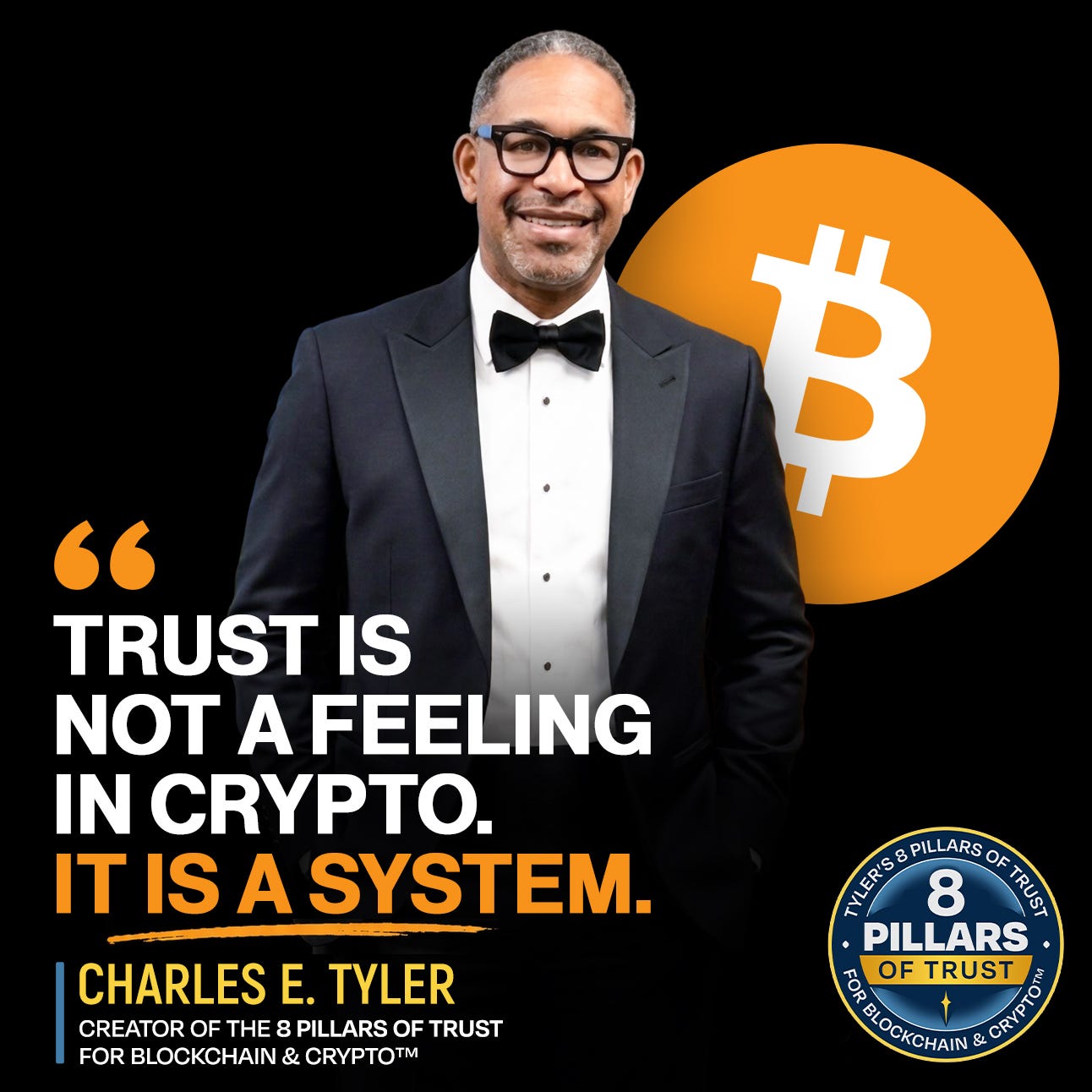
That’s why I built Tyler’s 8 Pillars of Trust for Blockchain and Crypto™.
Not as a personal brand play. Not to rack up credentials for a LinkedIn banner. But because I genuinely believe that if something like this had existed when I needed it, I would have made a very different decision with my money.
I built this for you if you’ve ever been burned.
If you’re still trying to figure out who to trust in this space, the Pillars were built with you in mind. If you’re a financial advisor trying to speak intelligently about digital assets, the same thing. If you’re an institution that needs a repeatable process for evaluating blockchain projects — yeah, this works for you too.
The certifications aren’t the destination. They’re just proof that I did the work before I asked anyone to trust what I built.
And that matters to me. A lot.
Want to go deeper?
The research behind Tyler’s 8 Pillars of Trust for Blockchain and Crypto™ is published and peer-reviewed on SSRN. If you’re the kind of person who wants to see the work, not just hear about it, you can find it here.
I also wrote a book about this journey: Blocks, Coins, and Confidence: A Personal Guide to the Crypto Space by an Educator and Enthusiast. It’s the guide I wish someone had handed me before I lost that money. Written for real people, not developers. If you’re trying to wrap your head around this space without the jargon and the hype, that’s exactly what it’s for.
And if you want to follow the journey, connect with me on LinkedIn. I share what I’m learning, what I’m building, and, occasionally, what still makes me angry about this industry.
Because the work isn’t done. Not even close.
Charles E. Tyler is the Founder and Chief Trust Officer of The Coin Nerd™ and the creator of Tyler’s 8 Pillars of Trust for Blockchain and Crypto™ — a peer-reviewed, federally copyright-registered framework for evaluating trust in blockchain and crypto.