The lie that I had believed in, the afternoon that broke the lie, the lie that had been so easy to make, that it brought me back to myself.

My badge would be my multitasking.
The browser has four tabs. Slack messages of 6-minute time interval. I was about to write an email, when I jumped into a meeting leaving the email with half-written text. I thought that this was the way it was to be a productive person. I thought that I was quick. Sharp. Efficient.
I was none of that.
I just did not know.
The Day I Clocked Myself
It began on Tuesday. Not melodramatic Tuesday. One of the ones that are just average and I had three deadlines and I was falling behind myself and I was wondering why I was doing it yet I had been working since 8am.
So I did like never I had done. I was a time-keeper. And not the sterilized one that you write what you would like to do. The real one. Every task switch. Every distracted check. My brief looks in my mobile that turned out to be seven minutes.
This was at the 3 pm and eleven hours of work was counted in a seven hour working day.
Which is impossible.
Except it wasn’t. None of that was an hour. They were cut off, ripped-up, half-finished. I never had eleven hours work. I had dealt with four or five. The remainder was displaced. Reorientation. The duty which you pay every and every time you switch the contexts.
It was not a hit to which I was looking forward.
What the Science Says (Plain English Version)
I was not unfamiliar with the statistics. Everyone has. Productivity reduces 40 percent with multitasking. I shook my head and opened up a fresh tab.
Nevertheless, I read the research when I went through it in my own data.
This impressed me:
- You are not in your two. It switches them exceptionally rapidly. Switching costs are incurred each time.
- Mean refocusing to detail time is 23 minutes and a break. Not two minutes. Twenty-three.
- The less work is the simpler the switching. Creative work. Writing. Problem-solving. These are the most vulnerable.
The most surprising part about this was the following: that is not the cause why we cannot multitask due to lack of discipline. The human brain was not designed to do it and that is why, we are not very good at doing it. It does not mean that I do not make a failure as a person. It is just biology.
The simple part was to get used to not defending, to understand that it was.
Going Cold Turkey: What That Was Like
I never hit this. I am not a so-easy-go-slow.
I made my mind up on Monday and I had one rule.
One task. One window. One hour. Then a break.
That is it. The whole mechanism was of such type.
The first two days were rather unfriendly. Even during an intensive working session, I still picked up my phone. I still felt the desire to search into something. Physical, it was, and true, a pang in the breast, as though I had lost some thing precious.
Nothing I missed. I had just emptied my system of the dopamine loop of ever-changing.
Fourth day everything was different.
I had an assignment of writing which would have required me three days of half days. Not that I had labored more. I did not enter the flow state in my entry.
It was then I was converted.
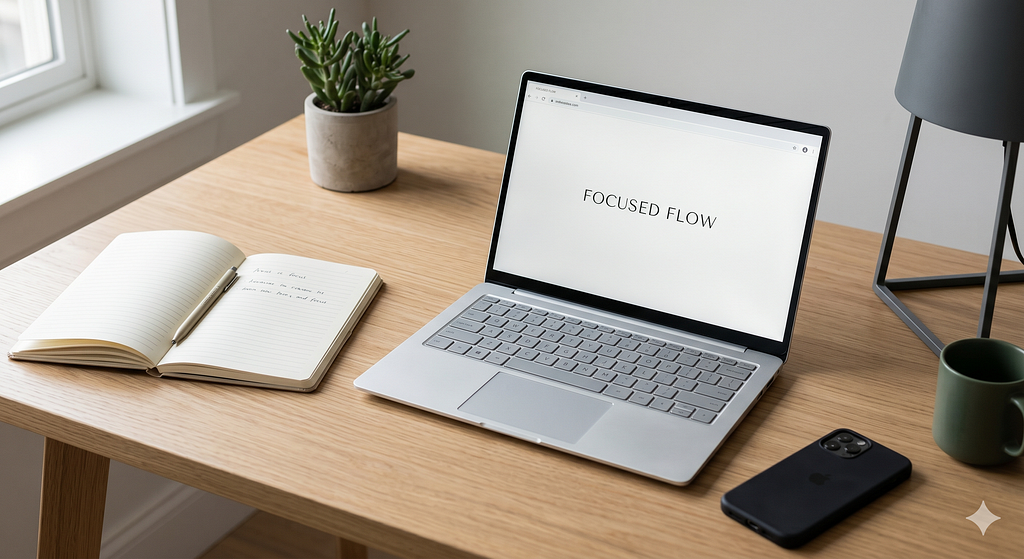
The Attention Residue Problem No One Talks About
The following is the argument that changed my way of thinking permanently in regard to this argument.
A name that was proposed by one of the researchers called Sophie Leroy was that of attention residue. The idea is simple and stomach-turning. There is some part of your brain that is doing that as you switch between Task A and Task B. It lingers. It leaks into your new focus. You think that you are dead and your mind is free.
By this I mean that whenever you open Slack, as you break writing, you drag with you a slice of Slack, to the writing. You bring some email stress along with you to your next endeavor whenever you open your email.
You never are present because you never are whole.
When I had the realization of that, I stopped viewing focus as an issue that had to be punished. I started thinking of it as a pollution problem. And the reply was simple: stop to poison your mind.
The System I Am Currently Using
I would here like to be specific, as general counsel is no good.
My current approach:
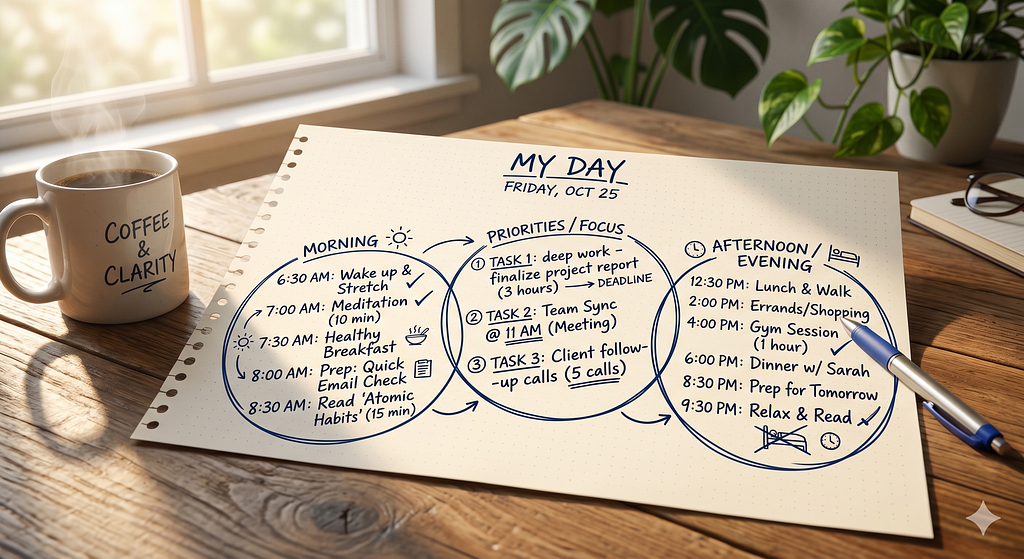
Morning planning (10 minutes). I enumerate the three things that I need to do when I open anything first. Not ten things. Three. I will start with the most challenging.
Deep work blocks (90 minutes). One task. Looking through the windows close to the one I require. Phone elsewhere. Notifications off. I use a necessary beat. No lyrics in music when working. Instrumental only.
Intentional check-ins (3 times a day). Email and Slack 9am, 1pm and 5pm. That is it. Not reactive. Scheduled.
Ritual of shutdown (5 minutes). I write the note of what I have done, the next thing to do, and what is undone. This is one of the messages that my brain adopts as a safe message to release. It sounds small. It is not small.
It was not the hours that I work that had increased. I do work fewer. However, the time, when I work, is more productive than ever, which results in better results.
Less time. Better work. That is the deal.
[Image suggestion: Morning light on the table on a three circle handwritten day planning sheet]
The Surprise Side Effect I Was Unaware Of
I believed that I could have done more. I had not expected not to be so anxious.
But so have it befallen.
You can never be ahead of your time, when you are constantly doing more than a number of things at the same time. Always catching up. Always half-present. It makes this grade two of hum of stress that you can no longer experience as it is your norm and standard.
And the hum has been, and therewith you know.
I started to come out of the day with the impression that I had done something. Went through the inbox only. Only attended the meetings. Real, tangible work I would indicate.
It is a good habit which is addictive.
Honest Downsides
It is not all good, I shall not say.
Things which grow hard:
- You need to make a priority. When you have time to do this or that, then you have time to make a choice on what is important. That is uncomfortable. Multitasking is not a choice between one or the other but, can enable you to do either without doing a very good job.
- People are used to prompt responses. A few are irritable when checking email every day (3 times) compared to those who check email every day (24 hours). You cannot go without expectations or it rubs.
- A desperate affair there. On a planned check-in it cannot all be on wait. You must have a system of real emergencies and those which appear to be urgent.
Not all of them are dealbreakers. It is but a question of trade-offs that you must be prepared.
Is This Worth Caring About?
Yes, if you:
- Do imaginative or critical work that requires thinking intensively
- Appear to be at the back, when you make efforts
- End days feeling busy and not productive
- Have an inability to concentrate and work at tasks
Maybe not if:
- It is the real time coordination that is required
- You have written a special work and that will not fit you
But here is my faith surely. Most of the individuals who have the perception that they should multitask have just not been at a position to establish what they can do without multitasking.
And you cannot fairly compare till you make good attempts to bring the other into action.
Now and Thenceforth
I have been doing it over a year. The habits at this stage are muscle memory. I must not wrestle with focus as I have wrestled with combat.
The second tier that I am exploring is time management and energy management. Nevertheless with the utmost concentration you should work at the right time because you should work at the time when your brain is in its optimum. This is among the errors that I continue to make whenever I am planning to feast on hard-thinking during my low-energy windows.
But that is still another article.
The Closing Thought
I revisit it.
Multitasking was regarded as productive as it was hectic. And has been industrious in our culture laced with competent. They are not connotative of one another. They are almost the opposites.
I never had been able to do best anything, but to cease doing five things badly, and start doing one thing well.
It is pathetic mere. Maybe it is. Simple is easy and easy is different.
One week trial. Not casually. Actually commit. One task at a time. Real blocks. No switching.
Then say that you made no change in your production.
Why I Quit Multitasking Cold Turkey (And How It Quietly Rewired My Brain) was originally published in DataDrivenInvestor on Medium, where people are continuing the conversation by highlighting and responding to this story.