Why I Co-Founded PlotBook: The Prospecting Problem Nobody Was Talking About
--
There are 8.4 million high-net-worth individuals in the United States. Most wealth advisors can’t find them.
I spent years adjacent to the wealth management industry before I ever thought about building a company inside it. And the thing that struck me most was not how sophisticated the financial advice had become, or how advanced the portfolio modeling was. It was how primitive the front end of the business still looked.
Finding clients. Prospecting. The thing that has to happen before any of the sophisticated work can begin.
I kept watching talented, credentialed advisors spend their afternoons doing something that felt deeply wrong: manually piecing together research on potential clients. Google searches. LinkedIn stalking. County assessor websites with interfaces that looked like they were built in 2003. Spreadsheets with names that may or may not have been worth pursuing. Hours of effort to produce a list of maybe twenty names, half of which would bounce.
This was not a niche problem. This was the standard operating procedure for an entire industry.
The broken workflow I couldn’t stop thinking about
Here is what “finding a high-net-worth prospect” looked like for most advisors I talked to.
You’d start with geography. You know a neighborhood is wealthy. You’ve driven through it. You’ve seen the homes. You have an instinct that the right clients are in there somewhere. But instinct doesn’t give you names. So you’d open a county property records site, try to figure out how to search by street, download a PDF that renders as garbled text, and slowly, painstakingly, try to identify who actually owns the home you’re looking at.
Then you’d take that name to Google. Then LinkedIn. Then maybe a people-search site. You’d try to triangulate: is this person actually wealthy, or do they just live in an expensive house with a lot of mortgage behind it? Is this the right person, or a common name with five other results? Do they have a financial advisor already? What’s their background?
Two hours later, you might have three qualified names.
Multiply that by the number of neighborhoods worth targeting in a market like Dallas or Miami or Los Angeles. Then multiply it by the number of weeks in a year. Then ask yourself what all of that manual labor is costing in time, in opportunity cost, in sheer cognitive drain.
The math was staggering. And nobody seemed to be solving it.
The insight that changed how I thought about this
The more I dug into the problem, the more one thing became clear: every existing tool in this space was built around the same flawed assumption.
That you already know who you’re looking for.
WealthEngine, Wealth-X, Catchlight, most of the legacy prospecting platforms ask you to start with a name. You feed them a person and they return wealth estimates. Which is useful, but it skips the hardest step entirely: how did you get the name in the first place?
The answer, for most advisors, was referrals, cold lists purchased from data brokers, or the kind of manual research I described above. None of these scaled. Referrals are limited by your existing network. Cold lists are often stale, poorly targeted, and expensive. Manual research is slow.
What I kept coming back to was a different question: what if you started with the property instead of the person?
Property ownership is public record. Home value is verifiable. And here’s what the data confirms: two-thirds of high-net-worth individuals hold investment real estate, with direct residential ownership being the dominant strategy. The house someone lives in is one of the most reliable proxies for their wealth profile that exists. It doesn’t change with a job title update. It doesn’t disappear when someone leaves LinkedIn. It’s sitting there on a map, assessable, searchable, real.
A $2.5 million home in a specific zip code tells you something immediately and accurately about the person inside it. No name required to start.
That was the inversion. Don’t start with a name and try to find the wealth. Start with the wealth signal, the property, and surface the person.
What we built
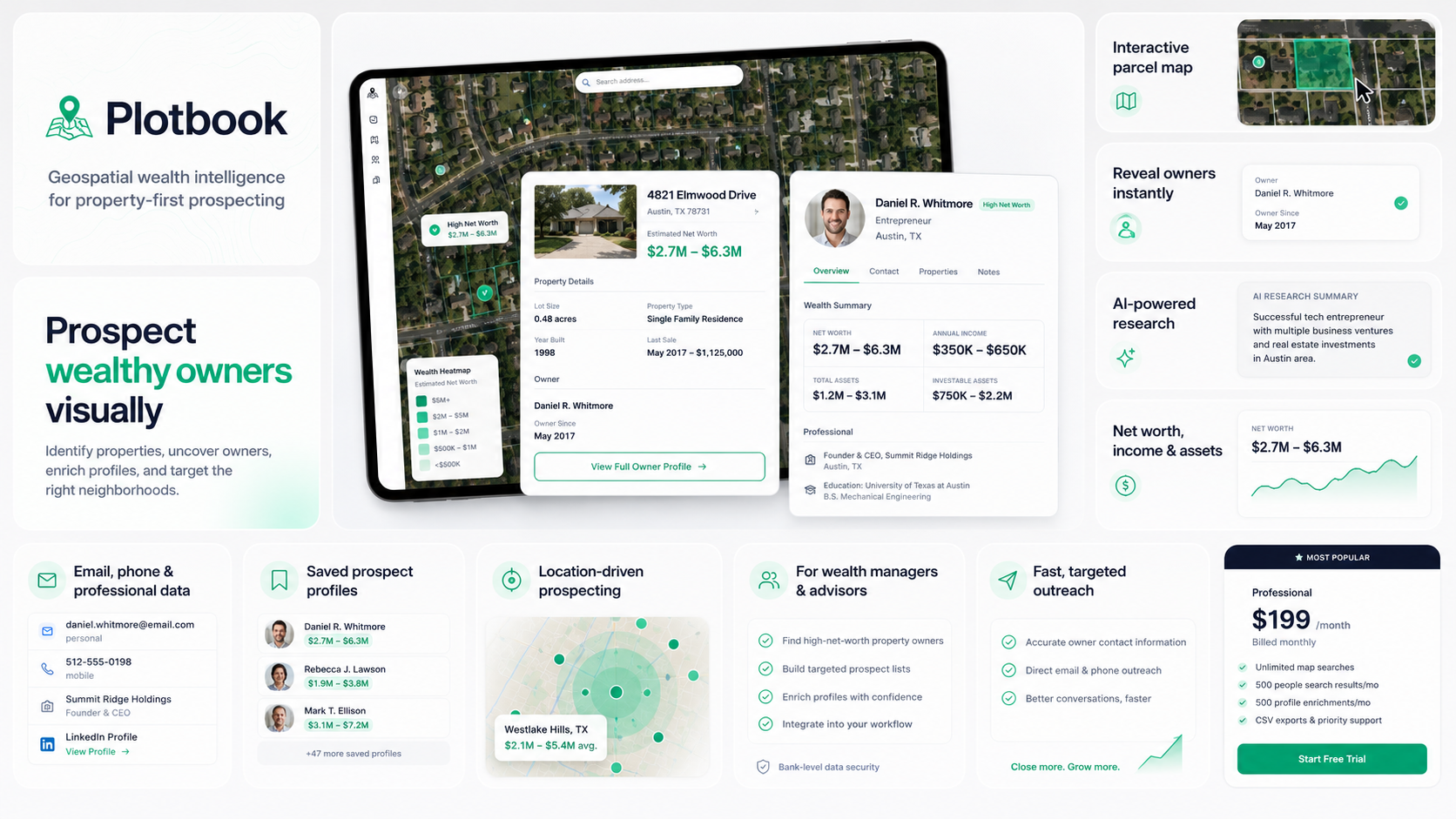
PlotBook is a geospatial wealth intelligence platform. The short version: you open a map, navigate to any neighborhood in the United States, and immediately see which properties meet your criteria. Filter by estimated home value, by neighborhood, by zip code, by metro area. Click on a property and get the full picture: estimated net worth of the owner, investable assets, income range, contact information, and an AI-generated research summary that tells you who this person is and why they might be a fit for wealth management services.
The workflow that used to take two hours now takes about thirty seconds per property. The research that required five different tabs and three different websites is unified in a single view. And instead of starting from a name and hoping the wealth is there, you start from a neighborhood where you already know the wealth exists and work your way to the right people.
We built it to cover 99% of residential parcels across the United States, visualized through an interactive property wealth map. The data is continuously refreshed. The AI wealth profiles surface net worth estimates, investable assets, equity positions, and ownership context that would have taken a skilled researcher hours to assemble manually.
The part that surprised me most
Once we started showing PlotBook to advisors, the reaction that stuck with me most wasn’t excitement about the speed. It was something more personal.
Advisors kept telling me they felt guilty about how much time they’d been spending on research. That they’d known for years that the process was broken but assumed that’s just how the business worked. That they’d gotten used to treating prospecting as a slog rather than a workflow that could be optimized.
One advisor told me: “I used to block off Friday afternoons for research. I haven’t done that in two months.”
That hit differently than any conversion metric.
PlotBook also lets advisors save and organize the profiles they find, add notes, tag prospects, and return to them when the timing is right. The tool isn’t just for finding people. It’s for building a pipeline that actually reflects the wealth in a given geography.
Who this is actually for
The obvious use case is private wealth advisors and RIAs. But what became clear quickly is that the property-first model of prospecting is useful for a much wider group of people.
Nonprofits and development officers looking for major gift donors. Family offices identifying co-investment partners. Insurance agents serving affluent households. Luxury real estate professionals targeting buyers for high-value listings. Political fundraisers. Any professional whose job it is to find and reach wealthy individuals in a specific geography.
The underlying problem is the same across all of them: wealth exists in specific places. Those places are mappable. But the tools to connect geography to wealth to contact information had never been assembled in one coherent product.
That is the gap PlotBook fills.
What we get wrong about where wealth lives
There is a persistent assumption in the prospecting world that high-net-worth individuals are primarily findable through professional networks. That wealth reveals itself through LinkedIn, through conference attendance, through industry associations, through who you know.
And that’s partly true. Referrals remain one of the most reliable paths to HNW clients. But referrals are bounded by your existing network. They don’t help you find the business owner in Frisco, Texas who sold his company two years ago and is sitting on $8 million in investable assets and hasn’t been approached by a single advisor because he’s not on anyone’s radar yet.
He’s on a map, though.
His home is on a street in a neighborhood that correlates clearly with his wealth profile. His property records are public. His estimated net worth is derivable. His contact information is findable.
The wealth isn’t hidden. It’s just on a map that most advisors haven’t learned to read yet.
Why now
The wealth management industry is at an interesting inflection point. The number of high-net-worth individuals in the United States has more than quadrupled in the past 25 years, and in 2024, the country added over a thousand new millionaires every single day. The Great Wealth Transfer, an estimated $83.5 trillion expected to pass between generations by 2048, means that new pools of investable capital are forming in new places, in neighborhoods that weren’t on anyone’s prospect list five years ago.
The advisors who will win this next era are not the ones with the best investment philosophy or the most credentials. They are the ones who find the right clients first.
PlotBook is built for them.
A final note
I did not build PlotBook because I had a clean, premeditated vision of disrupting wealth management prospecting. I built it because I kept watching a problem that was solvable go unsolved, and the patience for that eventually ran out.
The tools exist. The data exists. The map already shows you where the money is.
All we did was make it possible to read it.
Kathleen is co-founder of PlotBook, a geospatial wealth intelligence platform for private wealth advisors, RIAs, family offices, and financial professionals. If you’re spending hours on prospect research by hand, there is a better way. Try a sample report at plotbook.io/sample-report