Why Great Founders Sell
 VICTOR RAPHAEL3 min read·Just now
--
She hadn’t missed a single week in three years. Every Monday, product review. Every Friday, investor update. The business was generating $40K a month, the retention was strong, the team was small but capable. From the outside, everything looked like a success story in progress. Then she listed it for sale. Most people in her network assumed something was wrong.
Nothing was wrong. That’s the part most buyers never understand.
The dominant narrative around acquisitions frames selling as a sign of distress a founder who ran out of runway, couldn’t find product-market fit, or simply gave up. That story is real for some deals. But it describes a minority of what’s actually for sale in Web3 and AI right now. A significant portion of the assets coming to market are being sold by builders who did everything right and made a deliberate decision to exit at the top of what they could do with it.
Understanding why changes how you evaluate every deal you look at.
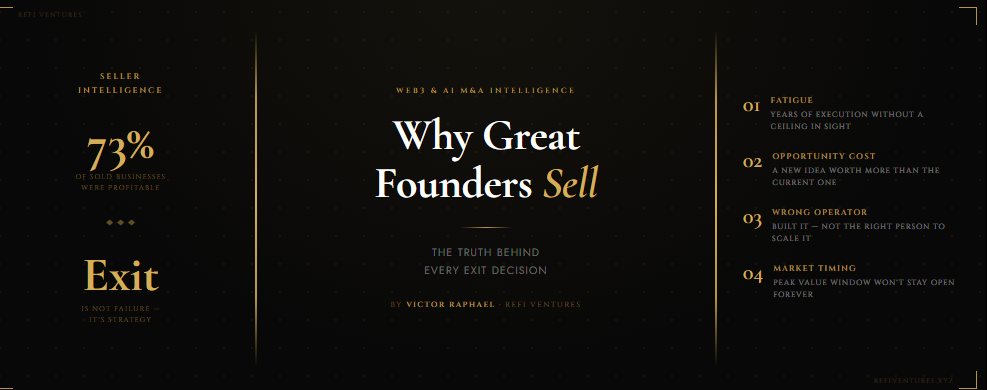
The most common reason serious founders sell is fatigue and not the kind that implies weakness. Three years of building inside a volatile market, managing a team through bear cycles, keeping community sentiment stable during protocol updates, and doing it all without the institutional support a VC-backed company gets that accumulates. Founders reach a point where they’ve taken the business as far as their energy can carry it. The ceiling isn’t the market. It’s them. The honest move is to hand it to someone who has the bandwidth and motivation to take it further. That’s not failure. That’s self-awareness.
The second reason is opportunity cost. The founders selling the best businesses are usually the ones with the most options. A builder who created one successful Web3 protocol has a clear read on where the next opportunity is, and it’s almost always somewhere else. They’re not abandoning a sinking ship they’re reallocating capital, time, and attention to a higher-expected-value move. The acquisition isn’t the end of their story. It’s how they fund the next chapter.
There’s a third reason that rarely gets named directly: some founders are exceptional at building but genuinely not the right operator to scale. They know it. They built the product, proved the concept, assembled the early users and they can see clearly that what the business needs next requires a different skill set than what they have. A growth operator. A business development machine. Someone who runs on systems rather than intuition. Selling to that person isn’t giving up control; it’s placing the asset where it can actually grow.
And then there’s timing. Markets don’t stay favorable forever. A Web3 founder who built during the right cycle, achieved real traction, and is looking at the next two years with uncertainty about regulation, liquidity, and market sentiment they’re not being pessimistic by choosing to exit at peak value. They’re being rational. The window for a clean, premium exit at a strong multiple is finite. The founders who understand that sell into it. The ones who don’t often watch that window close.
None of this means every listing is a great deal. Some businesses are genuinely being sold because they’re broken, stalled, or shedding users. Buyers need to know the difference. But the reflex to assume the worst about every seller is leaving real money on the table for buyers who learn to read the actual signal.
The business that founder sold the one generating $40K a month with strong retention closed in six weeks. The buyer inherited a functioning operation, a loyal user base, and a revenue stream that covered the acquisition cost within eighteen months. She moved on to her next build. Both sides won.
That’s what a clean exit looks like. It happens more than people realize.
Explore what’s available at refiventures.xyz.