Why Do Stock Prices Suddenly Crash After Going Up?
--
You watched a stock climb for days. Your portfolio looked healthy. Then — without warning — it dropped 20% in a single afternoon. Sound familiar? You’re not imagining things. And it’s not just bad luck.
Sudden stock crashes after a strong rally are one of the most common — and most painful — experiences for everyday investors. The good news? These events are rarely random. Once you understand the forces behind them, you can start to see them coming.
In this article, we break down exactly why stocks crash after going up, who’s usually behind it, and how tools like MoneyChoice use quantum-powered algorithms to detect these moves before they happen.
The 6 Real Reasons Stocks Crash After Rising
Markets don’t move on pure logic. They move on human behavior, institutional strategy, and economic forces — often all at once. Here are the six most common triggers behind a sudden reversal.
1. Profit-Taking by Large Investors
When a stock rises significantly, institutional investors and hedge funds begin selling their positions to lock in gains. This sudden surge in supply — with no matching demand — drives prices down fast. Retail investors often misread this as a technical glitch or overreaction, only to realize too late that the “smart money” had already left the table.
2. Market Manipulation — The Pump-and-Dump
This is one of the most damaging hidden forces in the market. Bad actors artificially inflate a stock’s price through coordinated hype, social media buzz, or false enthusiasm. Once retail investors pour in and the price peaks, the manipulators sell everything at once — causing the price to collapse and leaving ordinary investors with massive losses.
3. Overbought Technical Conditions
When a stock rises too quickly, it becomes “overbought” — meaning its price has moved far ahead of its fundamental value. Technical traders use indicators like the RSI (Relative Strength Index) to identify these conditions and begin selling, which cascades into broader selling pressure. The higher the stock climbed, the harder the fall can be.
4. Fear, Panic, and Emotional Crowd Behavior
Markets are not rational machines — they’re driven by psychology. When prices start to slip even slightly from a peak, fear spreads quickly. Stop-loss orders trigger automatically, margin calls force more selling, and retail investors panic-sell to limit losses. What starts as a minor dip becomes a self-fulfilling crash driven by emotion, not fundamentals.
5. Bad News and Earnings Surprises
A stock that has been climbing on optimism can be devastated by a single piece of bad news — a missed earnings report, a product recall, a regulatory investigation, or a CEO resignation. When the gap between expectation and reality is large, the price correction can be violent and sudden, especially after a prolonged run-up.
6. Macroeconomic Shocks
Rising interest rates, inflation data, Federal Reserve announcements, or geopolitical events can shift investor sentiment across the entire market in minutes. Even fundamentally healthy stocks crash in these environments because investors flee risk assets broadly. No individual stock is immune to macro forces when they hit hard enough.
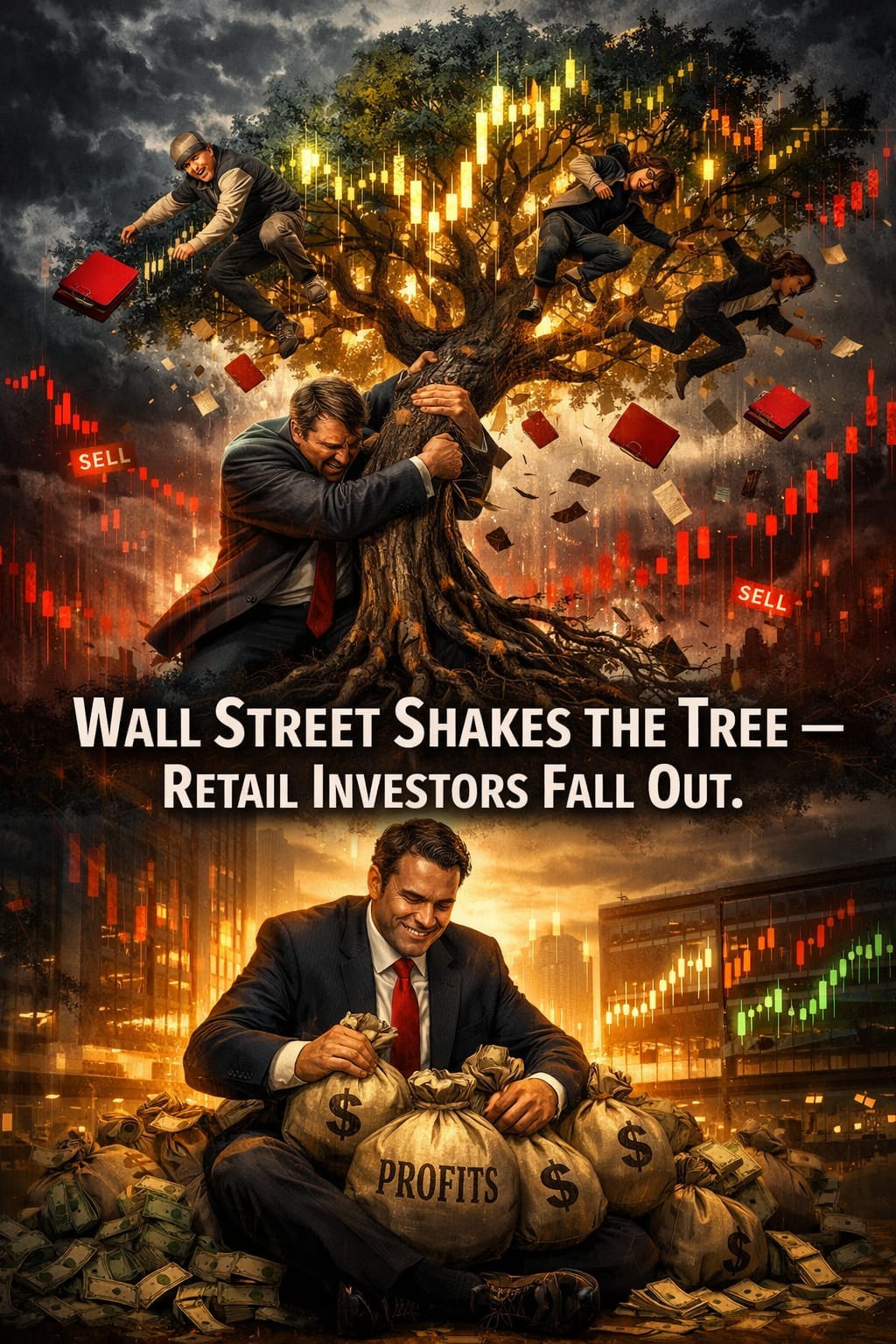
Wall Street Shakes the Tree — Retail Investors Fall Out
Wall Street shakes the tree, and retail investors fall out. That’s how manipulation works — create fear, trigger panic selling, buy the dip.
This isn’t a conspiracy theory — it’s a documented market dynamic. Large institutions have advantages that ordinary investors don’t: access to real-time order flow data, algorithmic trading systems, and the capital to move markets themselves. They understand exactly how retail investors behave under pressure.
The sequence is depressingly predictable: generate hype → drive up price → create fear → trigger mass selling → buy back at the bottom. The retail investor enters near the top and exits near the bottom, transferring wealth upward every single time.
⚠ Pump-and-Dump Reality Check: According to financial regulators, pump-and-dump schemes cost investors hundreds of millions of dollars annually. The rise of social media and messaging apps has made these schemes faster, wider-reaching, and harder to detect — unless you have the right tools.
How MoneyChoice Detects Crashes Before They Happen
Most investing tools are built to analyze what already happened. MoneyChoice is built to see what’s coming next.
The platform applies principles from quantum physics to stock market behavior — based on the observation that stocks and electrons share similar patterns of movement, both seeking stable orbits and responding to external pressures in predictable ways. This framework powers a set of seven proprietary analytical “IQs” that give investors a meaningful edge.
Specifically relevant to crash protection are three of these tools:
Overbought / Oversold IQ
This indicator detects when a stock has risen too far, too fast — identifying the precise inflection points where a reversal is statistically likely. Instead of reacting after the crash, you can exit (or short) before the crowd panics.
Manipulation Detection Algorithm
MoneyChoice’s algorithms are trained to recognize the unique volume spikes and trading patterns that precede pump-and-dump crashes. In documented cases, the system identified manipulation in stocks like RRC and YELP — flagging 40% upside opportunities while simultaneously protecting users from the 40% crashes that followed.
Money Movement IQ
This tool tracks where institutional investors — the “smart money” — are actually moving their capital. When large players start quietly exiting a position, the Money Movement IQ picks up that signal early, long before retail sentiment turns negative.
What You Should Do When a Stock Has Been Rising Fast
Whether you use MoneyChoice or not, here are evidence-based steps to protect yourself when a stock has already had a strong run-up:
1. Check for overbought conditions. If a stock’s RSI is above 70, it’s in overbought territory. This doesn’t mean it will crash immediately — but it means risk is elevated and you should tighten your stop-loss orders.
2. Watch the volume. Unusual spikes in trading volume without a clear news catalyst are a classic early signal of manipulation or institutional distribution. Be suspicious of sudden, unexplained volume surges.
3. Follow the news sentiment — not the hype. A stock rising on genuine improving fundamentals is different from a stock rising because of viral social media posts or forums. MoneyChoice’s News IQ and Crowd Psychology IQ automate this analysis for you.
4. Set a defined exit strategy before you’re emotional. Decide in advance: at what price will you take profit? At what price will you cut your loss? Having a rule removes the psychology that Wall Street exploits.
5. Use tools that see ahead, not behind. Most retail investors are trading with lagging indicators — data that confirms what already happened. MoneyChoice’s quantum-powered platform is designed to anticipate what’s next, not just describe what’s past.
Stop Getting Caught on the Wrong Side of the Market
MoneyChoice’s quantum algorithms scan 1,000+ stocks daily, detect manipulation before it peaks, and deliver clear entry points — free to start, no credit card required.
Get Free Daily Predictions at moneychoice.us →
Free plan available forever · 80%+ accuracy since 2016 · All wins and losses shown
Frequently Asked Questions
Why do stocks drop right after I buy them?
This often happens because retail investors tend to buy after a stock has already made a significant move — when it’s near its peak. Large investors who bought earlier are using that very moment to exit their positions, creating selling pressure. It’s not coincidence; it’s the predictable result of entering a trade without understanding where institutional money is headed.
Is a sudden stock crash always manipulation?
No. Crashes happen for many reasons — earnings misses, macroeconomic shifts, profit-taking, and genuine fear. However, manipulation is more common than most retail investors realize, particularly in smaller-cap and high-momentum stocks. Tools that analyze volume patterns and trading behavior can help distinguish between the two.
Can you predict a stock market crash?
No tool can guarantee the future. However, platforms like MoneyChoice use historical pattern analysis, quantum-based frameworks, and real-time data to identify elevated risk conditions before crashes occur. With 80%+ accuracy since 2016 across documented trades, data-driven prediction is far more reliable than gut instinct or social media tips.
What is the safest way to invest when stocks are volatile?
Diversification, defined risk rules (never risk more than a fixed percentage per trade), and using analytical tools that track where institutional money is flowing are foundational strategies. MoneyChoice’s auto-trading fund operates with a built-in rule to never risk more than 5% on a single position — a discipline that protects capital during volatile conditions.
How does MoneyChoice protect me from pump-and-dump schemes?
MoneyChoice’s Manipulation Detection algorithm identifies the abnormal volume spikes, rapid price acceleration, and trading pattern signatures that characterize pump-and-dump events. In documented cases like RRC and YELP stocks, the system predicted the upside opportunity and warned of the subsequent crash — letting users profit from the move while avoiding the collapse.
The Bottom Line
Stock prices crash after going up for a reason — always. Whether it’s institutional profit-taking, market manipulation, overbought conditions, fear, bad news, or macro forces, there are patterns behind every crash. The investors who consistently protect their wealth are the ones who learn to read those patterns in advance.
The problem is that most of the tools available to retail investors are designed to look backward. What you need is a system that looks forward — one that tracks where the smart money is moving, flags when a stock is overbought, and alerts you when manipulation patterns are emerging.
That’s exactly what MoneyChoice was built to do. With quantum-powered predictions, a transparent 80%+ accuracy track record since 2016, and a free plan that gives you two daily predictions at no cost, there’s no reason to keep getting caught off guard.
Wall Street has always had the edge. Now you can have it too.