Why Digital Payments Still Feel Broken at the Counter in Pakistan
 Fazal Wahid3 min read·Just now
--
QR payments are growing.
Cards are everywhere.
But at the counter — something still feels broken.
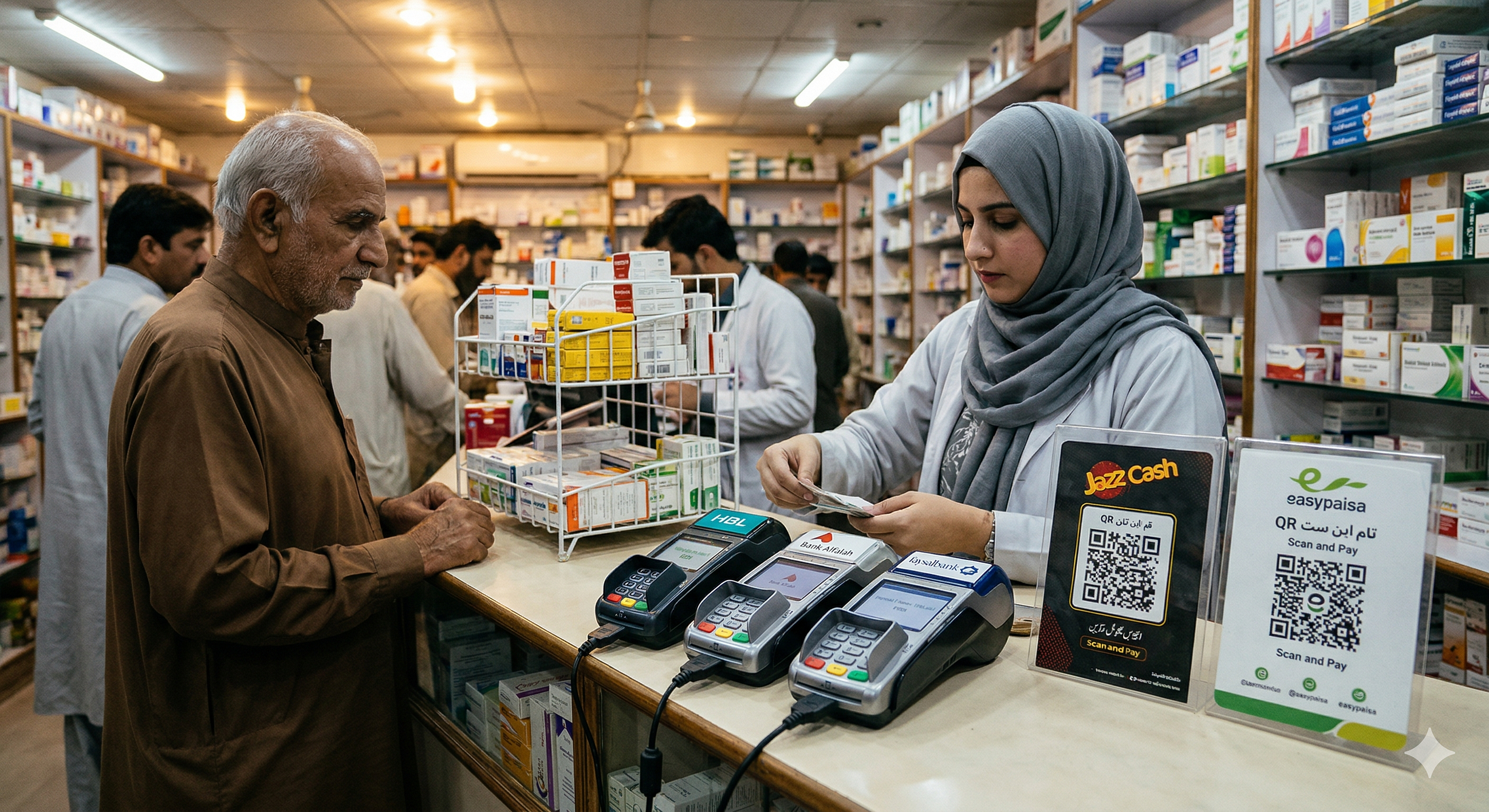
I was speaking to a friend who runs a large pharmacy in Pakistan.
On paper, everything looks modern. In reality, it’s a different story.
Cards Still Dominate — But at a Cost
Around 70% of their digital payments are still card-based.
Customers trust cards.
There’s a certain comfort — even a status — in taking out a card and handing it over.
But behind that simple interaction, the system is far from simple.
Getting a POS machine isn’t easy
- You need a reference inside the bank
- Someone visits your shop for verification
- Need to open a bank account in the same bank
- Everything is handled manually
And once it’s set up, that same person becomes your only point of contact.
No proper dashboard.
No real support system.
Just dependency.
Settlement is manual
Every day, before 10 PM, the merchant has to:
- Trigger settlement manually on the POS
- Print long receipts with all transactions
- Keep them for the records
If they forget?
Settlement gets delayed to the next day… or even later.
Reconciliation is painful
The merchant has to:
- Match settlement reports with printed receipts
- Check every transaction manually
Imagine comparing hundreds of receipts just to verify your own money.
In one case, the numbers didn’t match.
They reported it.
The process dragged on for months.
The money never came back.
They stopped using that POS.
Disputes are worse
If a transaction fails but the customer is charged twice:
- The merchant must prove what happened
- Show printed receipts
- Resolve it manually
Sometimes they even refund the customer themselves just to close the issue.
And after all this…
They still pay almost 3% in fees.
And yet — despite everything —
Cards are still trusted.
QR Payments: Easier, But Not Complete
QR payments are growing fast.
They’re:
- easy to set up
- low cost
- accessible
But when you look closely at the counter, new problems appear.
Multiple QRs everywhere
Different apps. Different codes.
No standard experience.
Awkward customer flow
Sometimes customers need to:
- ask for a number
- show their phone
- confirm manually
There’s hesitation — especially in certain social situations.
Confirmation is still manual
This is the biggest issue.
After payment:
- The merchant waits
- Someone checks the phone
- confirmation comes through an app or notification
In this pharmacy:
- The owner’s brother manages the apps
- if he’s not around, they wait
- so they keep a phone at the counter
Accessible to staff.
And even then:
“We’ve never had fraud… but we still have to check.”
The Real Problem
Payments are digital.
But confirmation is still manual.
Merchants don’t really fear fraud.
They fear uncertainty.
- Did the payment go through?
- Did we receive it?
- Should we trust this screen?
The Missing Layer
The problem in Pakistan isn’t payments. It’s trust at the moment of the transaction.
QR solved the cost.
But it didn’t fully solve trust.
What If Confirmation Didn’t Depend on a Phone?
What if the moment money lands…
The system itself confirms it.
Out loud.
In real time.
No checking.
No waiting.
No dependency on another person.
Just:
“Payment received.”
That’s the missing layer.
Not more apps.
No more QR codes.
But a real-time confirmation layer at the counter.
What We’re Building
At HilfiTech, this is exactly what we’ve been working on.
Hilfi Pay — payment confirmation that speaks the moment money lands.
Under 200ms.
No phone checking.
No queue pause.
Because at the ground level, payments aren’t judged by APIs.
They’re judged by moments.
And the moment a merchant hears:
“Payment received.”
— That’s when digital payments truly replace cash.
We are currently testing/deploying HilfiPay with a select group of high-velocity merchants in the UAE and Pakistan. If you’re a retailer, a clinic owner, or a developer looking to integrate a zero-latency confirmation layer into your flow, let’s talk.
Visit www.hilfitech.com/hilfipay to request a demo or join our early-access waitlist.