Why Concrete Vaults Matter in the Next Era of DeFi
 Ziggi4 min read·1 hour ago
--
There was a time when participating in DeFi felt simple.
Deposit assets. Earn yield. Watch your portfolio grow.
But as the ecosystem evolved, so did the complexity behind staying competitive.
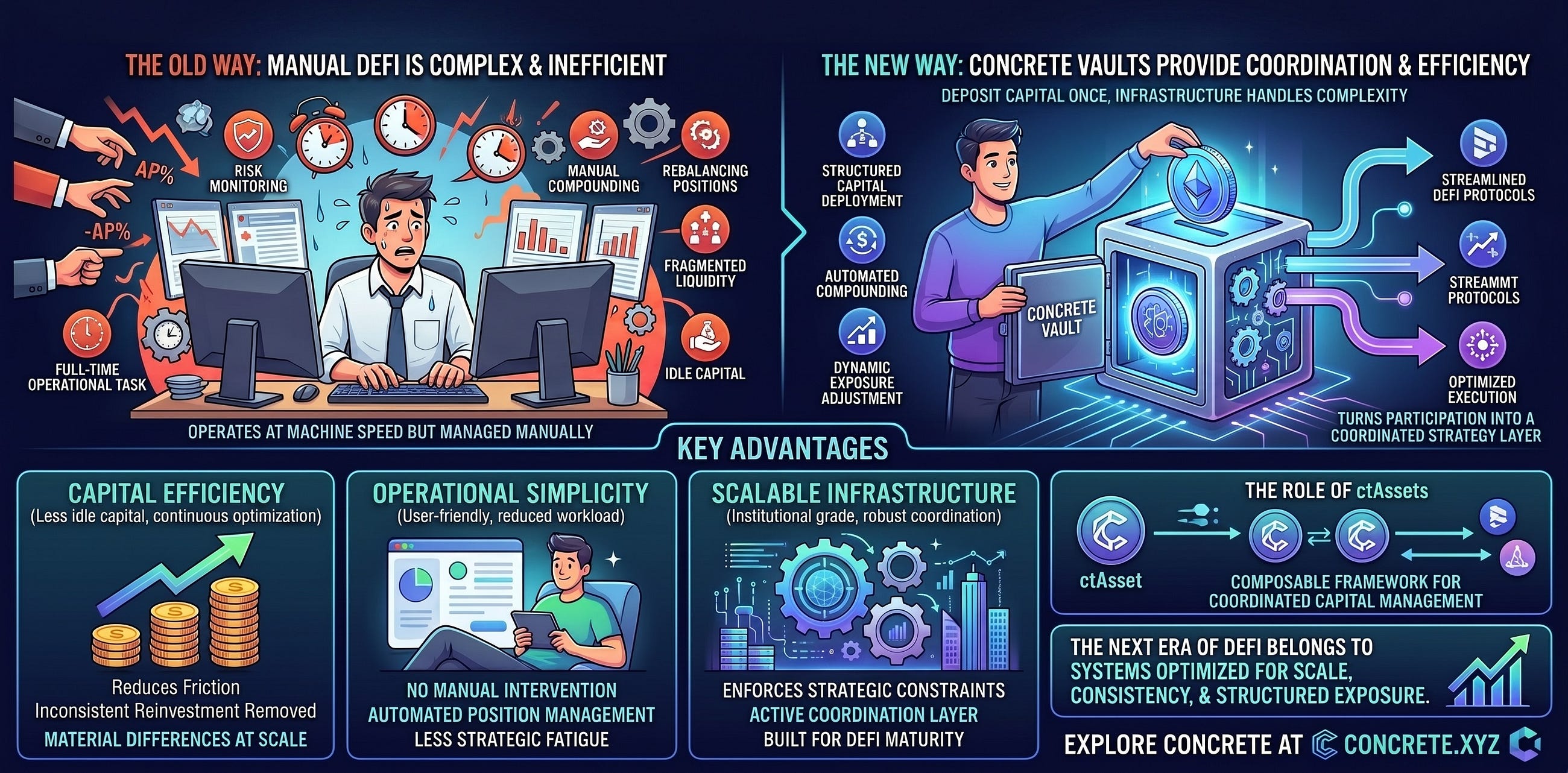
Today, extracting meaningful yield onchain often demands constant attention. Users move liquidity across protocols chasing higher APYs, manually compound rewards, rebalance positions after market shifts, monitor collateral exposure, and continuously reassess risk. In practice, DeFi has quietly become a full-time operational task disguised as passive income.
The problem is not a lack of opportunity.
The problem is coordination.
Most users are still managing capital manually in an environment that now operates at machine speed.
That friction creates inefficiency everywhere. Idle capital sits unused between repositioning. Rewards remain unclaimed for days. Execution timing becomes inconsistent. Risk management depends entirely on the user being online, informed, and reactive.
As DeFi grows more sophisticated, manual capital management becomes increasingly difficult to scale.
This is where vault infrastructure begins to matter.
And it is exactly why systems like Concrete are becoming increasingly important within structured DeFi.
The Shift From Manual Management to Coordinated Capital
At their core, DeFi vaults exist to solve an operational problem.
Instead of requiring every individual user to constantly manage positions themselves, vaults create structured systems that coordinate capital deployment automatically.
Concrete Vaults are designed around this idea.
Rather than forcing users to manually rebalance positions or chase fragmented opportunities across protocols, vault infrastructure allows capital to operate through predefined execution systems that continuously optimize exposure over time.
The difference may sound subtle, but it fundamentally changes the user experience.
Instead of treating DeFi like a series of disconnected actions, vaults turn participation into a coordinated strategy layer.
Users deposit capital once. The vault infrastructure handles the operational complexity underneath.
That includes automated compounding, position management, strategy execution, and dynamic capital deployment across opportunities.
The result is not simply convenience.
It is a more efficient way for onchain capital to function.
Why Capital Efficiency Becomes the Real Advantage
One of the biggest inefficiencies in DeFi today is inactive capital.
Every time a user pauses between strategies, waits to rebalance, delays compounding rewards, or hesitates during volatile market conditions, capital becomes less productive.
At scale, these inefficiencies compound.
Concrete Vaults are built to reduce that friction through structured onchain capital deployment.
By coordinating pooled liquidity through automated systems, vault infrastructure can continuously reposition assets according to strategy parameters without requiring manual intervention from every participant.
That matters because modern DeFi increasingly rewards efficiency over activity.
The users generating the best long-term outcomes are not necessarily the ones clicking fastest between protocols. They are the ones participating in systems designed to optimize execution consistency over time.
This is where automated compounding becomes especially important.
In traditional manual workflows, users frequently lose yield through delayed execution, inconsistent reinvestment, or operational fatigue. Vault infrastructure removes much of that burden by automating the compounding cycle directly within the system architecture.
The effect is cumulative.
Small operational improvements repeated continuously across large pools of capital create materially different outcomes over time.
This is one reason institutional DeFi infrastructure continues moving toward structured vault systems rather than purely manual participation models.
Concrete Vaults Are More Than Yield Wrappers
A common misconception in DeFi is that vaults are simply passive yield aggregators.
In reality, sophisticated vault infrastructure functions more like an execution and coordination layer for capital.
Concrete Vaults are designed with systems that actively structure how liquidity is deployed, maintained, and adjusted as conditions evolve.
That includes mechanisms for rebalancing positions, enforcing strategic constraints, coordinating onchain execution, and maintaining structured exposure to opportunities without requiring users to constantly manage the process themselves.
This distinction matters.
Because as DeFi matures, the challenge is no longer just finding yield.
The challenge is sustaining efficient exposure while managing complexity and operational overhead at scale.
Structured DeFi systems solve this by replacing fragmented manual actions with coordinated infrastructure.
The infrastructure becomes the strategy interface.
The Role of ctAssets in Structured DeFi
One of the more important aspects of Concrete’s architecture is how ctAssets integrate into the broader vault system.
Rather than approaching liquidity as isolated positions scattered across protocols, ctAssets help create a more composable framework for coordinated capital management.
This enables Concrete Vaults to structure capital deployment more efficiently across opportunities while maintaining onchain execution and automated operational logic underneath.
In many ways, this reflects where the industry is heading overall.
The next phase of DeFi likely will not be defined by users endlessly moving between dashboards searching for temporary APY spikes.
It will be defined by infrastructure layers capable of coordinating liquidity intelligently, efficiently, and continuously.
That transition mirrors what happened in traditional financial systems as markets matured.
Manual execution eventually gives way to systems optimized for scale, consistency, and structured exposure.
DeFi is beginning to move through that same evolution now.
The Bigger Shift Happening Across DeFi
As the ecosystem grows, complexity increases alongside opportunity.
New protocols launch constantly. Strategies evolve faster. Liquidity fragments across chains and ecosystems. Risk management becomes more nuanced. Competitive yield increasingly depends on execution quality rather than simple participation.
At some point, manually managing every position stops being sustainable.
Infrastructure begins replacing constant repositioning.
This is why DeFi vaults are becoming increasingly important.
Not because users want less control, but because efficient systems outperform fragmented manual coordination over time.
Concrete Vaults represent part of this broader shift toward structured DeFi infrastructure — systems designed to coordinate capital more intelligently across onchain opportunities while reducing operational friction for participants.
The future of DeFi may not belong to the users refreshing dashboards all day searching for the next move.
It may belong to the infrastructure quietly optimizing capital underneath the surface.
Explore Concrete at https://concrete.xyz/