Why Concrete Vaults Matter in the Future of DeFi
 Miandadkhan4 min read·Just now
--
DeFi created a financial system where anyone can deploy capital onchain without relying on traditional intermediaries.
But as the ecosystem expanded, participating efficiently became increasingly difficult.
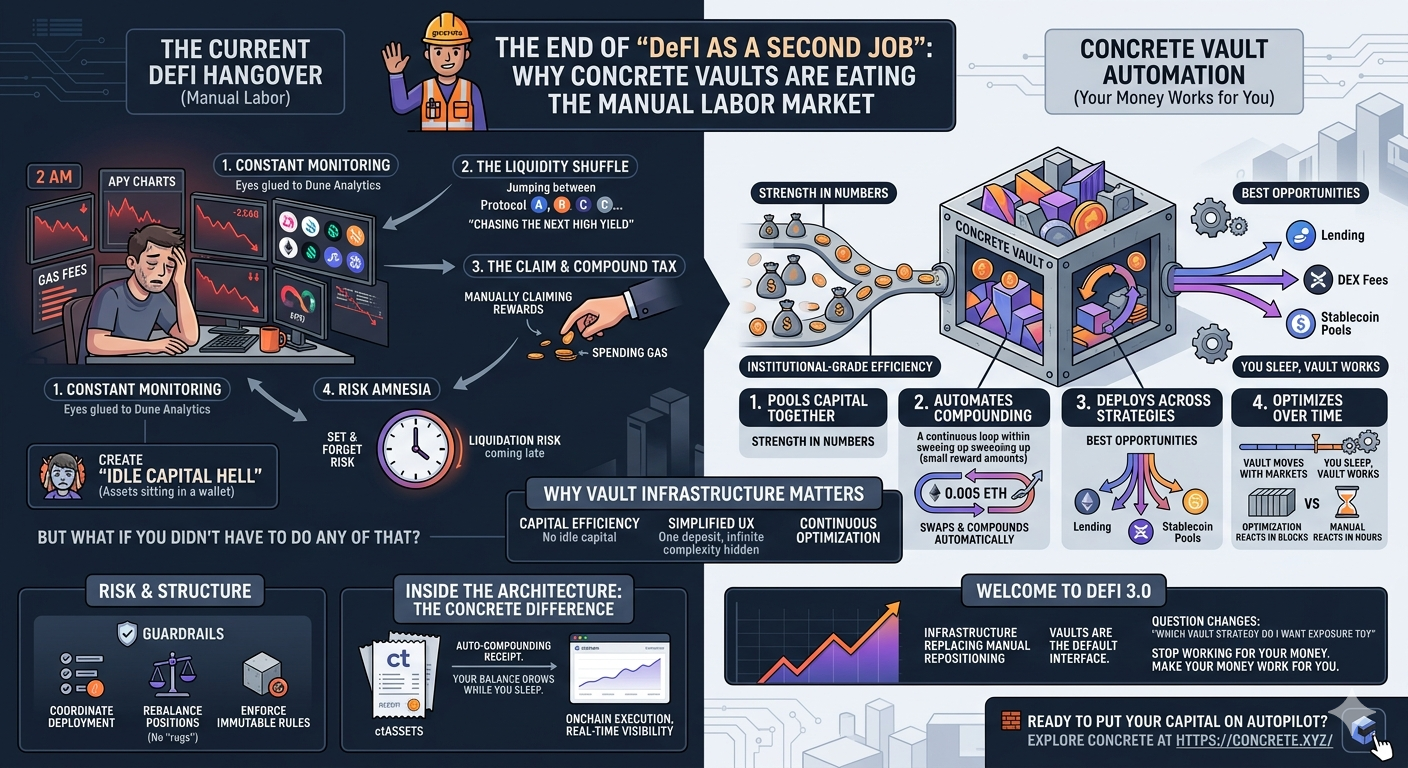
Today, staying competitive in DeFi often requires users to constantly monitor APYs, move liquidity between protocols, claim and compound rewards manually, rebalance positions, and track risk exposure across multiple platforms.
What initially looked simple has evolved into a highly operational environment.
For many users, DeFi no longer feels like passive finance.
It feels like a full-time management system.
This creates a major issue across the ecosystem:
Too much manual coordination leads to inefficiency.
Users spend significant time repositioning capital instead of benefiting from optimized infrastructure. Idle liquidity, delayed execution, fragmented opportunities, and inconsistent decision-making all reduce overall capital efficiency.
This is exactly why DeFi vaults have become increasingly important.
Vault infrastructure simplifies complexity by transforming fragmented manual actions into structured onchain systems.
And this is where Concrete Vaults are building their role within structured DeFi.
The Problem With Manual Strategy Management
Modern DeFi moves quickly.
Yields change constantly.
Liquidity rotates between protocols.
Opportunities appear and disappear rapidly.
To keep up, users often need to:
-- monitor multiple protocols daily
-- reposition liquidity frequently
-- manually compound rewards
-- rebalance positions continuously
-- track changing market conditions
-- manage execution across ecosystems
This process creates friction for both experienced and newer users.
The larger DeFi becomes, the harder it is for individuals to optimize capital manually at scale.
Manual execution may work temporarily, but it does not scale efficiently as ecosystems become more complex.
This is the core reason vault infrastructure matters.
Vaults simplify the process.
What Concrete Vaults Actually Do
At a fundamental level, Concrete Vaults help users coordinate capital more efficiently through structured systems.
Instead of every participant managing strategies manually, the vault infrastructure automates much of the operational layer.
Concrete Vaults help users:
-- pool capital together
-- automate compounding
-- deploy across multiple strategies
-- optimize positions over time
-- reduce operational complexity
This changes how users interact with DeFi entirely.
Rather than constantly repositioning liquidity manually, users gain exposure to systems designed for structured onchain capital deployment.
The goal is not simply convenience.
The goal is improving capital efficiency while reducing unnecessary operational overhead.
This allows users to focus more on exposure and less on constant management.
Why Vault Infrastructure Matters
As DeFi evolves, infrastructure becomes increasingly valuable.
The future of onchain finance is not only about finding yield opportunities.
It is about coordinating capital efficiently across changing environments.
This is what DeFi vaults are designed to improve.
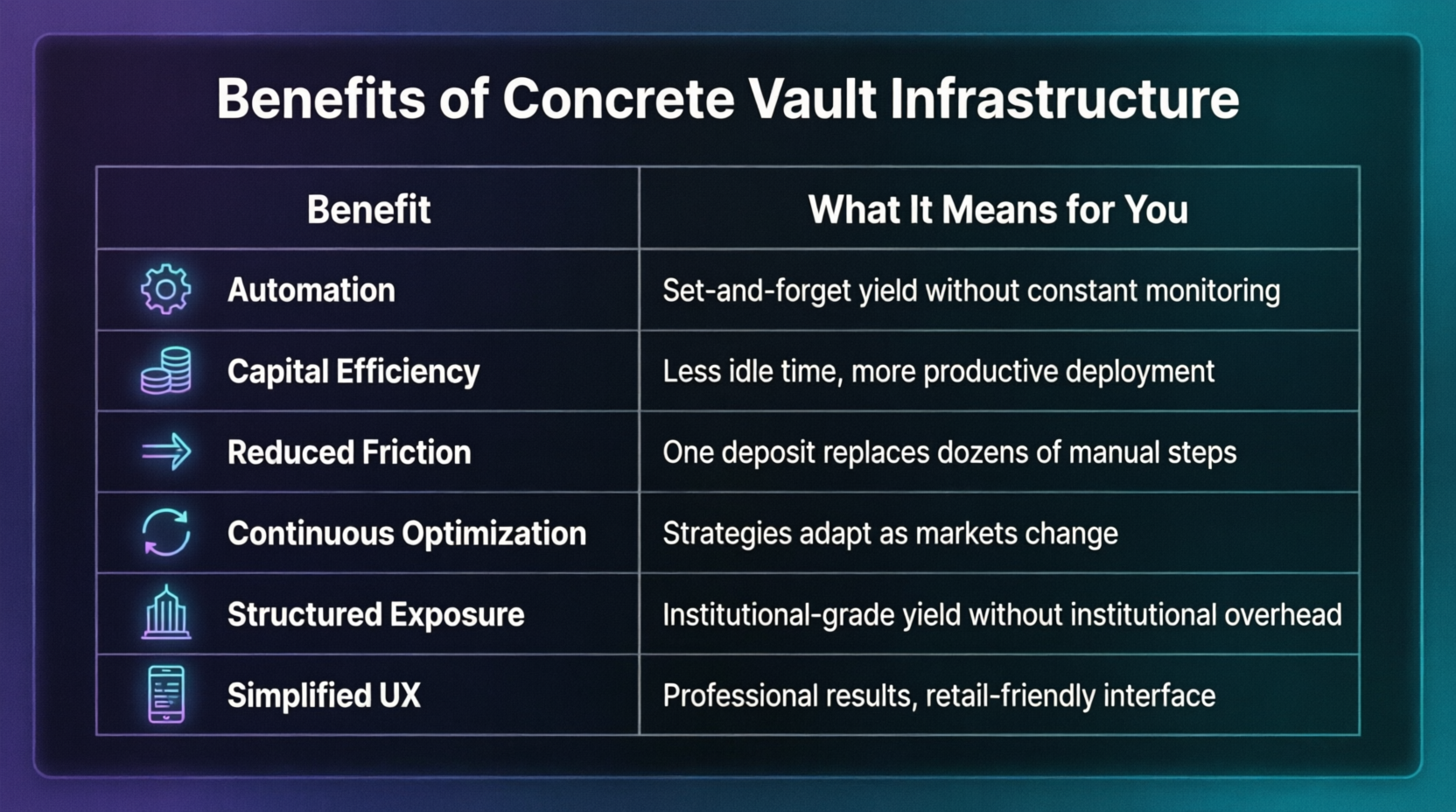
Automation
Vaults reduce the need for constant manual interaction.
Processes such as automated compounding, rebalancing, and execution can happen continuously through structured systems.
Capital Efficiency
Idle capital remains one of the largest inefficiencies in fragmented DeFi environments.
Vault infrastructure helps optimize deployment so liquidity remains productive instead of underutilized.
Simplified User Experience
Most users do not want to manually manage positions every day.
Vault systems abstract much of the complexity away from the user while maintaining exposure to onchain opportunities.
Continuous Optimization
Markets constantly evolve.
Vault systems allow strategies to adapt dynamically instead of remaining static for long periods.
This creates a more responsive framework for structured DeFi participation.
Ultimately, vault infrastructure helps users spend less time managing positions while improving consistency across execution.
Vaults Are More Than Simple Yield Wrappers
One of the biggest misconceptions about vaults is that they simply automate farming rewards.
Modern vault architecture is significantly more advanced.
Concrete Vaults include systems designed to:
-- coordinate capital deployment
-- rebalance positions
-- enforce strategy constraints
-- optimize execution
-- respond to changing market conditions
This creates a more structured approach to participating in DeFi.
Instead of reacting emotionally or manually to every market movement, users rely on systems built for coordinated execution.
This becomes increasingly important as institutional DeFi participation continues to grow.
Larger capital pools require infrastructure capable of managing complexity efficiently.
How Concrete Vault Architecture Works
The strength of Concrete Vaults comes from their structured architecture.
The system combines:
-- ctAssets
-- automated compounding
-- onchain execution
-- structured vault systems
-- coordinated capital allocation
Together, these components create a framework designed to optimize how liquidity moves across opportunities.
Rather than relying on fragmented manual management, Concrete Vaults coordinate onchain capital deployment through automated infrastructure.
This matters because DeFi is evolving beyond basic liquidity farming.
The next generation of infrastructure focuses on:
-- scalable execution
-- structured exposure
-- efficient coordination
-- automated optimization
-- institutional-grade capital management
Concrete Vaults are designed around these principles.
The objective is not simply maximizing short-term yield.
It is creating sustainable systems capable of managing capital efficiently at scale.
The Bigger Shift Happening Across DeFi
DeFi is becoming increasingly sophisticated.
As protocols expand and opportunities multiply, manual strategy management becomes harder to sustain.
Users cannot realistically spend all day moving liquidity between protocols forever.
This is why infrastructure is replacing constant repositioning.
Vaults are gradually becoming the default interface for deploying capital onchain because they simplify execution while improving efficiency.
The future of DeFi may not belong to the users endlessly clicking between protocols searching for the next yield opportunity.
It may belong to the systems built to coordinate capital more efficiently through automation, structured execution, and intelligent infrastructure.
And this is exactly where Concrete Vaults position themselves within the evolution of structured DeFi.
Explore Concrete at https://concrete.xyz/