Why Concrete Vaults Matter in Modern DeFi
--
DeFi promised open financial systems, permissionless access, and higher capital efficiency. But for most users, the actual experience still feels fragmented and operationally heavy.
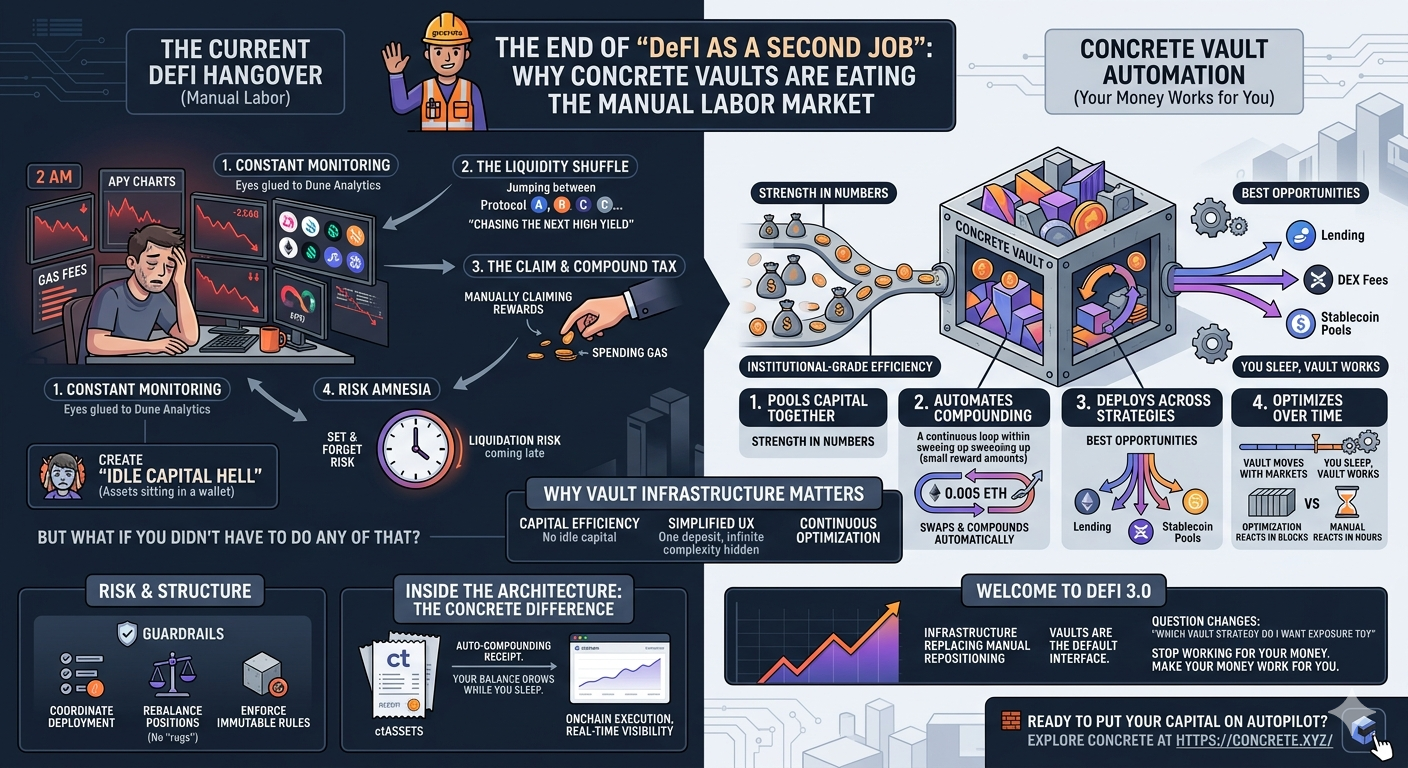
To stay competitive, users often need to constantly monitor APYs, move liquidity between protocols, claim and compound rewards, rebalance positions, and manually track risk exposure across multiple platforms.
This creates a major problem.
Instead of focusing on capital allocation, users spend most of their time managing infrastructure manually.
The result is friction, idle capital, inefficient deployment, and inconsistent outcomes.
This is where Concrete Vaults introduce a more structured approach to DeFi participation.
The Problem With Manual DeFi Management
The current DeFi landscape rewards active management.
Opportunities shift quickly.
Liquidity moves constantly.
Yield changes across protocols in real time.
To maintain strong performance manually, users often need to:
-- monitor multiple protocols daily
-- reposition liquidity frequently
-- optimize farming strategies
-- claim rewards repeatedly
-- compound earnings manually
-- manage changing market conditions
For individual users, this process becomes difficult to scale.
Manual strategy management may work temporarily, but as DeFi grows more complex, constant repositioning becomes inefficient.
This is why DeFi vaults are becoming increasingly important.
What Concrete Vaults Actually Do
At a basic level, Concrete Vaults help users coordinate capital more efficiently.
Instead of every participant manually managing positions, vault infrastructure automates large parts of the operational process.
Concrete Vaults help users:
-- pool capital together
-- automate compounding
-- deploy across strategies
-- optimize positions continuously
-- reduce operational complexity
This changes the user experience completely.
Rather than actively managing every movement manually, users gain exposure to a structured system designed to optimize onchain capital deployment over time.
The goal is not simply convenience.
The goal is improving consistency and capital efficiency while reducing operational friction.
Why Vault Infrastructure Matters
Vault infrastructure represents an important evolution in DeFi architecture.
As protocols become more advanced, the complexity of strategy execution increases.
Most users do not want to spend hours moving liquidity between platforms every week.
Vault systems solve this by introducing automation and structured coordination.
Some of the biggest advantages include:
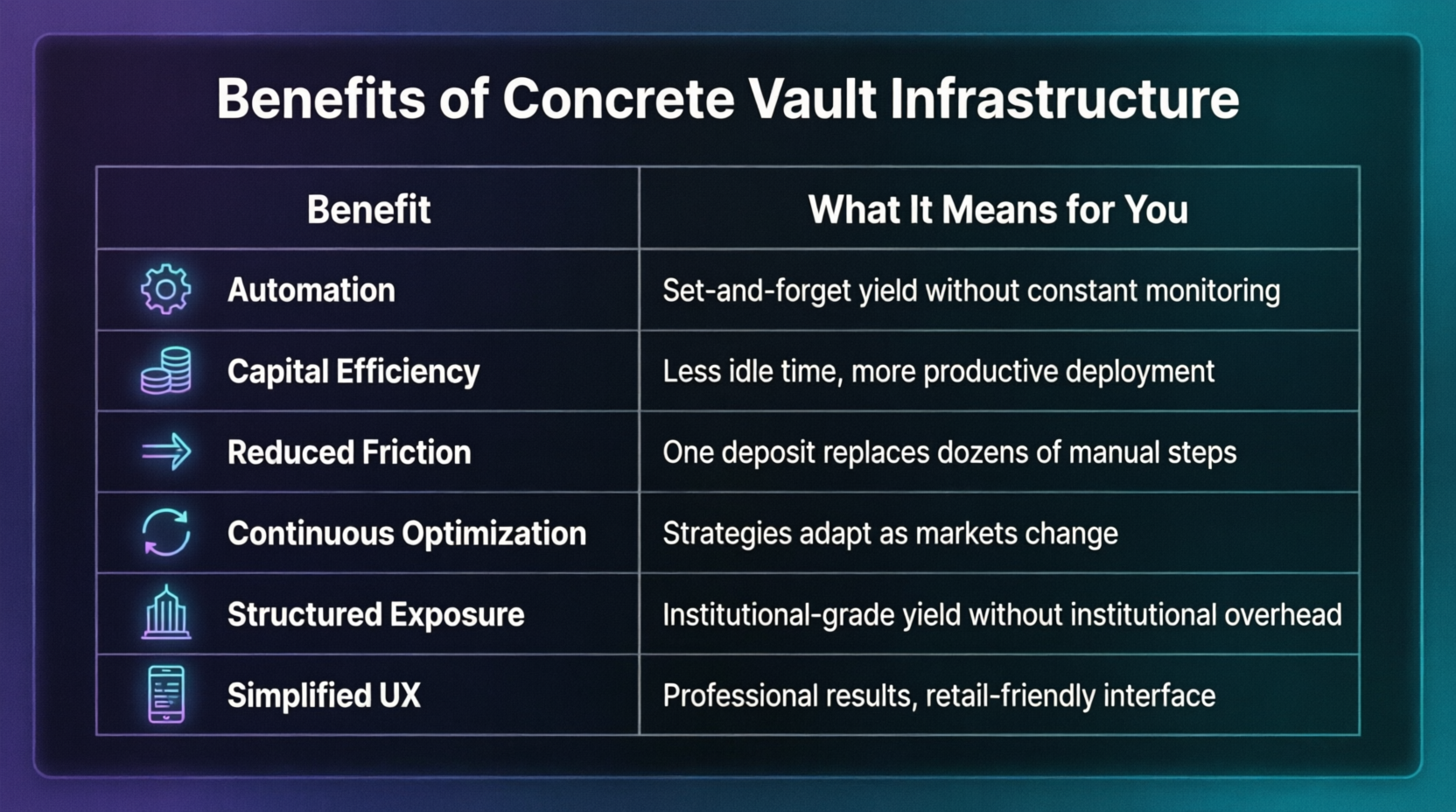
Automation
Vaults reduce the need for constant manual interaction.
Processes like rebalancing, compounding, and strategy adjustments can happen automatically through predefined systems.
Capital Efficiency
Idle capital becomes a major issue in fragmented DeFi environments.
Vault systems help deploy liquidity more efficiently across opportunities instead of leaving assets underutilized.
Simplified User Experience
DeFi participation becomes easier when users no longer need to manage every position themselves.
Vaults abstract much of the operational burden away from the user.
Continuous Optimization
Markets move constantly.
Vault infrastructure allows strategies to adjust over time instead of remaining static.
This creates a more adaptive approach to yield generation and onchain capital management.
Ultimately, vaults help users spend less time managing positions while improving execution consistency.
Vaults Are More Than “Yield Wrappers”
A common misconception is that vaults are simply passive yield tools.
But modern vault infrastructure is much more sophisticated.
Concrete Vaults are designed with systems that help:
-- coordinate capital deployment
-- rebalance positions
-- enforce strategy constraints
-- respond to changing market conditions
-- maintain structured execution frameworks
This creates a more organized and systematic way to participate in DeFi.
Rather than reacting manually to every market movement, users rely on structured infrastructure designed to optimize positioning over time.
This is one reason why vault systems are becoming increasingly important for both retail and institutional DeFi participants.
How Concrete Vault Architecture Works
The strength of Concrete Vaults comes from their structured architecture.
The system combines:
-- ctAssets
-- automated compounding
-- onchain execution
-- structured vault systems
-- coordinated capital allocation
Together, these components help optimize how liquidity moves throughout the ecosystem.
Instead of fragmented manual management, Concrete creates infrastructure that coordinates capital deployment more efficiently across yield opportunities.
This approach matters because DeFi is evolving beyond simple liquidity farming.
The next stage of DeFi infrastructure focuses on:
-- scalable coordination
-- automated execution
-- structured exposure
-- sustainable capital efficiency
-- institutional-grade systems
Concrete Vaults are designed around these principles.
The objective is not only generating yield.
It is building systems capable of managing onchain capital at scale.
The Bigger Shift Happening in DeFi
DeFi is becoming increasingly complex.
As ecosystems expand, manual strategy management becomes harder to sustain.
Users cannot realistically spend all day moving assets between protocols forever.
This is why infrastructure is replacing constant repositioning.
Vaults are gradually becoming the default interface for deploying capital onchain because they simplify execution while improving efficiency.
The future of DeFi may not belong to users endlessly clicking between protocols searching for the next opportunity.
It may belong to systems built to coordinate capital more efficiently through automation, structure, and intelligent deployment frameworks.
And this is exactly where Concrete Vaults position themselves within the evolution of structured DeFi infrastructure.
Explore Concrete at https://concrete.xyz/