Why Concrete Vaults Matter in a More Complex DeFi Market
 Sana4 min read·Just now
--
DeFi promised open access to financial opportunity. Anyone with a wallet could provide liquidity, earn yield, deploy capital across protocols, and participate in markets that once belonged to institutions.
But the reality of using DeFi today looks very different from the original vision.
Most users spend more time managing positions than actually benefiting from them.
They monitor APYs every day.
They move liquidity between protocols chasing better returns.
They claim rewards manually.
They compound positions themselves.
They rebalance exposure when market conditions shift.
They track smart contract risk, emissions changes, and liquidity fragmentation across multiple chains.
The deeper DeFi grows, the harder it becomes for individuals to manage efficiently.
And that creates a major problem:
Manual strategy management does not scale.
The average user cannot compete with automated systems that optimize positions continuously across markets. Even experienced DeFi participants lose efficiency through idle capital, delayed reactions, and fragmented execution.
This is the environment where DeFi vaults become essential infrastructure.
The Purpose of a Vault
At a basic level, a vault exists to simplify onchain capital deployment.
Instead of every user managing strategies independently, vault infrastructure coordinates capital through automated systems designed to optimize exposure over time.
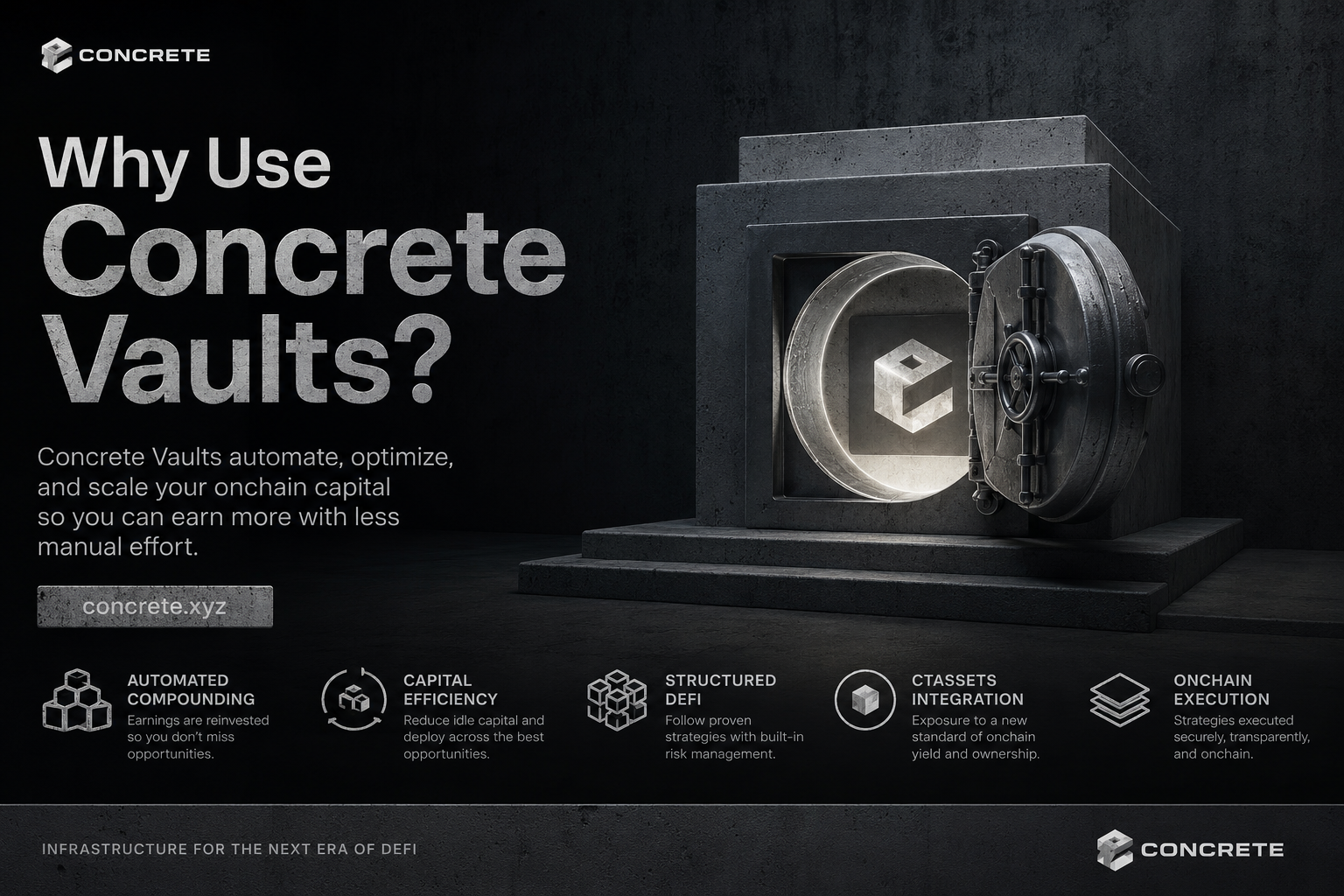
Concrete Vaults take this concept further by building structured systems for capital coordination, automated compounding, and efficient execution across DeFi opportunities.
Rather than constantly repositioning assets manually, users deposit capital into a system designed to manage operational complexity on their behalf.
That changes the entire user experience.
A user no longer needs to spend hours adjusting positions across protocols. The vault handles the execution layer while the user maintains exposure to the underlying strategy.
This creates a more scalable way to participate in DeFi.
What Concrete Vaults Actually Do
Concrete Vaults are designed to coordinate capital efficiently across structured DeFi strategies.
Users deposit assets into vault systems that can:
- pool capital together
- automate compounding
- deploy liquidity across strategies
- rebalance exposure
- optimize positions over time
- reduce operational overhead
This matters because efficiency in DeFi often comes down to execution quality.
A strategy that compounds consistently and reallocates liquidity efficiently can outperform manual management simply because the system reacts faster and wastes less capital.
Concrete Vaults help remove friction from the process.
Instead of managing ten separate actions manually, users interact with a structured system built for continuous optimization.
That creates a cleaner interface between users and increasingly complex DeFi markets.
Why Vault Infrastructure Matters
The growth of institutional DeFi depends heavily on infrastructure.
Institutions cannot scale capital deployment through manual wallet management and fragmented execution. They need systems that structure exposure, automate operations, and coordinate liquidity efficiently.
That is exactly where vault infrastructure becomes important.
Concrete Vaults improve capital efficiency by reducing idle assets and automating repetitive management tasks that normally drain time and attention.
This includes:
- automated compounding
- continuous position management
- coordinated liquidity deployment
- structured exposure to yield opportunities
- reduced operational complexity
In traditional finance, infrastructure abstracts complexity away from the end user.
DeFi is moving in the same direction.
Most users do not want to micromanage positions every hour. They want reliable systems that can deploy capital efficiently while maintaining transparent onchain execution.
Vaults create that layer.
Structured DeFi Requires Structured Systems
Many people still view vaults as simple “yield wrappers.”
That misses the bigger shift happening across DeFi.
Modern vault architecture functions more like an onchain coordination layer for capital.
Concrete Vaults are designed with systems that can:
- rebalance positions
- enforce strategy constraints
- respond to changing market conditions
- coordinate liquidity deployment
- optimize execution across opportunities
This creates a more structured approach to DeFi participation.
Instead of every participant acting independently, vault systems aggregate and organize capital into coordinated strategies.
That structure becomes increasingly valuable as markets become more fragmented and competitive.
The complexity of onchain markets continues to grow.
New protocols launch every week. Liquidity shifts rapidly. Yield opportunities rotate across ecosystems. Execution quality matters more than ever.
Manual management struggles to keep up with that environment.
Structured vault systems are built for it.
The Role of ctAssets and Onchain Execution
Concrete Vault architecture introduces additional layers that improve how capital moves through DeFi systems.
Through ctAssets, automated compounding, and onchain execution infrastructure, Concrete Vaults are designed to coordinate liquidity more efficiently across opportunities.
This creates several advantages:
- users maintain structured exposure without constant repositioning
- strategies can optimize capital deployment continuously
- rewards can compound automatically
- execution remains transparent onchain
- liquidity coordination becomes more scalable
The importance of ctAssets becomes clearer as DeFi evolves toward infrastructure-driven capital management.
Assets are no longer sitting passively inside wallets. Systems now coordinate those assets dynamically across protocols and strategies.
That transition changes how yield generation works.
Instead of individuals manually hunting for opportunities, infrastructure handles optimization at the system level.
This is one of the biggest shifts happening across structured DeFi today.
The Future of DeFi Looks Automated
DeFi is becoming more sophisticated every cycle.
The number of protocols, strategies, and liquidity venues continues to expand. That complexity creates opportunity, but it also creates operational burden.
Most users cannot spend all day moving capital between positions.
And eventually, they will not need to.
Infrastructure is replacing constant manual repositioning.
Vaults are becoming the default interface for deploying onchain capital efficiently.
The future of DeFi may not belong to the users clicking between protocols every few hours trying to optimize yield manually.
It may belong to systems designed to coordinate capital at scale with better execution, better structure, and better efficiency.
Concrete Vaults represent that direction.
Explore https://concrete.xyz/