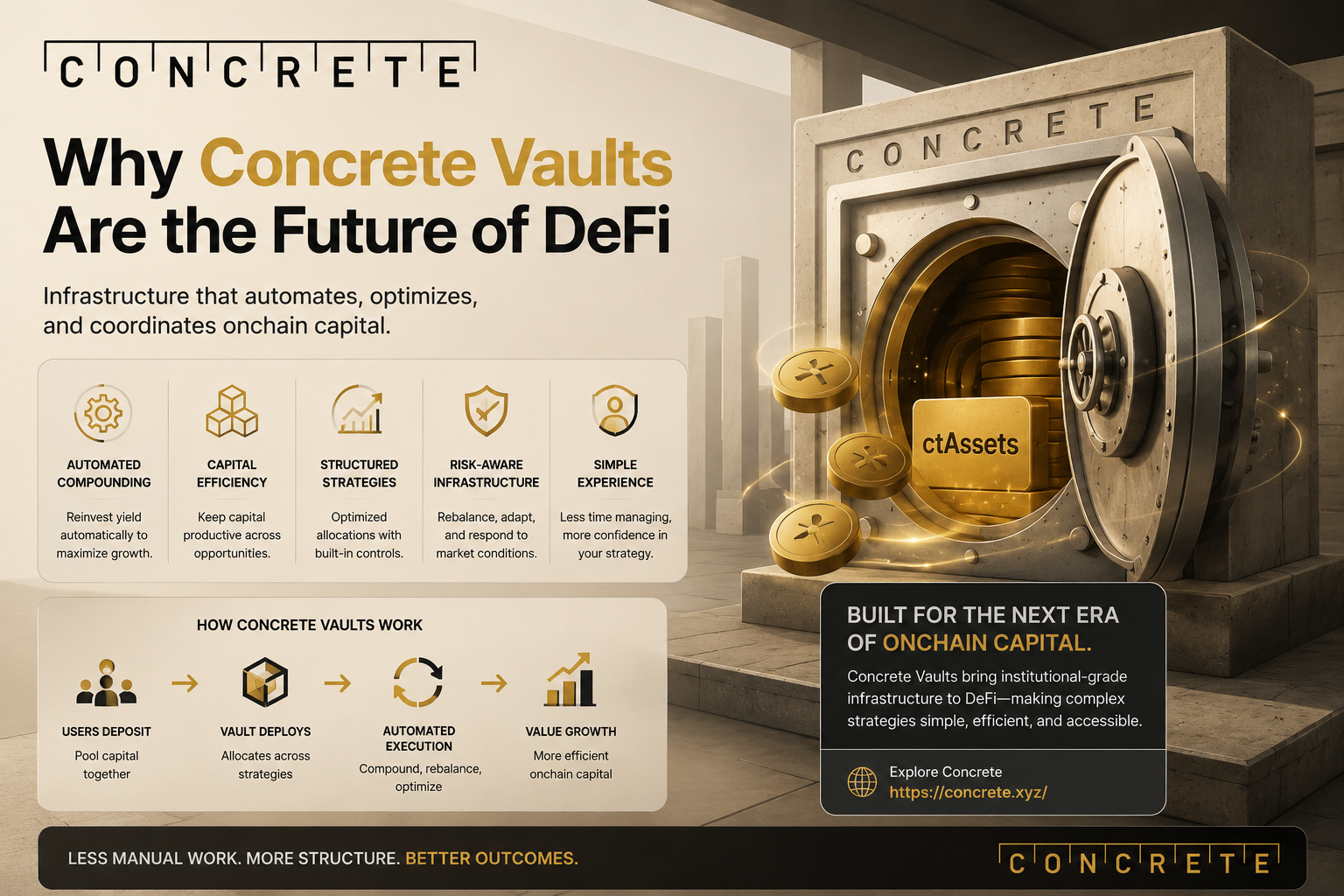
Why Concrete Vaults Could Become the Default Interface for DeFi
--
DeFi promised open access to financial opportunity.
But for most users, participating efficiently in DeFi today still feels like a full-time job.
To stay competitive, users constantly monitor APYs, rotate liquidity between protocols, claim rewards, compound positions, rebalance exposure, and manage risk manually. Every decision requires time, attention, and execution speed.
As the ecosystem expands, the complexity only increases.
This is exactly why vault infrastructure is becoming one of the most important layers in modern DeFi.
And why **Concrete Vaults** are positioning themselves as a major piece of the future of structured onchain capital deployment.
## The Problem With Manual DeFi Management
The current DeFi experience is fragmented.
Users often jump between multiple protocols searching for the best yield opportunities. Liquidity sits idle between transactions. Rewards remain unoptimized until manually compounded. Risk exposure changes rapidly as market conditions evolve.
Even experienced users struggle with:
* constant strategy management
* inefficient capital allocation
* operational overhead
* gas costs from repositioning
* emotional decision-making
* maintaining consistency over time
The reality is simple:
Manual DeFi management does not scale efficiently.
As DeFi becomes more sophisticated, infrastructure that automates and coordinates capital becomes increasingly necessary.
This is where **DeFi vaults** enter the picture.
## What Are Concrete Vaults?
At their core, **Concrete Vaults** simplify how users interact with DeFi strategies.
Instead of manually repositioning capital every day, users deposit assets into a structured vault system designed to optimize deployment automatically.
Concrete Vaults help users:
* pool capital together
* automate compounding
* deploy assets across strategies
* optimize positions continuously
* reduce operational complexity
Rather than spending hours adjusting positions manually, users gain exposure to an actively coordinated system built for efficiency.
The vault becomes the operational layer.
The user simply accesses the strategy.
## Why Vault Infrastructure Matters
Vaults are far more than “yield wrappers.”
They represent a shift toward infrastructure-driven DeFi.
As markets become more competitive, efficiency matters more than ever. Idle capital creates opportunity cost. Delayed compounding reduces long-term returns. Manual execution introduces friction and inconsistency.
Vault infrastructure solves these problems through automation and coordination.
The advantages are significant:
### Automated Compounding
Rewards generated within strategies can be reinvested automatically, allowing positions to grow more efficiently over time without requiring manual interaction.
### Improved Capital Efficiency
Instead of leaving assets idle, vault systems continuously work to deploy capital across productive opportunities.
### Reduced Complexity
Users no longer need to constantly monitor every protocol, strategy adjustment, or reward cycle manually.
### Continuous Optimization
Vaults are designed to adapt dynamically as conditions evolve, improving consistency compared to manual strategy execution.
### Structured Exposure
Users gain access to structured DeFi systems rather than navigating fragmented opportunities individually.
This creates a more scalable model for participating in onchain finance.
## Structured DeFi Requires Structured Systems
One of the biggest misconceptions about vaults is that they simply aggregate yield.
In reality, sophisticated vault systems coordinate capital deployment through defined operational frameworks.
Concrete Vaults are designed with systems that help:
* rebalance positions
* enforce strategy parameters
* manage deployment logic
* automate execution
* adapt to changing market conditions
This introduces structure into an ecosystem that is often highly fragmented and reactive.
Instead of relying entirely on individual users to constantly optimize positions manually, vault infrastructure handles much of the operational complexity behind the scenes.
That shift is critical for the evolution of institutional DeFi.
## The Role of ctAssets and Onchain Execution
A major component of the Concrete ecosystem is the integration of **ctAssets** and automated onchain execution systems.
These mechanisms allow Concrete Vaults to coordinate capital more efficiently across strategies while maintaining structured exposure.
The goal is not simply maximizing yield at any cost.
The goal is sustainable and efficient onchain capital deployment.
Through automated compounding, structured vault architecture, and coordinated execution, Concrete creates an infrastructure layer designed for modern DeFi participation.
This is important because DeFi is no longer just about accessing protocols.
It is increasingly about accessing optimized systems.
And systems outperform fragmented manual management over time.
## The Bigger Shift Happening in DeFi
DeFi is entering a new phase.
The early era rewarded users who manually hunted opportunities across protocols every day. But as the ecosystem matures, complexity continues to rise.
Manual strategy management becomes harder to sustain.
Infrastructure becomes more valuable.
Vaults are increasingly becoming the default interface for deploying capital onchain because they simplify participation while improving operational efficiency.
The future of DeFi may not belong to users endlessly clicking between protocols searching for the next yield opportunity.
It may belong to systems designed to coordinate capital more intelligently.
That is the direction structured DeFi is moving toward.
And Concrete Vaults are building directly for that future.
Explore Concrete at https://concrete.xyz/