 I Am Groot5 min read·Just now
--
Why Concrete Vaults Are Becoming the Future of Structured DeFi
Decentralized finance has unlocked a new financial system built on transparency, permissionless access, and onchain innovation. But as DeFi expands across multiple chains, protocols, and strategies, managing capital manually has become increasingly difficult.
Today, many users enter DeFi expecting passive yield opportunities, only to discover that maintaining competitive returns requires constant attention.
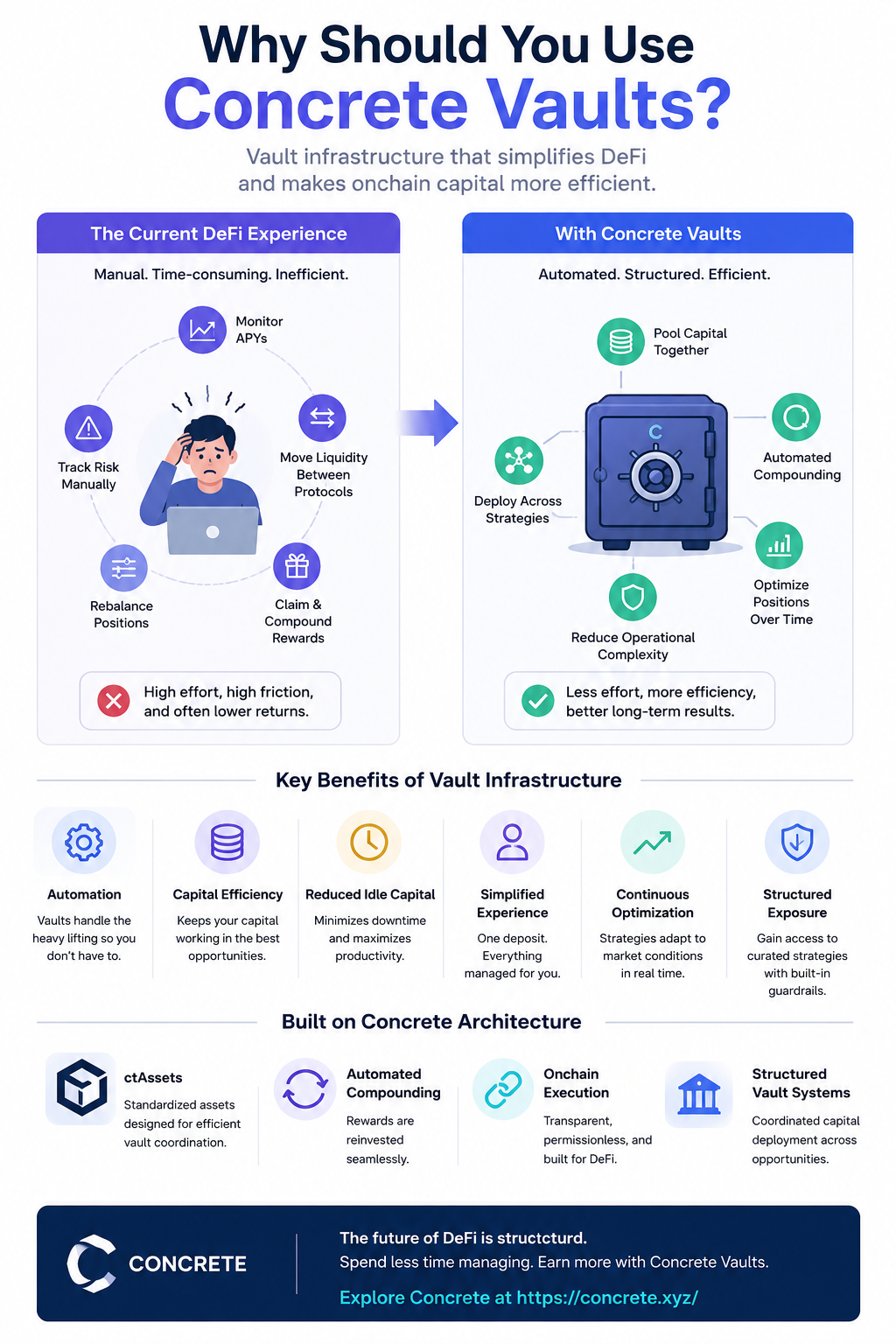
To stay profitable, users often need to:
- monitor APYs across protocols
- shift liquidity between platforms
- claim and compound rewards manually
- rebalance positions regularly
- track protocol risk in real time
- respond quickly to market changes
This creates a fragmented experience where users spend more time managing positions than actually benefiting from them.
The result is operational fatigue.
Instead of efficient capital deployment, users frequently deal with idle liquidity, missed opportunities, unnecessary gas costs, and inconsistent strategy execution. As DeFi grows more advanced, manual participation becomes harder to sustain.
That is where **Concrete Vaults** introduce a different model.
---
# The Role of Vaults in Modern DeFi
At their core, DeFi vaults are infrastructure systems designed to automate capital management.
Rather than forcing users to manually execute every action themselves, vaults coordinate strategies programmatically.
This changes the entire user experience.
Instead of constantly repositioning assets between protocols, users deposit into a structured system that manages optimization on their behalf.
Concrete Vaults are designed to help users:
- pool capital efficiently
- automate compounding
- deploy liquidity across strategies
- optimize yield opportunities continuously
- reduce operational complexity
- improve consistency of execution
This transforms DeFi from a high-maintenance environment into a more scalable financial system.
The importance of this shift cannot be overstated.
As liquidity environments become more competitive, automation becomes essential.
---
# Why Manual DeFi Management No Longer Scales
Early DeFi users were comfortable spending hours managing positions across multiple protocols. But the ecosystem has evolved.
Today’s DeFi environment includes:
- fragmented liquidity markets
- multi-chain execution
- rapidly changing yield conditions
- complex reward systems
- volatile incentives
- sophisticated trading strategies
For individual users, manually coordinating all these moving parts becomes inefficient.
Even experienced participants struggle to consistently optimize capital allocation across every opportunity.
This creates three major problems:
## 1. Idle Capital
Liquidity often sits unused between transactions or remains deployed in underperforming positions.
Idle capital reduces overall efficiency and lowers long-term returns.
## 2. Execution Inefficiency
Users cannot monitor markets 24/7.
Opportunities may appear and disappear quickly, leaving manual participants behind automated systems.
## 3. Operational Burden
Constant repositioning requires time, attention, and technical understanding.
DeFi becomes increasingly inaccessible for users who cannot dedicate full-time effort to managing strategies.
Vault infrastructure addresses these issues directly.
---
# How Concrete Vaults Improve Capital Efficiency
Concrete Vaults are designed around one core principle:
**Capital should remain productive at all times.**
Instead of relying on fragmented user decisions, vault systems coordinate liquidity deployment programmatically through structured execution logic.
This introduces several advantages.
## Automated Compounding
Rewards generated within strategies can be automatically reinvested back into positions.
This removes the need for manual harvesting while improving compounding efficiency over time.
Automated compounding also helps users avoid unnecessary delays between reward cycles.
---
## Continuous Position Optimization
Yield conditions in DeFi change constantly.
Concrete Vaults are designed to adjust positioning dynamically rather than leaving liquidity static.
This enables:
- smarter allocation decisions
- reduced inactive liquidity
- improved responsiveness to market conditions
- more consistent strategy execution
Instead of manually chasing opportunities, users gain exposure to systems built for continuous optimization.
---
## Simplified User Experience
One of the largest barriers in DeFi is complexity.
Managing multiple protocols, wallets, rewards systems, and liquidity positions creates friction for both new and experienced users.
Concrete Vaults simplify participation by abstracting much of the operational workload into structured infrastructure.
Users interact with a coordinated vault system rather than juggling multiple protocols independently.
This creates a cleaner and more scalable DeFi experience.
---
# Vaults Are More Than Simple Yield Wrappers
Many people misunderstand vaults as basic “yield aggregators.”
In reality, advanced vault infrastructure functions more like an active coordination layer for onchain capital deployment.
Concrete Vaults include systems designed to:
- coordinate liquidity deployment
- rebalance positions
- maintain strategy parameters
- enforce allocation structures
- optimize execution paths
- respond to changing market environments
This introduces a more disciplined framework for participating in DeFi.
Rather than relying entirely on emotional or reactive decision-making, vault systems apply structured logic to capital management.
This is especially important as institutional DeFi participation continues to grow.
Larger pools of capital require infrastructure capable of maintaining consistency, efficiency, and scalable execution.
---
# The Importance of Structured DeFi Infrastructure
The next phase of DeFi is not only about higher yields.
It is about building sustainable infrastructure.
Structured DeFi systems reduce friction between users and opportunity by creating programmable frameworks for capital coordination.
Concrete Vaults represent this transition.
By combining:
- automated compounding
- structured execution
- ctAssets
- coordinated liquidity management
- onchain capital deployment
Concrete is building infrastructure designed for a more mature DeFi ecosystem.
The introduction of **ctAssets** further strengthens this model by enabling more efficient vault coordination and structured exposure to strategies operating across the ecosystem.
Instead of isolated positions scattered across protocols, ctAssets help organize liquidity into programmable financial systems capable of adapting over time.
This is a major evolution from traditional manual farming models.
---
# Why Institutional DeFi Needs Vault Systems
Institutional DeFi participation introduces different requirements than retail speculation.
Institutions require:
- predictable infrastructure
- scalable liquidity systems
- transparent execution
- structured risk management
- operational efficiency
Manual strategy management cannot support institutional-scale coordination efficiently.
Vault architecture becomes essential because it standardizes execution while reducing operational overhead.
Concrete Vaults are positioned within this broader evolution toward infrastructure-driven finance.
As DeFi matures, systems capable of automating and coordinating capital efficiently will become increasingly important.
---
# The Future of Onchain Capital Deployment
DeFi is becoming more sophisticated every year.
Strategies are growing more complex.
Liquidity environments are becoming more competitive.
Execution speed matters more than ever.
In this environment, manually managing positions across protocols does not scale efficiently.
Infrastructure is replacing constant repositioning.
Users no longer want to spend entire days monitoring APYs, claiming rewards, and adjusting positions manually.
Instead, the future points toward intelligent vault systems capable of coordinating capital automatically.
Concrete Vaults represent this larger shift toward structured DeFi infrastructure.
The future of DeFi may not belong to the users endlessly clicking between protocols.
It may belong to the systems designed to deploy capital more efficiently, optimize liquidity continuously, and simplify participation at scale.
Explore Concrete at https://concrete.xyz/