Why Concrete Vaults Are Becoming the Future of DeFi Capital Management
--
DeFi opened the door to permissionless finance, but participating efficiently is still harder than most people admit.
Today, staying competitive onchain often feels like a full-time job.
Users constantly monitor APYs, rotate liquidity between protocols, claim rewards manually, compound earnings, rebalance positions, and manage risk across multiple ecosystems. Every opportunity comes with another dashboard, another bridge, another transaction, and another decision to make.
The result?
Friction.
A system designed to make finance more open has also become increasingly complex to navigate efficiently.
That is exactly why DeFi vaults are becoming one of the most important pieces of infrastructure in onchain finance.
And this is where Concrete Vaults enter the picture.
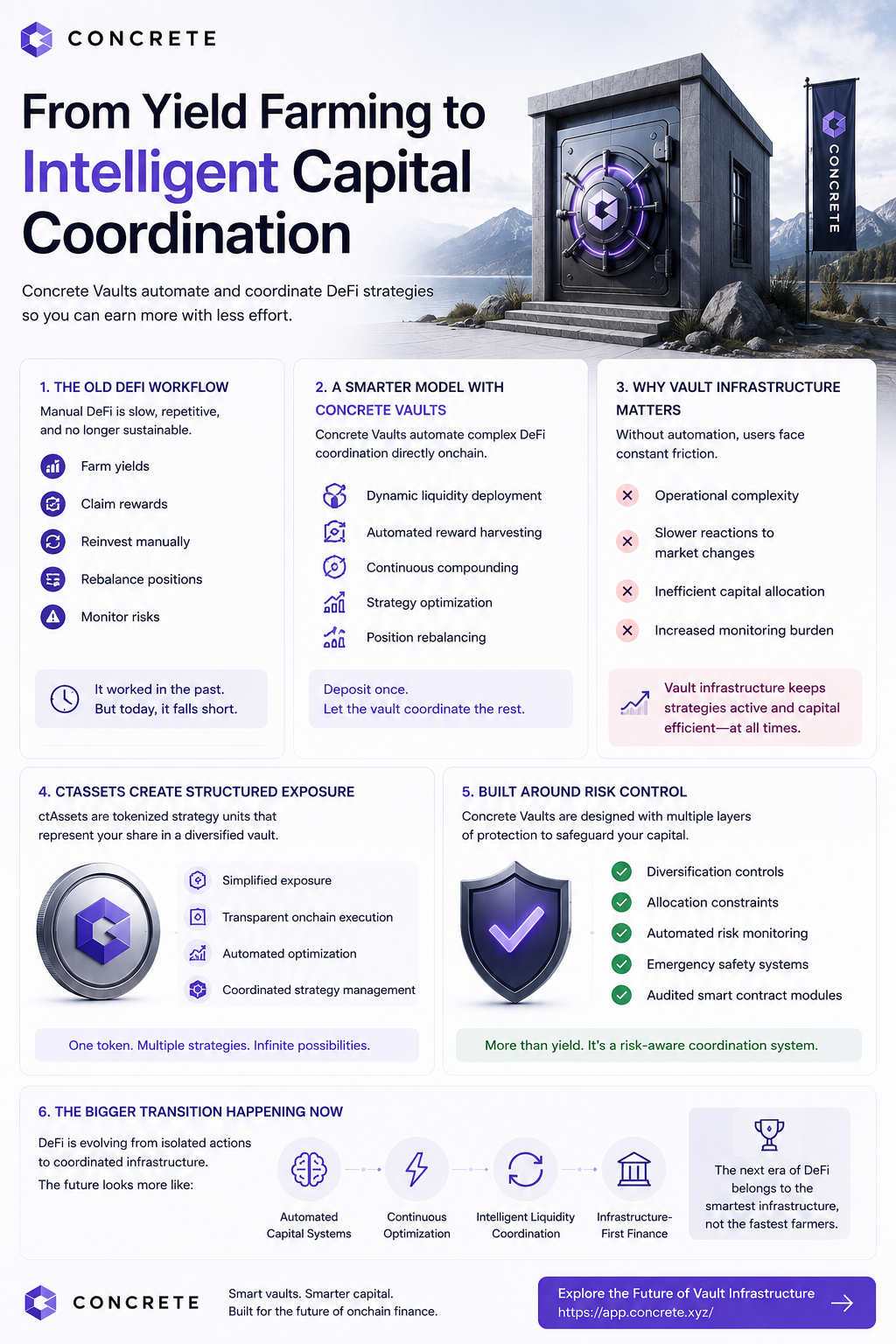
The Problem With Manual DeFi Management
The reality of modern DeFi is simple:
Manual strategy management does not scale.
As protocols multiply and opportunities fragment across chains, users face several persistent problems:
- idle capital sitting unutilized
- missed yield opportunities
- inefficient reward compounding
- emotional decision-making
- constant repositioning costs
- fragmented liquidity management
Even experienced users struggle to optimize every position in real time.
The more complex DeFi becomes, the more difficult it is for individuals to coordinate capital efficiently on their own.
This is why structured DeFi infrastructure matters.
Vaults simplify the process.
Instead of requiring users to manage every step manually, vault systems automate the operational layer of capital deployment.
What Do Concrete Vaults Actually Do?
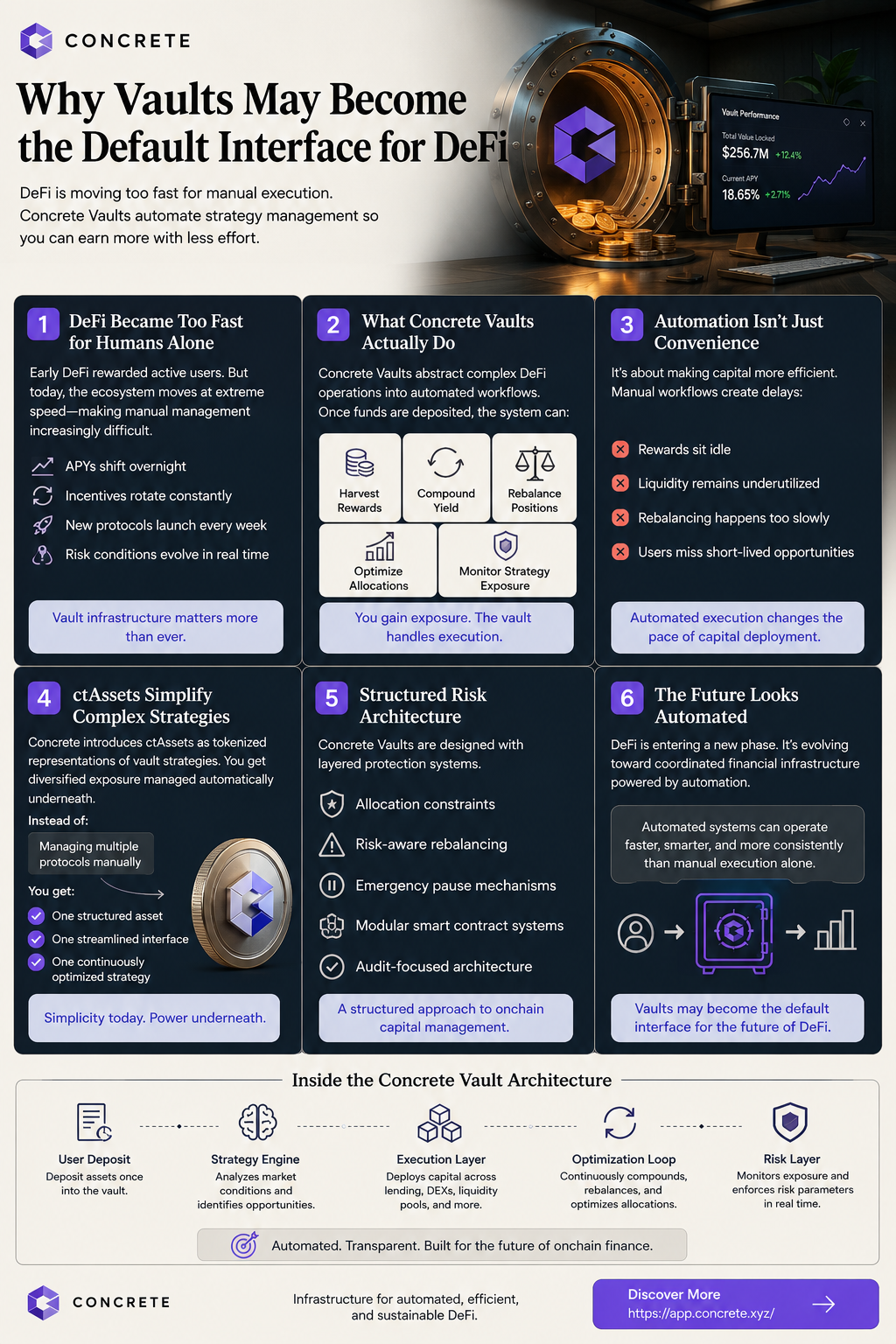
At their core, Concrete Vaults are designed to help users deploy capital more efficiently through structured systems.
Instead of manually chasing opportunities, users deposit assets into vaults that coordinate strategies onchain.
This allows users to:
- pool capital together
- automate compounding
- optimize positions continuously
- deploy liquidity across strategies
- reduce operational overhead
- maintain structured exposure to yield opportunities
Rather than constantly moving assets between protocols, users gain exposure to an automated framework designed to manage capital more efficiently over time.
This changes the DeFi experience entirely.
Users spend less time managing infrastructure and more time participating in the ecosystem itself.
Why Vault Infrastructure Matters
The importance of vault infrastructure goes far beyond convenience.
Vaults fundamentally improve capital efficiency.
In traditional manual DeFi participation, capital is often underutilized because users cannot rebalance fast enough or monitor every opportunity continuously.
Concrete Vaults help solve this problem through automation and structured execution.
Key advantages include:
Automated Compounding
Rewards generated inside strategies can be compounded automatically, allowing positions to grow more efficiently over time without requiring manual intervention.
Reduced Idle Capital
Instead of assets sitting inactive, vault systems continuously coordinate deployment across opportunities.
Continuous Optimization
Markets move quickly. Vault infrastructure allows positions to adjust dynamically rather than relying on delayed manual management.
Simplified User Experience
Users no longer need to interact with multiple protocols constantly just to maintain competitive positioning.
Structured Exposure
Vaults provide organized access to yield opportunities while maintaining predefined strategy structures.
The result is a more scalable model for participating in DeFi.
Concrete Vaults Are More Than Yield Wrappers
One misconception about DeFi vaults is that they are simply passive yield products.
But Concrete Vaults are designed with deeper infrastructure layers that coordinate how capital is deployed and managed onchain.
This includes systems that help:
- rebalance positions
- coordinate liquidity deployment
- enforce strategic parameters
- respond to changing market conditions
- optimize execution efficiency
This creates a more structured approach to DeFi participation.
Instead of relying entirely on individual users to make every optimization decision manually, the vault architecture itself helps coordinate capital deployment intelligently.
That distinction becomes increasingly important as DeFi evolves toward institutional DeFi infrastructure.
The Role of ctAssets and Structured Onchain Capital Deployment
One of the most important aspects of the Concrete ecosystem is its approach to structured onchain capital deployment.
Through systems like ctAssets, Concrete Vaults are designed to create more efficient coordination between users, strategies, and yield opportunities.
Combined with automated compounding and onchain execution, this infrastructure allows capital to move through structured systems rather than fragmented manual interactions.
This matters because the next phase of DeFi growth will likely depend on infrastructure efficiency rather than pure access alone.
Anyone can access DeFi.
The real advantage now comes from coordinating capital efficiently.
Concrete Vaults aim to provide exactly that.
The Bigger Shift Happening in DeFi
DeFi is entering a new phase.
Early users were willing to manually manage every transaction, every farm, and every rebalance. But as the ecosystem matures, complexity increases dramatically.
Manual strategy management is becoming unsustainable.
The future of DeFi may not belong to users clicking between protocols all day searching for yield.
It may belong to the infrastructure coordinating capital automatically behind the scenes.
This is why DeFi vaults are becoming increasingly important.
They transform fragmented user actions into structured systems designed for consistency, automation, and capital efficiency.
Concrete Vaults represent this broader shift toward scalable onchain finance infrastructure.
And as institutional DeFi continues to grow, systems built for automated coordination may become the default interface for deploying capital onchain.
Explore Concrete at Concrete