Why Concrete Vaults Are Becoming Essential in DeFi
 HOA THAN4 min read·1 hour ago
--
DeFi offers incredible opportunities.
But for most users, participating effectively is far from simple.
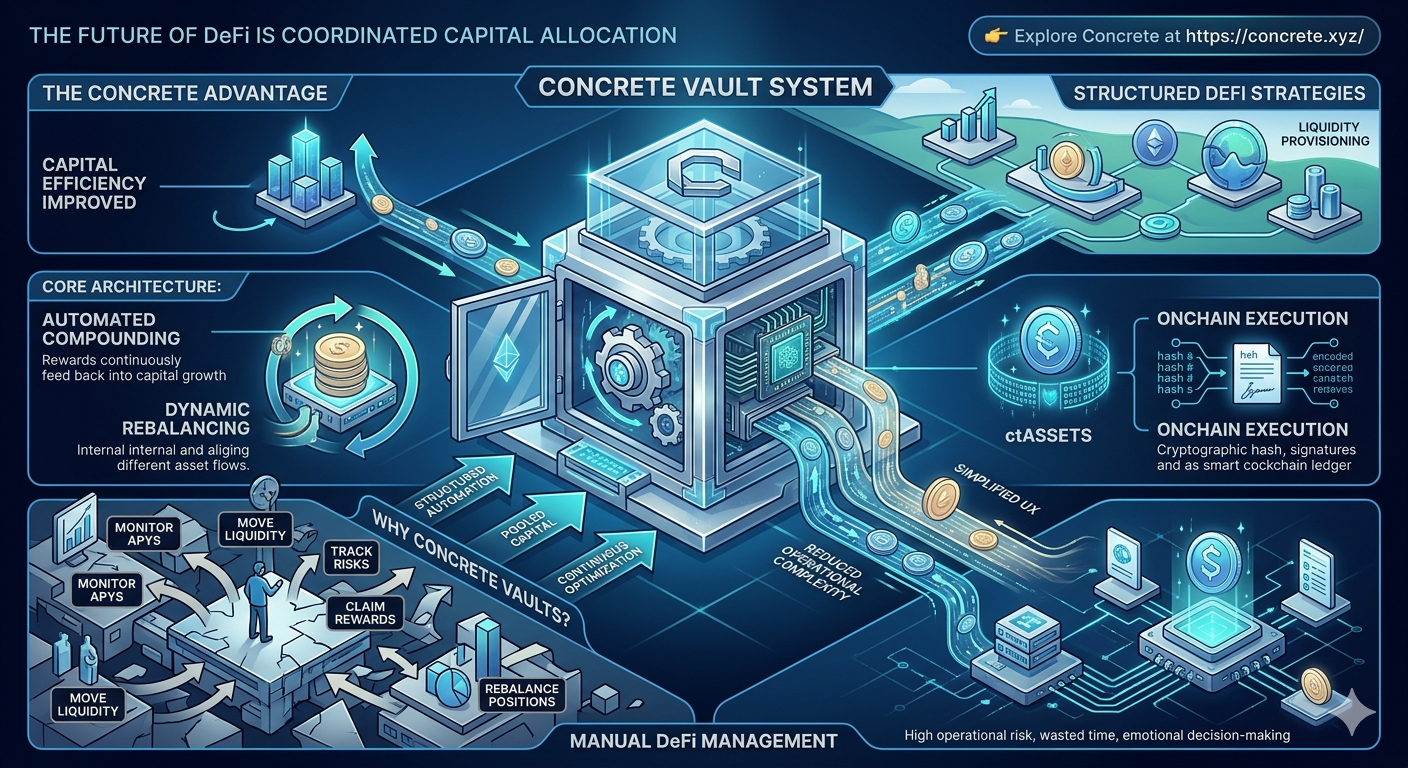
To stay competitive, users often need to:
- monitor APYs constantly
- move liquidity between protocols
- claim and compound rewards manually
- rebalance positions
- track risks across multiple platforms
What starts as “passive income” quickly turns into a full-time operational task.
And as DeFi grows more complex, manual management becomes increasingly inefficient.
This is exactly why DeFi vaults exist.
The Problem With Manual DeFi Management
Modern DeFi moves fast.
Yields change daily. Liquidity shifts constantly. Incentives rotate between ecosystems.
To maximize returns manually, users must continuously reposition capital across protocols.
That creates several problems:
- wasted time
- fragmented liquidity
- idle capital
- inconsistent strategy execution
- emotional decision-making
- higher operational risk
For many users, the biggest challenge is not finding opportunities.
It is managing them efficiently.
What Are Concrete Vaults?
Concrete Vaults simplify onchain capital management through structured automation.
Instead of manually moving assets between strategies, users deposit capital into vault systems designed to optimize deployment over time.
Concrete Vaults help users:
- pool capital together
- automate compounding
- optimize positions continuously
- deploy across multiple strategies
- reduce operational complexity
Rather than reacting to every market movement manually, users gain exposure to a coordinated system built for efficiency.
This transforms DeFi participation from constant micromanagement into structured capital allocation.
Why Vault Infrastructure Matters
As DeFi evolves, infrastructure becomes increasingly important.
The industry is shifting away from users manually clicking between protocols all day.
Instead, systems are emerging that coordinate capital automatically.
This is where DeFi vaults provide real value.
Automation
Vaults automate repetitive processes like harvesting rewards, compounding yield, and reallocating liquidity.
Users no longer need to monitor positions 24/7.
Capital Efficiency
One of the biggest problems in DeFi is idle capital.
Vault systems improve capital efficiency by actively deploying assets into productive strategies instead of leaving them unused.
Simplified User Experience
Managing multiple protocols manually creates friction.
Vault infrastructure abstracts away much of that complexity, allowing users to access opportunities through a more streamlined experience.
Continuous Optimization
Markets evolve constantly.
Vault systems can rebalance and optimize positions over time, creating more consistent exposure to yield opportunities.
The key advantage is simple:
Users spend less time managing positions while improving efficiency and consistency.
Vaults Are More Than Yield Wrappers
A common misconception is that vaults simply “wrap yield.”
But advanced vault infrastructure does much more than that.
Concrete Vaults are designed with systems that help:
- coordinate onchain capital deployment
- rebalance positions dynamically
- enforce strategy constraints
- respond to changing market conditions
- maintain structured exposure across opportunities
This creates a more disciplined and scalable approach to participating in structured DeFi.
Instead of relying entirely on manual execution, users interact with systems engineered for coordination and efficiency.
How Concrete Vault Architecture Works
This is where Concrete takes a differentiated approach.
Concrete Vaults are built around infrastructure designed to optimize capital deployment across DeFi opportunities.
Core components include:
ctAssets
ctAssets act as structured representations of vault participation and strategy exposure within the ecosystem.
They help standardize how capital interacts across vault systems.
Automated Compounding
Rewards generated through strategies can be automatically reinvested through automated compounding, improving long-term efficiency without requiring constant user intervention.
Onchain Execution
Concrete emphasizes transparent onchain capital deployment, where strategy execution occurs through programmable infrastructure rather than fragmented manual coordination.
Structured Vault Systems
Rather than isolated positions, Concrete Vaults operate as coordinated systems designed to optimize exposure, rebalance capital, and improve overall capital efficiency.
This creates infrastructure that scales more effectively as DeFi becomes increasingly complex.
👉 Explore Concrete at https://concrete.xyz/
The Bigger Shift in DeFi
DeFi is evolving rapidly.
Manual strategy management may have worked in earlier cycles, but it becomes less sustainable as ecosystems expand.
The future of institutional DeFi will likely depend on infrastructure that can coordinate capital intelligently and efficiently.
This is why vault systems are becoming increasingly important.
They reduce friction.
They improve capital efficiency.
And they help users participate in DeFi without constantly managing every position manually.
The future of DeFi may not belong to users endlessly moving liquidity between protocols.
It may belong to the systems designed to coordinate capital more effectively.
Final Thoughts
As DeFi grows more sophisticated, infrastructure matters more than ever.
Concrete Vaults represent a shift toward automated, structured, and scalable participation in DeFi.
Through:
- automated compounding
- structured vault systems
- efficient onchain capital deployment
- and optimized capital coordination
Concrete is helping redefine how users interact with modern DeFi infrastructure.
The next phase of DeFi may not be manual.
It may be coordinated.