Why Casino Operators Need Flexible Banking Solutions
--
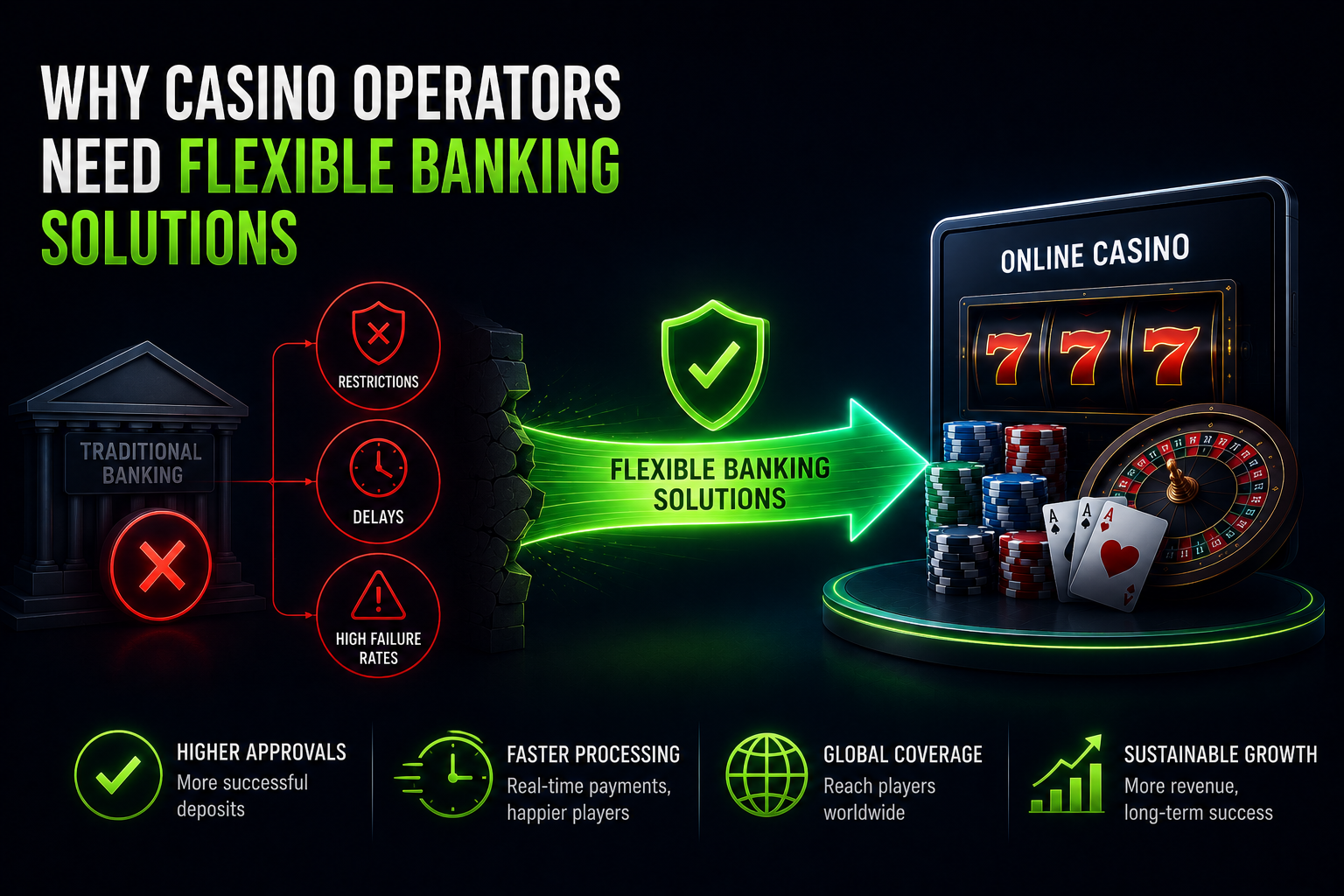
The word “flexible” gets used casually in payments discussions, often as a synonym for “has a lot of features.” In the context of casino banking, flexibility means something more specific and more operationally consequential: the ability to adapt to market conditions, regulatory changes, processor relationships, and player behaviour without those adaptations requiring a platform rebuild or a months-long migration.
Casino operators who have rigid payment infrastructure do not stay competitive. The iGaming market moves too fast, the regulatory landscape shifts too frequently, and player payment preferences evolve across too many dimensions for a fixed, inflexible banking architecture to serve operators well over time.
The Market Conditions That Demand Flexibility
Online gaming is one of the fastest-moving verticals in digital commerce. New markets open as jurisdictions pass enabling legislation. Existing markets tighten as regulators add requirements. Player demographics shift, bringing different payment preferences. New payment methods emerge and gain adoption faster than most product roadmaps anticipate.
An operator whose banking solution is built around a specific set of card processors and bank relationships is well-positioned for the market as it exists when that infrastructure is built. Two years later, the picture may be completely different. A key jurisdiction may have added local payment method requirements. A major processor may have terminated high-risk merchants following a change in risk policy. A new payment method may have become dominant in a high-value player segment.
Flexible banking infrastructure responds to these changes without forcing the operator into a crisis migration. Processors can be added or substituted without rebuilding integration layers. New payment methods can be activated through a platform that already supports them rather than through bespoke development. Regulatory requirements can be met through configuration rather than reconstruction.
The Processor Relationship Problem
One of the most uncomfortable realities in iGaming payments is that processor relationships are not permanent. High-risk processors — the segment that serves gaming operators — operate under their own regulatory and risk constraints. They can and do terminate merchant relationships when chargeback ratios rise above acceptable thresholds, when their own banking partners apply pressure on gaming verticals, or when compliance reviews raise concerns about operator practices.
For a casino operator dependent on a single processor, a termination notice is a crisis. Processing stops. Players cannot deposit. Revenue collapses instantly. The operator must scramble to establish a replacement relationship — typically taking weeks to months — during which the business is severely impaired.
This risk is not hypothetical. Processor terminations are a regular feature of the iGaming payments landscape, and operators who have not built redundancy into their banking architecture experience significant business disruption when they happen.
Flexible banking solutions address this directly. When an operator processes through multiple acquiring relationships and routes transactions dynamically across them, a single processor termination becomes a routing change rather than a crisis. Volume shifts to available processors, processing continues, and the operator has time to establish replacement relationships from a position of operational continuity rather than desperation.
Local Payment Methods and Regulatory Compliance
Flexibility in banking is not only about processor redundancy. It is equally about the ability to meet players where they are — accepting the payment methods that players in each market actually prefer, rather than the subset that a specific banking relationship happens to support.
Regulatory requirements increasingly mandate local payment method support in licensed markets. Several European jurisdictions have introduced requirements that operators accept local bank transfer methods alongside card payments. Some Asian markets require specific regional e-wallet integrations for licensed operators to process legally.
An operator with a rigid, fixed banking solution that doesn’t support these methods faces a binary choice when entering such markets: build bespoke integrations at significant cost and time, or stay out of the market. Neither is a good option when competitors with flexible infrastructure can activate new payment method support through existing platform capabilities.
Flexible banking solutions with broad APM (Alternative Payment Method) coverage — like the 150+ payment options available through BoxCharge — give operators the ability to enter new markets and meet local compliance requirements without custom payment development work for each new jurisdiction.
The Chargeback Management Dimension
Chargebacks are the constant companion of iGaming operations. They cannot be eliminated, but they can be managed — and the banking solution an operator uses has a significant impact on how effectively chargeback risk is contained.
Flexible banking infrastructure supports chargeback management in several ways. Transaction routing logic can direct higher-risk transaction profiles to processors with better handling of gaming chargebacks. Fraud detection tools integrated into the payment flow can flag suspicious transactions before they process, reducing the source volume of disputes. Automated dispute response workflows can engage with chargeback cases efficiently, improving win rates.
A rigid banking architecture with limited processor relationships and basic fraud tooling leaves the operator exposed. Chargeback ratios climb. Processor relationships come under pressure. The operator enters the cycle of reactive crisis management rather than proactive risk containment.
Flexibility in this context means having tools and relationships that can adapt to the chargeback patterns specific to your player base, your market mix, and your promotional strategies — rather than accepting whatever outcomes a fixed infrastructure produces.
Currency and Settlement Flexibility
Multi-currency operations are standard in international gaming. Players deposit in local currencies. Operators manage treasury in primary currencies. Regulatory requirements in some markets mandate local currency settlement.
Banking solutions that cannot handle multi-currency operations flexibly impose a hidden cost on operators: conversion losses, reconciliation complexity, and the inability to offer players a native currency experience in markets where that matters for conversion rates.
Flexible banking infrastructure supports currency at every level — local currency IBANs for player deposits, multi-currency merchant accounts for consolidated processing, and settlement options that match the operator’s treasury management preferences. BoxCharge’s infrastructure, for example, supports multi-currency deposits and settlements, enabling operators to serve global player bases without the currency mismatch that creates both player friction and back-office complexity.
Building for Regulatory Change, Not Just Current Compliance
The regulatory environment for online gaming is not static. Markets that are currently open may introduce new requirements. Licensed jurisdictions regularly update technical standards and financial reporting obligations. The direction of global iGaming regulation is broadly toward tighter requirements — more KYC, more transaction monitoring, more local compliance obligations.
Operators whose banking architecture is built around today’s regulatory requirements will face costly upgrades as those requirements evolve. Operators whose banking infrastructure is provided by partners with dedicated compliance teams and continuously updated regulatory frameworks are better positioned to absorb regulatory change without business disruption.
This is part of what flexible banking solutions provide: not just the capability set of today, but the organisational commitment and infrastructure investment to keep pace with the regulatory environment that the iGaming industry will navigate over the next five to ten years.
The BoxCharge Approach to Flexible Banking
BoxCharge was built specifically to provide high-risk merchants — including casino operators — with the banking flexibility that the iGaming environment demands. Dedicated merchant accounts, dynamic payment routing, 150+ payment method coverage, virtual IBAN infrastructure, multi-currency support, and integrated chargeback management are not add-on features. They are the core of what purpose-built flexible banking infrastructure for gaming looks like.
Operators who partner with BoxCharge are not locked into a specific processor configuration or a fixed payment method set. As market conditions change, as new jurisdictions open, and as player preferences evolve, the payment infrastructure adapts with them — without the rebuild cycles and migration costs that rigid banking solutions impose.
Flexibility Is Risk Management
Ultimately, banking flexibility for casino operators is a risk management posture. The risks in iGaming payments are real — processor terminations, regulatory changes, market shifts, chargeback cycles — and they are ongoing. The operators who manage these risks effectively are not the ones who have chosen the lowest-cost banking solution or the most well-known gateway. They are the ones who have built payment infrastructure that can absorb shocks, adapt to change, and continue performing regardless of what the market throws at it.
Flexible banking is not a premium feature for large operators. It is the baseline that any serious gaming operation should build on — because the alternative is finding out how rigid your infrastructure is at the worst possible moment.
BoxCharge provides flexible, purpose-built banking and payment solutions for online casino operators. Visit boxchrge.com to explore the platform.