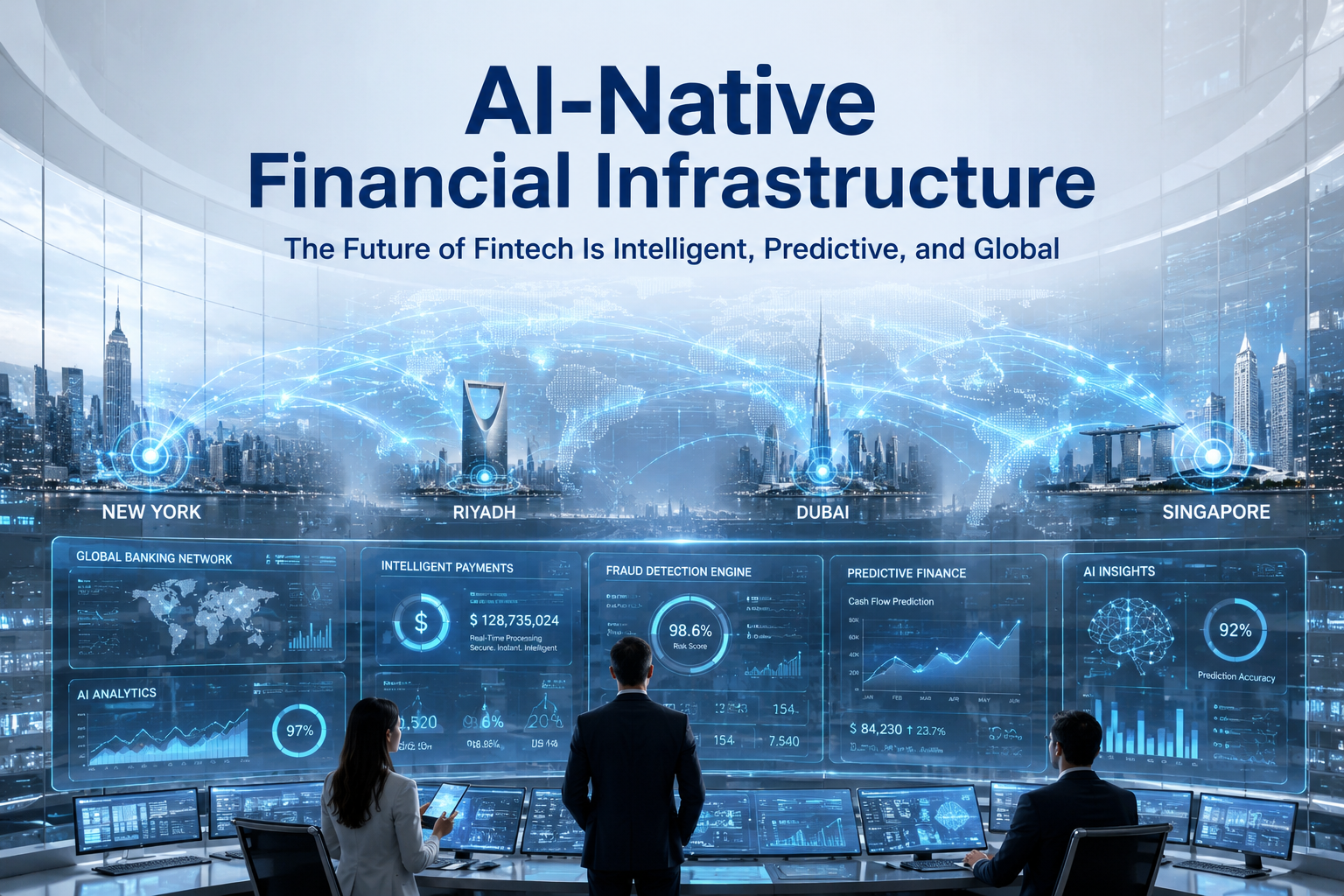
Why AI-Native Financial Infrastructure Is Reshaping Fintech
--
For years, the fintech conversation revolved around the same handful of markets.
Most major platforms were designed in Silicon Valley, funded in mature economies, and built around assumptions that worked primarily for Western banking systems. The model was familiar: digitize finance, improve the customer interface, scale globally later.
That strategy worked for a generation of fintech companies.
But the industry is changing much faster now.
The next wave of financial transformation is not being driven by geography alone. It is being shaped by operational complexity, regulatory pressure, AI adoption, and the growing expectation that financial systems should think in real time instead of simply recording transactions after they happen.
That shift matters.
Because modern enterprises no longer need software that only processes financial activity. They need systems capable of understanding patterns, predicting risk, detecting anomalies, and helping leadership teams make faster operational decisions.
This is where intelligent financial infrastructure enters the picture.
And this is also where companies like Hyena.ai are beginning to stand out.
The Fintech Industry Is Quietly Moving Into an AI-First Era
A few years ago, artificial intelligence in finance was often treated like an innovation experiment.
Banks explored chatbots. Fintech startups tested recommendation engines. Fraud teams used limited automation for transaction monitoring.
Today, the expectations are entirely different.
Financial organizations now expect AI systems to assist with:
- Fraud prevention
- Customer intelligence
- Treasury visibility
- Predictive forecasting
- Compliance monitoring
- Risk scoring
- Automated workflows
- Operational analytics
In other words, AI is no longer a side feature.
It is becoming operational infrastructure.
The organizations moving fastest are not necessarily the ones building the flashiest mobile apps. In many cases, they are the companies quietly rebuilding internal financial operations around intelligence, automation, and predictive systems.
That transformation is creating enormous demand for every capable enterprise AI development company working inside the fintech ecosystem.
Legacy Financial Systems Were Never Designed for Real-Time Intelligence
One of the biggest misconceptions in modern banking is that digital transformation automatically creates operational agility.
It does not.
Many institutions still operate on fragmented infrastructure that was designed years before real-time analytics became essential.
Inside large financial organizations, it is still common to find:
- Disconnected reporting systems
- Delayed reconciliation processes
- Rule-based fraud engines
- Manual compliance workflows
- Siloed customer data
- Reactive risk management models
These systems can process transactions, but they struggle to generate intelligence.
And that distinction is becoming increasingly important.
A transaction record tells you what already happened.
AI-powered financial infrastructure helps organizations understand what is about to happen next.
That difference changes everything from fraud prevention to treasury planning.
Financial Leaders Are Starting to Prioritize Predictive Infrastructure
The most competitive financial organizations are no longer relying only on historical reporting.
They are investing heavily in predictive decision-making.
This is one reason why demand for Predictive analytics for finance continues growing across enterprise banking, fintech platforms, and large-scale digital payment ecosystems.
Predictive systems help organizations identify signals early, before operational issues become expensive problems.
For example:
- Unusual transaction patterns can trigger fraud reviews immediately
- Liquidity risks can be forecasted before cash flow disruptions occur
- Customer churn indicators can be detected weeks earlier
- Compliance anomalies can surface before audits begin
- Credit risk models can adapt continuously instead of quarterly
This creates a fundamentally different operating environment.
Instead of reacting slowly, financial teams gain the ability to move proactively.
That advantage compounds over time.
AI Is Reshaping the Way Financial Risk Is Managed
Risk management used to depend heavily on static frameworks.
Financial institutions created policies, monitored reports, escalated concerns manually, and adjusted controls over long operational cycles.
That approach is becoming harder to maintain.
The scale and speed of modern financial activity introduces risks that traditional systems struggle to process efficiently.
Cross-border transactions, digital banking ecosystems, embedded finance, AI-generated fraud attempts, and evolving compliance standards are all increasing operational pressure.
This is where AI risk management fintech systems are becoming essential rather than optional.
Modern AI-driven risk environments can evaluate:
- Behavioral anomalies
- Transaction velocity
- Geographic inconsistencies
- Identity irregularities
- Device intelligence
- Historical account activity
- Network-level fraud patterns
More importantly, these systems improve continuously as new data enters the environment.
That adaptive capability is difficult to replicate using traditional rule-based infrastructure.
Hyena.ai focuses heavily on building intelligent enterprise ecosystems capable of supporting this type of evolving financial environment.
Fraud Detection Has Become Far More Complex Than Most Organizations Expected
Financial fraud is evolving faster than many institutions anticipated.
A few years ago, fraud detection often focused on suspicious transactions or stolen credentials.
Today, the landscape looks very different.
Organizations now deal with:
- Synthetic identity fraud
- AI-generated phishing campaigns
- Deepfake verification attacks
- Coordinated bot activity
- Account takeover attempts
- Cross-platform transaction laundering
Traditional detection systems frequently struggle because they depend on predefined logic. Fraudsters, meanwhile, adapt rapidly.
That mismatch creates dangerous operational gaps.
Modern AI fraud detection banking systems operate differently.
Instead of looking only for fixed rules, they analyze behavioral patterns in real time.
A login location alone may not appear suspicious. But when combined with unusual device behavior, abnormal transaction timing, navigation inconsistencies, and spending pattern changes, the system begins identifying meaningful risk indicators.
This layered intelligence significantly improves fraud prevention accuracy while reducing unnecessary customer friction.
That balance matters more than ever in digital finance.
The Strongest Fintech Platforms Are Becoming Invisible Infrastructure
Consumers often notice the front-end experience of fintech platforms first.
They notice faster onboarding, cleaner interfaces, or instant payments.
But the real long-term advantage is usually hidden much deeper.
The strongest financial platforms are increasingly built around invisible operational infrastructure:
- AI orchestration systems
- Intelligent automation layers
- Predictive analytics engines
- Real-time compliance monitoring
- Autonomous fraud prevention
- Adaptive risk intelligence
These capabilities rarely appear in marketing headlines, yet they determine whether a financial platform can scale efficiently across markets.
This is particularly important in regions experiencing rapid fintech growth such as the UAE and Saudi Arabia.
The Gulf Region Is Becoming a Serious AI and Fintech Innovation Hub
Global fintech leadership is no longer concentrated in one region.
Across the Gulf, governments and enterprises are investing aggressively in AI transformation, digital banking modernization, and intelligent infrastructure development.
The UAE and Saudi Arabia are both accelerating initiatives involving:
- Smart banking ecosystems
- Digital identity frameworks
- AI-powered government services
- Intelligent payment systems
- Financial automation
- Data-driven compliance operations
What makes this shift interesting is the pace.
Many organizations in the region are not trying to modernize decade-old consumer expectations. They are building for the next operational era immediately.
That creates strong demand for scalable AI fintech app development capabilities capable of supporting enterprise growth from the beginning rather than retrofitting intelligence later.
Hyena.ai aligns closely with this evolving enterprise environment.
AI Adoption Is No Longer Only a Technology Decision
One mistake many organizations still make is treating AI as a purely technical upgrade.
In reality, AI transformation changes operational culture itself.
Once intelligence systems become embedded into financial workflows, they influence:
- Decision-making speed
- Compliance operations
- Customer service models
- Internal reporting structures
- Fraud escalation procedures
- Risk governance frameworks
That means implementation requires more than developers alone.
Organizations need strategic AI partners capable of balancing technology, governance, scalability, and operational practicality.
An experienced enterprise AI development company understands that successful transformation depends just as much on integration strategy as it does on software engineering.
Why Enterprises Are Looking Beyond Generic AI Solutions
The market is flooded with generic AI tools right now.
Many promise automation. Others advertise instant intelligence or simplified transformation.
But enterprise finance environments are rarely simple.
Financial organizations operate under:
- Regulatory pressure
- Security expectations
- Complex approval structures
- Multi-market operational requirements
- Data governance obligations
As a result, enterprises increasingly prefer AI partners capable of building customized operational ecosystems instead of standalone tools.
That includes:
- Intelligent workflow automation
- Predictive financial analytics
- AI-powered compliance systems
- Enterprise-scale fraud monitoring
- Intelligent reporting environments
- Customer intelligence platforms
Hyena.ai approaches AI implementation from this enterprise-first perspective.
The focus is not only on automation.
The focus is on operational intelligence that scales responsibly.
The Future of Finance Will Be Built Around Intelligent Systems
The financial industry is approaching another major transition point.
The first era digitized banking.
The second era connected financial ecosystems globally.
The next era will revolve around intelligence itself.
In practice, most enterprise banking teams are now prioritizing systems that can:
- Predicting operational risk
- Monitoring financial behavior continuously
- Detecting fraud before escalation
- Automating repetitive decision flows
- Improving customer intelligence
- Enhancing compliance visibility in real time
That evolution is already underway.
And while many companies are still discussing AI as a future trend, leading enterprises are actively rebuilding infrastructure around it now.
Why Hyena.ai Fits Into This Shift
Modern enterprises do not simply need software vendors anymore.
They need long-term transformation partners capable of helping them navigate increasingly intelligent operational environments.
Hyena.ai focuses on building enterprise AI ecosystems that combine:
- Predictive intelligence
- Scalable automation
- Financial analytics
- Fraud prevention systems
- AI governance frameworks
- Intelligent operational workflows
That combination becomes especially valuable for organizations trying to modernize financial infrastructure without creating additional operational fragmentation.
In many ways, the future of fintech may depend less on who launches the next consumer-facing app and more on who builds the most intelligent infrastructure underneath it.
Final Thoughts
Five years ago, many fintech leaders believed digital adoption alone would solve operational inefficiencies. Instead, it exposed how fragile many financial systems actually were.
Scaling quickly means very little if compliance teams, fraud operations, and treasury visibility cannot keep pace.
Financial organizations now need resilience, intelligence, adaptability, and operational visibility at scale.
That pressure is one reason AI adoption inside financial operations accelerated much faster after 2023 than many analysts originally expected.
The strongest financial organizations are no longer treating AI like an experimental innovation layer sitting beside operations. They are redesigning financial operations around predictive systems, real-time intelligence, and adaptive infrastructure.
That is a much bigger transformation than most headlines suggest.
And it is creating new opportunities for enterprise-focused AI companies like Hyena.ai to shape the future of intelligent finance globally.