Who will be the next Fed Chair? How will this change the Crypto space?
 Zeuspace Group5 min read·1 hour ago
--
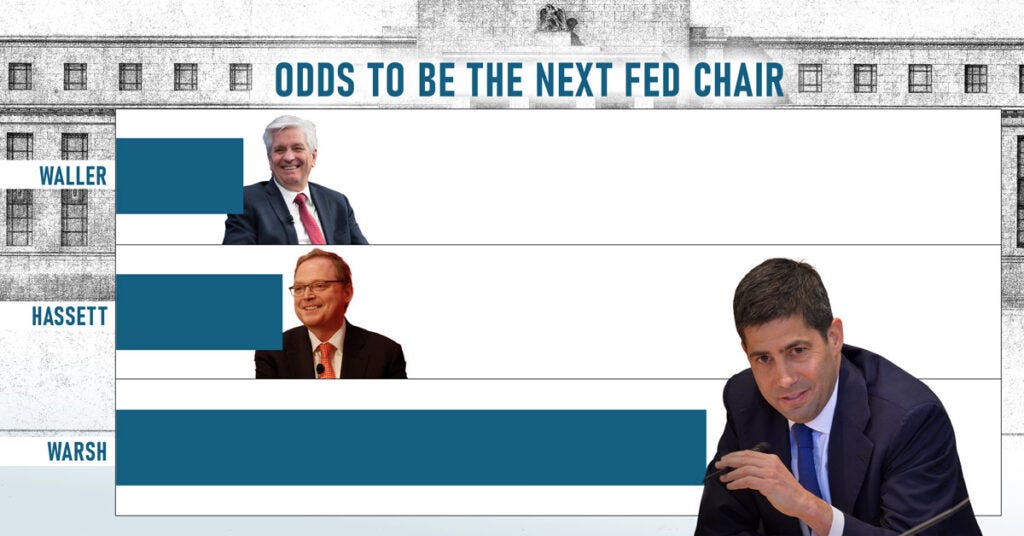
If we say that the cryptocurrency market in 2025 was primarily driven by sentiment and narrative, then starting in 2026, a more fundamental and directional macro variable is taking shape — the Federal Reserve may soon have a new leader, and expectations for candidate Kevin Hassett’s appointment are rapidly heating up.
For the crypto industry, this means not only a potentially faster reversal of the interest rate cycle but also a new phase in the regulatory environment, institutional participation, and market structure.
Rather than viewing blockchain, Web3, or Bitcoin itself as independent asset classes, it’s better to understand them within the framework of global liquidity and macro pricing. The Fed’s policy stance will determine how much risk the market is willing to take, and the crypto space sits right at the front of this chain.
Why is the crypto community both nervous and excited about a potential Fed leadership change?
Kevin Hassett is seen as a typical dovish economist. He doesn’t favor high interest rates and isn’t fixated on the absolute goal of bringing inflation down to 2%. For him, growth, employment, and capital expenditure matter far more than the decimal points of CPI.
More importantly, he has had multiple direct connections with the crypto industry in the past: he held over a million dollars in Coinbase stock, served as a member of Coinbase’s advisory board, participated in the White House Digital Asset Policy Working Group, and has repeatedly expressed positive attitudes toward crypto innovation. He has even stated that Bitcoin “will force traditional financial rules to be rewritten” — a view not commonly seen among past Fed members.
Therefore, market attention on him is not simply because of his personal ties to the crypto industry, but because he represents a potential policy direction: a monetary environment that may shift earlier and more significantly toward easing, accompanied by greater policy tolerance for innovation.
If Hassett takes office, what policy changes might we see at the Fed?
- Faster and deeper rate cuts
Over the past two years, although the Fed paused rate hikes at elevated levels, it has remained cautious and data-dependent. Hassett’s inclination is clearly different. He believes that the cost of high interest rates suppressing corporate investment and job growth is too high, so he is more likely to push for a faster pace of rate cuts, bringing the federal funds rate back below 3% in 2026, possibly even into the more stimulative range of 1%–2%.
For the crypto industry, lower interest rates mean two things: higher risk appetite, and more institutions willing to allocate to non-traditional assets with long-term growth potential. This is the starting point of every bull market cycle.
- Higher probability of QE restarting
Although quantitative tightening (QT) is set to officially end in December 2025, conventional logic suggests the Fed should maintain a neutral window for some time. But Hassett favors “active stimulus.” Once there are clear signs of economic slowdown, he may restart asset purchases and expand liquidity much earlier than the market expects.
If QE does return, the impact on the crypto market would be very direct:
- Lower cost of capital → higher leverage willingness
- Rising risk appetite → renewed narrative activity
- Return of balance sheet expansion logic → crypto as a high-beta as
This means a systemic revaluation of global risk assets, with the crypto market — being the most liquidity-sensitive sector — reacting first.
3. A clearer and more friendly regulatory environment
Unlike the vague regulatory stance toward crypto in recent years, Hassett believes regulation should protect innovation rather than stifle it. This could lead to over the next few years:
- Lower barriers for institutional compliance entry
- Faster expansion and greater variety of ETFs
- More feasible cooperation between banks and the crypto industry
- More transparent regulatory frameworks for digital assets
This would accelerate crypto’s transition from “speculative asset” to “institutional asset,” bringing greater stability and depth to the market.
Three possible paths for the crypto market in 2026
Combining policy expectations, macro environment, and market structure, three potential development paths can be outlined:
- Early arrival of the easing cycle (most likely)
In this scenario, if interest rates decline rapidly in 2026 and the Fed restarts QE, the return of liquidity would significantly accelerate the re-entry of institutional capital into the crypto market. Unlike 2020–2021, the next rally would be driven more by “improved liquidity + continued institutional allocation” rather than retail sentiment alone. With ETF channels already mature and compliance capital entering more efficiently, Bitcoin’s capital structure would be more stable. Once incremental funds flow back in a concentrated manner, prices could challenge all-time highs again, presenting a more robust and sustainable upward cycle. - Macro data worsens further, policy response forced to delay
If new risks emerge in employment or inflation, the Fed may be more cautious than expected, delaying or even pausing rate cuts. In such an environment, risk appetite would drop significantly, ETF inflows could shrink, and highly leveraged capital would exit the market. Bitcoin’s price would likely fall back to the 50,000–50,000–60,000 range, entering a “defensive phase” similar to 2022, characterized by deleveraging, position reduction, and wait-and-see attitudes, with limited liquidity and weak rebound momentum. - Regulatory shift toward moderation, but no large-scale easing
If regulatory attitudes become more moderate, adopting a clearer framework for crypto assets, but without large-scale macro easing, the market would enter a more “mature” state: more stable structure, lower volatility, and a rising share of long-term allocative capital. While such an environment would not be conducive to pushing Bitcoin to new highs quickly, it would also avoid extreme downside. In this scenario, Bitcoin would more closely resemble “digital gold,” trading in a range, with value storage logic gradually becoming dominant.