Where Is the Market Heading: Interpretation of March CPI and NFP Data
 Chad Lin5 min read·1 hour ago
--
As we move into mid-April, the market is still shrouded in uncertainty. The negotiations between the U.S. and Iran have been full of twists and turns, with market sentiment swinging between excitement and disappointment. Two major data, CPI and nonfarm payrolls, have also come out, with one below expectations and the other exceeding expectations.
So, what does all of this mean for the market? This article will explore the following topics:
- Breakdown of U.S. March CPI
- Breakdown of U.S. March nonfarm payroll data
- Recent market trends and future outlook
1. Breakdown of U.S. March CPI
If you had gone long on gold at the time of the release, you would have made substantial profits, because CPI came in below expectations.
The previous CPI was 2.4%, and the market expected it to rise to 3.4%. However, the actual figure was only 3.3%, not as high as anticipated. As a result, gold surged, crude oil dropped sharply, and the market immediately repriced.
However, the CPI increase was still significant. Unsurprisingly, energy was the biggest contributor, with a year-on-year increase of 12.5% in March! In contrast, food prices declined slightly. Although food rose 2.7% year-on-year in March, it was 0.4 percentage points lower than in February. Housing rose 3% year-on-year, roughly unchanged from February.
In other words, energy is the core driver of CPI. Without the U.S.-Iran conflict, CPI would likely have been effectively controlled, and the Fed’s rate-cutting process would have had more certainty. Going forward, whether rate cuts will be disrupted depends largely on energy.
Although the U.S. and Iran have begun talks, progress has been slow. Therefore, oil prices are unlikely to fall significantly in the short term and may even trend upward with volatility.
The good news is that core inflation is not as high. Excluding energy and food, core inflation stands at only 3%, in line with expectations and even lower than the previous 3.1%.
This suggests that, due to the “drag” from core PCE, the risk of overall CPI rising beyond expectations is decreasing. However, if oil prices remain elevated, overall inflation could rebound.
2. Breakdown of U.S. March Nonfarm Payrolls
Unlike CPI, the latest nonfarm payroll data significantly exceeded expectations.
In March, 178,000 jobs were added, far surpassing the expected 60,000. The unemployment rate of 4.3% was also lower than the expected 4.4%, indicating a strong labor market.
Industries previously impacted by AI, such as education and healthcare, added a total of 90,000 jobs, compared to a previous figure of -28,000. This was mainly due to the resolution of strike events in February. Meanwhile, with the arrival of spring, industries that were previously unable to operate fully, such as construction, hospitality, transportation, and warehousing, also contributed to job growth.
However, the market does not seem pleased with strong employment.
This is because robust employment reduces the urgency for rate cuts. Combined with the oil shock, the Fed has even less incentive to cut rates. Some even worry that strong employment could serve as a buffer for potential rate hikes.
Since the federal benchmark interest rate is still high, the likelihood of a rate hike is low.
The strength in this nonfarm report is more likely temporary, driven by factors like the resolution of strikes and seasonal effects. It does not justify a rate hike. In fact, the February JOLTS job openings rate fell to 4.2%, and the small business optimism index has weakened. These suggest that, in the long term, the U.S. labor market may not remain strong.
Of course, in today’s environment where inflation is the focus, weaker economic data is not necessarily bad news. The Fed is even less likely to raise rates when interest rates are already high and the economy is clearly slowing.
3. Recent Market Trends and Future Outlook
The market now appears to be shifting from “trading inflation” to “trading recession.”
The latest U.S. PMI remains strong, suggesting the economy is still expanding. However, some analysts believe this is a false prosperity, driven by inventory buildup in response to war. Meanwhile, the service sector, which is less directly related to war, has not shown similar strength. In March, the ISM manufacturing PMI was 48.7, only slightly lower than before, but the services PMI plunged from 51.8 to 45.2.
In summary, the market’s shift toward pricing in a recession is reasonable. However, due to the ongoing conflict, there is still a tendency toward excessive panic.
Currently, the main point of contention in U.S.-Iran negotiations is not oil, but nuclear weapons.
The U.S. demands that Iran stop supporting regional armed groups, limit its ballistic missile scale and range, commit to not developing nuclear weapons, hand over about 60% of its highly enriched uranium stockpile, and dismantle several nuclear facilities.
Iran, on the other hand, demands that the U.S. cease all wars in the Middle East and accept Iran’s uranium enrichment activities.
These are bottom lines that neither side is willing to compromise on. At least for now, no one knows how this situation will ultimately be resolved.
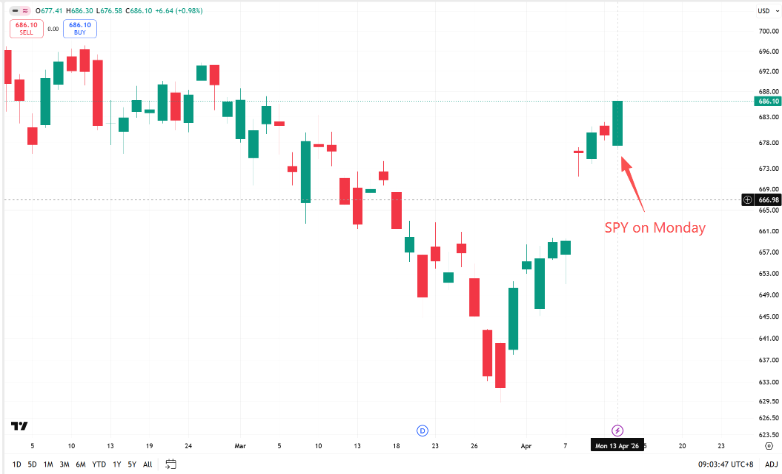
However, Monday’s stock market revealed an unusual phenomenon. After Trump angrily stated over the weekend that he would block the strait, the market initially panicked. The breakdown of negotiations and potential U.S. retaliation suggested escalating conflict, with even rumors of Turkey getting involved. Short sellers celebrated, believing they would profit greatly again, and cryptocurrencies plunged on the news. Yet, unsurprisingly, before the stock market opened, sentiment recovered. In the end, both stocks and gold closed higher.
This shows that the market has largely digested war-related fears. After nearly two months, the market has become accustomed to conflict, inflation, and recession, all of which are now consensus expectations. This also suggests that major asset classes may have finally bottomed out, potentially presenting an opportunity.
Source: Where Is the Market Heading: Interpretation of March CPI and NFP Data