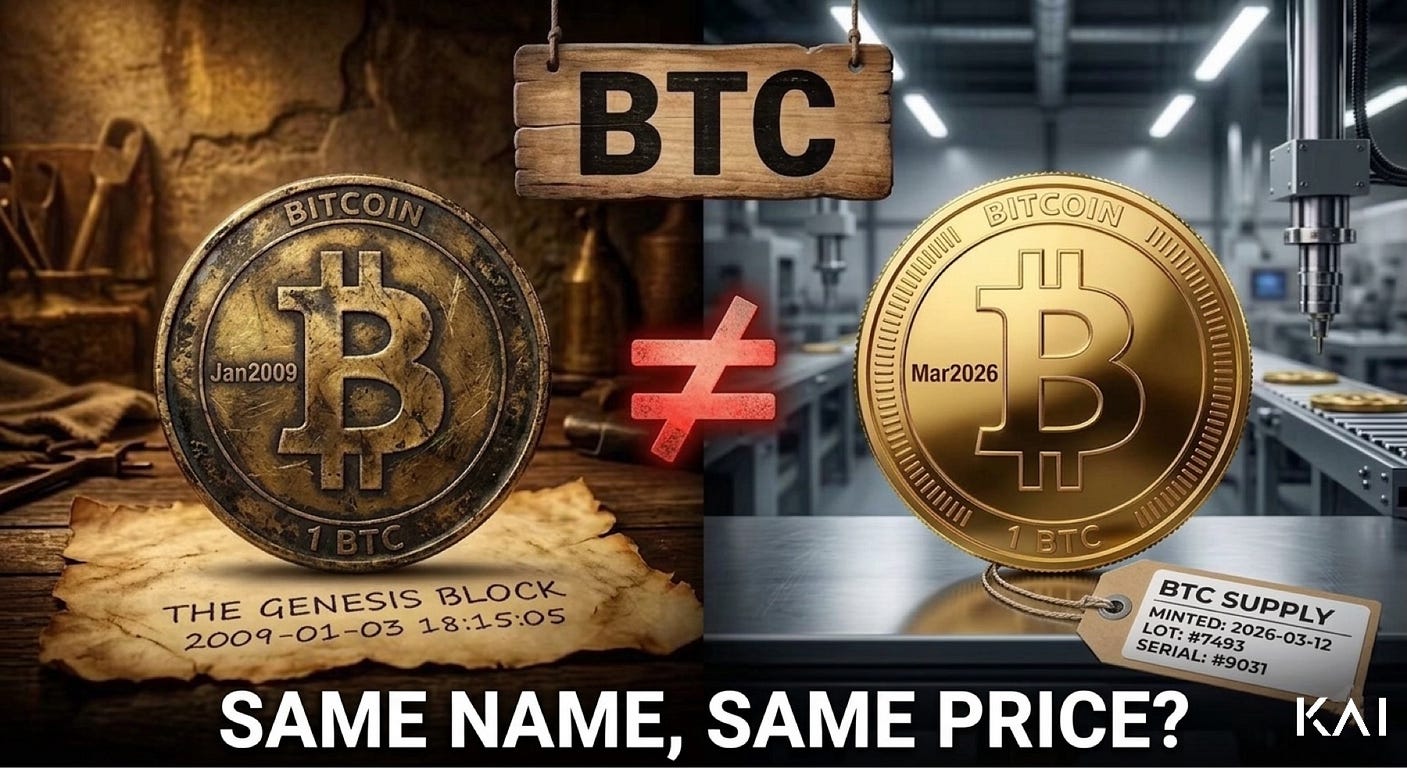
When the market treats every BTC the same, “Old Bitcoin” may become the next value narrative.
 KAIExchange4 min read·Just now
--
For years, most people have understood Bitcoin in a very simple way:
1 BTC = 1 BTC.
Same unit. Same market price. Same trading logic.
But as the crypto market matures, a deeper question is starting to emerge:
Are all Bitcoins really the same?
From a purely technical perspective, maybe yes.
But from the perspective of time, origin, on-chain history, narrative scarcity, and cultural meaning, the answer may be very different.
This is where the idea of Old Bitcoin begins.
And this is exactly why KAI positions itself as The World’s First Old Bitcoin Exchange.
Old Bitcoin is not a new token.
It is not a fork.
It is not a wrapped asset.
It is still Bitcoin.
But it refers to BTC mined in the early years of the network – Bitcoin that carries a clearer connection to the earliest era of the protocol, the earliest believers, and the earliest stage of decentralization itself.
In other words:
Not all Bitcoin may be equal in narrative value, even if they are equal in denomination.
That distinction matters.
Because in every mature asset market, time changes value.
An old bottle of wine is not priced like a new one.
An early-edition collectible is not valued like a reprint.
An artwork with verifiable historical origin is not treated the same as a later copy.
The same logic may eventually apply to Bitcoin.
Bitcoin’s fixed supply has always been part of its value.
But as adoption deepens, the market may begin to care not only about how much BTC exists, but also when that BTC came into existence.
That creates an entirely new dimension of understanding.
Old Bitcoin represents more than age.
It represents:
- proximity to Bitcoin’s origin
- connection to the early cypherpunk era
- stronger narrative scarcity
- historical traceability on-chain
- a new foundation for differentiated pricing and collection logic
This is not just a story about “older coins.”
It is a story about how Bitcoin itself may evolve from a uniform trading asset into a layered asset class.
That shift could be important.
For a long time, crypto users have mostly interacted with Bitcoin in two ways:
buy it, or trade it.
But Old Bitcoin introduces a third lens:
identify it. understand it. revalue it.
That changes the conversation.
Instead of asking only:
“Is BTC going up?”
The market may gradually start asking:
- Which era was this Bitcoin mined in?
- What kind of historical significance does it carry?
- Does early provenance matter?
- Can on-chain age become part of price discovery?
These are not strange questions.
Traditional finance and collectible markets ask similar questions all the time.
And crypto has already shown that narrative matters.
NFTs taught the market that mint time, collection identity, rarity, and cultural recognition can all shape value.
Ordinals and inscription culture pushed people to think differently about on-chain uniqueness.
Now Bitcoin itself may be entering a new phase of recognition.
A phase where history becomes part of valuation.
That is why Old Bitcoin is not simply a marketing term.
It is a market education process.
It helps users understand that Bitcoin is not only a ticker on a screen.
It is also a historical asset born from a specific moment in time – a moment defined by decentralization, resistance to control, peer-to-peer value transfer, and belief before institutions arrived.
The earlier the Bitcoin, the closer it is to that origin.
And in a market increasingly shaped by large institutions, custodians, paper products, and centralized narratives, that origin may matter more than ever.
Old Bitcoin reminds us of something the market has started to forget:
Bitcoin was not created to be just another standardized financial product.
It began as a decentralized monetary breakthrough.
So when we talk about Old Bitcoin, we are not only talking about age.
We are talking about historical signal, ideological purity, cultural scarcity, and future pricing power.
This is why KAI is building around this thesis.
KAI is The World’s First Old Bitcoin Exchange.
That means more than offering another place to trade BTC.
It means creating a new framework for users to understand Bitcoin through time, history, and differentiated value.
The future Bitcoin market may not be defined only by spot, leverage, or ETF headlines.
It may also be defined by a much more fundamental question:
Which Bitcoin carries the strongest story, the clearest origin, and the deepest historical meaning?
If that question continues to grow, Old Bitcoin will not be a niche idea for long.
It will become one of the most important educational narratives in the next stage of Bitcoin’s evolution.
Because in the end, Bitcoin has never been only about price.
It is also about time.
About history.
About identity.
About where value began.
And that is exactly where Old Bitcoin starts.
KAI – The World’s First Old Bitcoin Exchange.