When AI Starts Spending Autonomously: How Pivotx402 Resolves the Payment Trust Crisis of the x402 Era
 Pivotx40210 min read·Just now
--
1. Prologue: Pay.sh and the “Manhattan Moment” of Agentic Payments
On May 7, 2026, Google Cloud and the Solana Foundation jointly launched Pay.sh — a milestone that marked the formal transition of the x402 protocol from technical vision to production-grade infrastructure powering global AI agents such as Claude Code and Gemini. Through Pay.sh, developers can now enable an AI agent to natively invoke a Solana wallet and execute on-demand payments in under a minute.
Yet Pay.sh is merely the opening act of the agentic economy. As the barrier to “connecting” payments drops to zero, developers immediately confront a far deeper challenge: When AI agents begin executing payments at scale and high frequency, how do you guarantee absolute asset security? How do you manage fragmented on-chain transactions? And how do you give agents genuine autonomy?
These are precisely the questions Pivotx402 is built to answer. Designed as the execution and payment hub for autonomous agents, Pivotx402 represents the foundational settlement paradigm through which the agentic economy evolves from “conversational intelligence” into a self-directing on-chain value actor.
2. The Arc of x402: How a Protocol Is Rewiring the Internet’s Value Layer
2.1. From HTTP Ghost to Global Standard
The HTTP 402 status code — “Payment Required” — was defined in 1997 and then sat dormant for nearly three decades. It was the insatiable demand of AI agents for native payment capability that finally brought it back to life. In April 2026, Coinbase formally transferred stewardship of the x402 protocol to the Linux Foundation, severing its ties to any single corporate interest and elevating it to the status of an open internet standard — as foundational as TCP/IP itself.
2.2. The Circulatory System of the Agentic Economy
As of 2026, x402 transaction volume on Solana and Base has surpassed 150 million transactions. The protocol has reduced “payment” to an atomic primitive of the internet. The emerging industry consensus is unambiguous: payment is no longer the endpoint of a business transaction — it is the starting point of autonomous agent collaboration. Any API that lacks x402 payment capability will increasingly find itself excluded from the supply chains that future AI agents rely upon.
3. The Core Problem: Why Native x402 Cannot Support Production-Grade Agents
Pay.sh may have lowered the barrier to “connection” to an all-time low, but in doing so it has exposed a far more fundamental problem: connecting is easy; entrusting is hard. When AI agents begin executing payments at real scale and frequency, developers face three technical chasms that cannot be bridged by “simple integration” alone.
3.1. The Weakest-Link Security Problem: The AI Logic Layer Is the Attack Surface
In a native x402 direct-connection model, an AI agent typically needs to hold or directly access a private key in order to sign transactions. This creates a structurally fatal single point of failure: the security of the entire system is only as strong as the AI logic layer — and that layer is inherently fragile.
Prompt Injection is currently one of the most prevalent attack vectors targeting AI agents. A carefully crafted malicious input can manipulate an agent into executing unintended payment instructions — for instance, redirecting funds to an address controlled by the attacker. Under this architecture, no matter how secure the underlying blockchain is, the system’s security ceiling is permanently anchored to its most vulnerable component: the AI reasoning layer. This is the essence of the weakest-link problem — the barrel can only hold as much water as its shortest stave allows.
More troubling still is the inherent unpredictability of agent behavior. Even in the absence of external attacks, an agent operating under a logic fault may generate erroneous decisions that result in overpayment or asset loss. Without hardware-level policy enforcement, this class of risk cannot be systematically eliminated.
3.2. The Fragmentation Trap: The On-Chain Cost Catastrophe of High-Frequency Micropayments
A production-grade agent task is rarely a single API call. It is a complex workflow composed of dozens or even hundreds of chained sub-tasks. Take sniperxfun as an example: a single complete sniping operation requires the simultaneous invocation of 19 independent x402 APIs, spanning new pool discovery, smart contract security auditing, top-holder distribution analysis, and liquidity lock verification.
Under the native x402 model, each API call requires an independent on-chain payment — meaning a single sniping operation generates 19 separate on-chain transactions. This produces a dual catastrophe:
- Cost catastrophe: Even on a low-fee chain like Solana, the cumulative gas cost of 19 independent transactions far exceeds that of a single aggregated transaction. On high-fee chains like Ethereum, this model renders the business economically unviable outright.
- Sequencing catastrophe: The independent broadcast and confirmation of 19 transactions introduces uncontrollable timing variance on-chain. In a millisecond-competitive environment like sniperxfun, a delay in any single payment can cause the entire operation to fail.
This fragmented settlement model represents a systemic efficiency drain in any high-frequency, micro-value agentic economy scenario.
3.3. The Autonomy Gap: Reactive Payment Cannot Power a Truly Autonomous Agent
The native x402 protocol defines how to pay, but offers no answer to when to pay or whether to pay at all. In standard implementations, payment is reactively triggered — an agent initiates a payment request only after receiving a 402 Payment Required response from an API.
This reactive model constrains agent autonomy across two critical dimensions:
- Quality blindness: An agent has no way to evaluate API quality before paying. It cannot know whether a given API has a 99% or a 60% historical success rate, nor can it verify whether the returned data matches the advertised specification. Without a quality assessment mechanism, every payment an agent makes is effectively a blind purchase.
- Policy vacuum: A truly autonomous agent must be capable of dynamically adjusting its payment strategy based on task priority, budget constraints, and market conditions — for example, proactively deferring non-urgent payments during gas fee spikes, or automatically switching to a higher-quality alternative API when one becomes available. This class of higher-order payment decision-making is simply beyond what the native x402 protocol can provide.
4. Architectural Deep Dive: Pivotx402’s Brain-Vault Decoupling
Pivotx402 is not a wallet tool. It is a comprehensive execution framework that integrates security policy enforcement, batch settlement, and task orchestration. Its architectural core is the complete decoupling of AI business logic (the Brain) from hardware-level asset signing (the Vault). This is not a software-level logical separation — it is a physical, hardware-enforced isolation. The only communication channel between the two layers is a signing request that has passed strict policy validation.
4.1. The Business Orchestration Layer (The Brain): The Intelligent Frontend
The business orchestration layer runs in a standard server environment and handles all non-security-sensitive business logic. It serves as Pivotx402’s intelligent frontend, responsible for the following core functions:
- User intent parsing: Translating natural language user requests into executable AI task sequences.
- x402 protocol resolution: Interacting with multiple x402 API endpoints, parsing
402 Payment Requiredresponses, and extracting payment parameters including price, recipient address, and Facilitator metadata. - Batch Payment Planning: One of Pivotx402’s core capabilities. It aggregates the payment requirements of multiple API calls, performs cost estimation, and constructs one or more Solana Versioned Transactions — leveraging Address Lookup Tables (ALTs) to compress transaction size and achieve atomic multi-target settlement.
- Transaction construction and broadcast: Generating the complete raw transaction payload and broadcasting it to the Solana network once a signature is obtained.
4.2. The Hardware-Level Signing Layer (The Vault): The Secure Backend
The hardware signing layer is the most critical security barrier in the Pivotx402 architecture. It is provided by specialized third-party Agentic Wallet services, operates within a physically isolated secure environment, and its internal state is entirely opaque to the platform’s business servers.
Primary Integration: OKX Agentic Wallet
OKX Agentic Wallet is the primary hardware signing solution integrated into Pivotx402, with the following core capabilities:
- Key Custody: Pivotx402’s primary payment keys are permanently locked within OKX’s TEE (Trusted Execution Environment) or MPC (Multi-Party Computation) environment. Private keys never appear in plaintext in any server memory, physically eliminating the possibility of key exfiltration.
- Policy Engine (Mandate): The cornerstone of the entire security architecture. Before any signing operation is executed, OKX’s hardware environment subjects every transaction request to rigorous policy validation, including:
- Spending limits: Per-transaction, daily, and weekly maximum payment caps — any request exceeding these limits is automatically rejected.
- Address whitelisting: Transfers are only permitted to x402 API recipient addresses that have been pre-verified and registered within Pivotx402, categorically preventing funds from being redirected to unknown addresses.
- Transaction type restrictions: Strictly limiting the categories of permissible operations (e.g., Solana USDC transfers only), blocking any form of unauthorized asset movement.
- Hardware-level signing: Only after a transaction request has fully passed all policy checks does the signing operation execute within the hardware-isolated environment, returning the signed result to the business orchestration layer.
Co-Integrated Solutions: Phala Network and Cobo
Beyond OKX Agentic Wallet, Pivotx402 has simultaneously integrated two additional mature hardware-level signing solutions. All three operate in parallel within the system, covering distinct security requirements and compliance scenarios:
- Phala Network (TEE Infrastructure): Phala provides an open TEE hardware substrate on which Pivotx402 has deployed customized signing logic and policy engines. For institutional-grade scenarios requiring highly tailored security policies, the Phala integration delivers significantly more flexible policy orchestration capabilities.
- Cobo (MPC Institutional Custody): Cobo is an industry-leading MPC custody provider whose multi-signature and compliance capabilities are particularly well-suited to enterprise clients operating under strict regulatory requirements. Through the Cobo integration, Pivotx402 can deliver agent payment services that meet financial-grade security standards for institutional users.
The concurrent integration of all three solutions enables Pivotx402 to dynamically route to the most appropriate underlying signing infrastructure based on user profile, asset scale, and compliance requirements — achieving genuine production-grade diversification across the agent payment security layer.
5. Risk Management: The Credit-Based Isolation Buffer
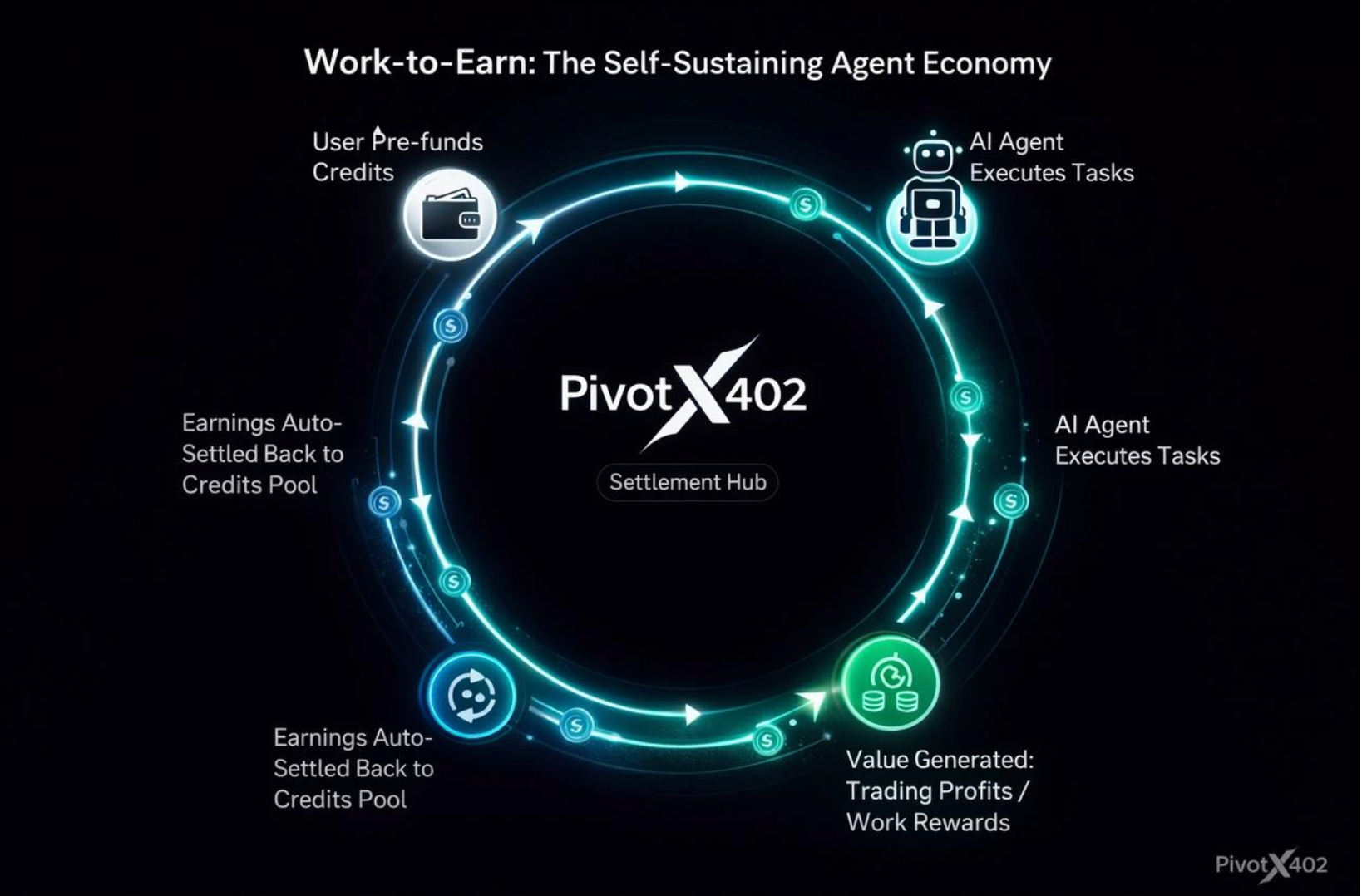
To further optimize the user experience, Pivotx402 introduces a Credits system that serves as a buffer layer between the Web3 technical substrate and Web2-grade usability. This system achieves physical asset isolation, eliminates gas anxiety, and closes the loop on the Work-to-Earn self-sustaining cycle.
Users pre-fund a Credits balance, which is the only resource the AI agent is authorized to consume during execution. The user’s primary wallet assets remain entirely segregated from the agent’s execution environment. The platform handles all on-chain settlement in batches, absorbing gas fee volatility on behalf of users. When an agent generates value through task execution — trading profits, work compensation, or service revenue — those earnings are automatically settled back into the Credits pool, creating a self-reinforcing economic loop that allows agents to sustain and expand their operations autonomously.
6. Settlement Logic: Atomic Batch Settlement on Solana
Addressing the high-frequency, fragmented nature of x402 protocol payments, Pivotx402 incorporates a powerful batch payment planning engine. It parses payment requirements across multiple API calls, leverages Solana’s Versioned Transactions to aggregate them into a single on-chain transaction, and uses Address Lookup Tables to compress transaction size for multi-recipient atomic settlement.
This approach delivers two decisive advantages: it dramatically reduces cumulative gas costs, and it eliminates the timing variance that would otherwise arise from independent transaction broadcasts — ensuring that complex multi-step agent workflows execute with the atomicity and determinism that production environments demand.
7. Ecosystem Evidence: Flagship Integrations and Real-World Use Cases
Pivotx402’s Agent Hub has attracted the first cohort of representative x402 service providers. Examining these live integrations reveals precisely how Pivotx402 creates structural value for API developers across diverse verticals.
7.1. sniperxfun: Full-Spectrum Intelligence for Solana’s Millisecond Battlefield
@sniperxfun is a purpose-built AI agent for the Solana ecosystem, designed to snipe Alpha tokens and newly launched trading pairs.
- The technical challenge: A successful sniping operation requires the instantaneous invocation of 19 x402 APIs, covering new pool discovery, smart contract security auditing (honeypot detection), top-holder distribution analysis, and liquidity lock verification. On a chain where every millisecond is contested, any payment latency or independent on-chain confirmation is enough to cause the entire operation to fail.
- How Pivotx402 enables it: Through the batch settlement engine, sniperxfun achieves atomic one-shot payment. All 19 payment requests are aggregated into a single Solana transaction, guaranteeing absolute synchronization between data acquisition and trade execution. For API providers, this means their high-value data endpoints can be seamlessly embedded into the fastest decision pipelines that AI agents operate within.
7.2. Wurk x402: The Orchestration Engine of a Machine-to-Machine Labor Market
Wurk has built a large-scale microjob marketplace operating on the principle of machines hiring machines — currently integrating 91 APIs.
- The technical challenge: Wurk’s model involves extremely fragmented task distribution. For example: Agent A pays 0.1 USDC to hire Agent B to run unit tests on a code snippet; Agent B then pays 0.05 USDC to purchase compute capacity. This high-frequency, micro-value, multi-level nested payment flow is catastrophic for conventional on-chain settlement.
- How Pivotx402 enables it: By combining the Credits pool with batch settlement, Wurk achieves an “offline logic processing + on-chain batch settlement” model. This eliminates the enormous gas overhead that would otherwise make the economics unworkable, while x402Score provides a dynamic quality scoring system for task outputs — attracting a growing community of developers to convert their tools into monetizable, payable nodes within the Wurk marketplace.
8. Closing: Join the Settlement Hub of the Agentic Economy
The x402 protocol has laid the highway. Pivotx402 is the intelligent infrastructure that makes it navigable at scale. We invite x402 service providers worldwide to list on Agent Hub. Whether you offer high-frequency trading data, decentralized compute (like Jatevo), or microtask labor, Pivotx402 provides the most secure and efficient payment integration available — and a direct on-ramp into the trusted, autonomous economy that AI agents are building.